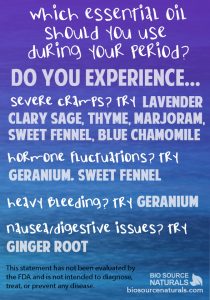
People searching for essential oils for menstrual cramps are often looking for natural, complementary approaches they can incorporate into their menstrual self-care routine. Menstrual cramps can range from mild discomfort to pain that significantly interferes with work, school, sleep, exercise, and everyday activities.
Essential oils do not correct an underlying medical condition or regulate hormones simply because they are used aromatically or topically. However, aromatherapy—particularly when combined with massage—has been studied for primary dysmenorrhea, the medical term for painful menstrual cramps that are not caused by another pelvic condition.
Systematic reviews of randomized trials have reported reductions in menstrual-pain scores among participants using aromatherapy compared with control or placebo groups. Aromatherapy massage has also shown favorable results. The research is encouraging, although differences among the studies and limitations in study quality mean the evidence should be interpreted cautiously.
Aromatherapy is therefore best viewed as a complementary menstrual-comfort practice, not a substitute for appropriate medical evaluation or treatment.
During menstruation, the uterus contracts as it sheds its lining. Prostaglandins—naturally occurring compounds involved in this process—contribute to uterine contractions and menstrual discomfort.
Cramps are commonly felt in the lower abdomen but may also be accompanied by lower-back discomfort, fatigue, nausea, digestive changes, headache, or a general feeling of being unwell.
Stress and poor sleep don’t necessarily cause menstrual cramps, but they can make an already uncomfortable time more difficult.
This is one reason menstrual self-care can include several approaches: warmth, rest, comfortable movement, relaxation, massage, hydration, aromatherapy, and any medical treatments recommended by your healthcare professional.
Several essential oils have been used in clinical aromatherapy research or traditionally incorporated into massage and relaxation practices surrounding menstruation.
Rather than claiming that an individual oil “regulates hormones” or acts as a painkiller, it is more accurate to consider both the emerging research and the aromatic and sensory qualities each oil brings to a menstrual-comfort ritual.
Lavender has a familiar floral-herbal aroma and is one of the most widely used essential oils for relaxation.
It can be especially appealing during menstruation when physical discomfort occurs alongside stress, irritability, or difficulty unwinding.
Lavender has also appeared in multiple clinical studies of aromatherapy for primary dysmenorrhea, including studies using aromatherapy massage.
Sweet Marjoram has a warm, softly herbaceous aroma traditionally incorporated into massage and relaxation blends.
Marjoram has also been included with lavender and clary sage in a randomized clinical study evaluating aromatic massage for primary dysmenorrhea.
Its warm aromatic character makes it a natural choice for a menstrual self-care blend, particularly when combined with massage or other relaxing rituals.
Clary Sage has a distinctive herbaceous, slightly sweet aroma and has a long history of use in women’s aromatherapy blends.
Clary sage has also been included in clinical aromatherapy research on menstrual discomfort, including blends containing lavender and marjoram.
You may see clary sage described online as “balancing hormones” or “regulating menstruation.” Those claims go beyond what we can responsibly conclude from aromatherapy research.
Ginger has a warm, spicy aroma that works particularly well in comforting massage blends.
Ginger has been included in some aromatherapy formulations studied for dysmenorrhea, often in combination with other essential oils.
This does not establish ginger essential oil as a treatment for menstrual nausea, digestive problems, or menstrual pain, but its warm aromatic character makes it an interesting option for menstrual self-care.
Blue Chamomile has an intense herbaceous aroma and distinctive deep blue color associated with its chamazulene content.
Chamomile essential oil can be incorporated into relaxing aromatic body-care and massage formulations when you want a softer, calming element in the blend.
Sweet Fennel has a sweet, licorice-like aroma and a long history of traditional use in women’s wellness preparations.
I would not describe fennel essential oil as regulating menstrual cycles or correcting hormone fluctuations. Those are medical and hormonal claims that aren’t appropriate for a topical or aromatic essential-oil product.
Fennel also has individual safety considerations, so check appropriate aromatherapy safety guidance before use.
Thyme has a strong herbaceous aroma.
The old version of this article stated that women using thyme experienced less pain than women taking ibuprofen. I would remove that statement. The broader evidence supports discussing aromatherapy research for dysmenorrhea, but it does not justify presenting thyme essential oil as a replacement for ibuprofen.
Thyme essential oils also vary by chemotype and can have very different safety profiles, making appropriate identification and dilution important.
Geranium has a rich floral-green aroma and is frequently incorporated into women’s aromatherapy and emotional-wellness blends.
Geranium has also appeared in some clinical research on aromatherapy for dysmenorrhea.
I would not retain the old claim that geranium controls heavy menstrual bleeding or regulates hormones. Heavy or unusually prolonged menstrual bleeding deserves medical evaluation rather than aromatherapy treatment.
Massage is particularly interesting because some of the clinical research on dysmenorrhea has evaluated aromatherapy massage rather than essential oils alone.
One randomized double-blind clinical trial studied a blend of lavender, clary sage, and marjoram diluted in cream and used for abdominal massage. Researchers reported reductions in menstrual-pain measurements and pain duration.
Larger systematic reviews have also found favorable results for aromatherapy massage, although researchers caution that the studies vary considerably in their methods and quality.
If abdominal massage is comfortable and appropriate for you, an appropriately diluted essential-oil blend can be incorporated into the ritual.
Essential oils should not be applied undiluted to the abdomen.
Menstrual self-care doesn’t have to involve just one technique.
You might combine appropriately diluted aromatherapy with a warm compress, comfortable clothing, rest, gentle movement when desired, slow breathing, or a quiet evening routine.
A warm aromatic massage can also create an intentional period of rest when you’re otherwise tempted to continue pushing through an uncomfortable day.
The purpose is not to “cure” menstrual cramps but to create a multi-sensory comfort ritual.
BioSource Naturals Feminine Balance Essential Oil Blend was created as an aromatherapy blend for menstrual-cycle comfort, relaxation, and emotional self-care.
Feminine Balance Essential Oil Blend Support combines:
Together, these oils create a floral-herbal aromatic profile with warm, comforting notes.
Follow the directions for the particular product format. Concentrated essential-oil blends should be appropriately diluted before topical use.
Menstrual cramps are common, but severe menstrual pain should not automatically be considered normal.
Talk with an appropriate healthcare professional if menstrual pain is severe, worsening, suddenly different from your usual pattern, interfering substantially with everyday activities, or accompanied by unusually heavy bleeding or other concerning symptoms.
Conditions such as endometriosis, adenomyosis, uterine fibroids, pelvic inflammatory disease, and other medical problems can cause painful periods.
Aromatherapy should not delay evaluation of significant or changing symptoms.
No. Essential oils do not cure dysmenorrhea or an underlying medical condition. However, clinical research suggests that aromatherapy, including aromatherapy massage, may have a complementary role in menstrual-pain management. The evidence is promising but has limitations.
Clinical studies and reviews have included oils such as lavender, clary sage, marjoram, rose, geranium, ginger, peppermint, and various essential-oil combinations. The formulations and methods of use differ substantially among studies.
Lavender is a popular choice because of its relaxing aroma, and it has also been included in several clinical studies of aromatherapy for primary dysmenorrhea.
I would not make that claim. Clary sage is traditionally associated with women’s aromatherapy and has been included in menstrual-pain aromatherapy research, but that does not establish that inhaling or topically applying clary sage “balances hormones.”
Essential oils should not be relied upon to regulate irregular menstrual cycles. Persistent irregularity or significant changes in your menstrual cycle should be discussed with an appropriate healthcare professional.
Essential oils should not be used as a treatment for heavy menstrual bleeding. Heavy or prolonged bleeding can have many causes and should be medically evaluated.
Concentrated essential oils generally should not be applied undiluted to the skin. Use an appropriately diluted or professionally formulated topical product and follow its directions.
No. Feminine Balance Essential Oil Blend is an aromatherapy product intended for menstrual-cycle comfort, relaxation, and emotional self-care. It is not intended to diagnose, treat, cure, or prevent PMS, dysmenorrhea, or another medical condition.
Essential oils are highly concentrated botanical substances and should be used thoughtfully. For topical application, concentrated essential oils generally require appropriate dilution. Individual oils have different dermal limits, contraindications, and safety considerations. This is especially important with potent oils such as thyme.
Pregnancy, breastfeeding, medications, health conditions, allergies, and individual skin sensitivity can also affect which oils and methods of use are appropriate.
External use only unless a product is specifically formulated and labeled for another route of use.
Looking for more information? Explore our comprehensive guide to Essential Oils for Pain Relief & Physical Comfort, including aromatherapy for sore muscles, joint comfort, back and neck tension, headaches, massage, relaxation, and everyday physical comfort.
Lee, H. W., et al. “Aromatherapy for Managing Pain in Primary Dysmenorrhea: A Systematic Review of Randomized Placebo-Controlled Trials.” Journal of Clinical Medicine, 2018. The review included 19 randomized controlled trials and found moderate evidence favoring aromatherapy for menstrual pain, while noting substantial heterogeneity and methodological limitations.
Song, J. A., et al. “Effects of Aromatherapy on Dysmenorrhea: A Systematic Review and Meta-analysis.” International Journal of Nursing Studies, 2018. The analysis reported favorable results for aromatherapy but noted substantial variation in intervention methods and limitations in the evidence base.
A later systematic review and meta-analysis evaluating aromatherapy alone and with massage also reported favorable results, particularly for aromatherapy combined with massage, while emphasizing heterogeneity, methodological weaknesses, and short follow-up periods.
Ou, M. C., et al. “Pain Relief Assessment by Aromatic Essential Oil Massage on Outpatients with Primary Dysmenorrhea: A Randomized, Double-Blind Clinical Trial.” Journal of Obstetrics and Gynaecology Research, 2012. The study evaluated an aromatic massage formulation containing lavender, clary sage, and marjoram.
The information provided on this page is for educational purposes only. Essential oils and aromatherapy are complementary wellness practices and are not intended to diagnose, treat, cure, or prevent PMS, dysmenorrhea, menstrual disorders, or any other disease or medical condition. Severe, persistent, worsening, or unusual menstrual symptoms should be evaluated by an appropriate healthcare professional.
1
I love all your products