
Pure Aromatherapy for Body, Mind & Spirit
When Someone Else’s Beliefs Don’t Align With Yours
When Someone Else’s Beliefs Don’t Align With Yours
 What happens when someone else’s beliefs don’t align with yours? Whether the differences involve spirituality, health, politics, religion, personal values, or life experiences, these moments can create emotional tension and uncertainty within relationships. This article explores how to stay grounded in your own truth without abandoning meaningful connections. You’ll also discover ways aromatherapy, somatic awareness, EFT tapping, journaling, and mindful reflection may support emotional balance, healthy boundaries, and respectful communication when beliefs differ.
Staying Grounded in Your Truth Without Losing Connection
There comes a quiet moment in many relationships when you realize something has changed.
It’s not always caused by an argument.
Sometimes there isn’t any conflict at all.
Instead, you begin to notice that you no longer see the world through the same lens.
It may become apparent during conversations about:
- health and healing
- spirituality
- religion
- politics
- parenting
- personal values
- or simply how each of you interprets life’s challenges
What once felt natural now feels different.
Not because either person is necessarily right or wrong.
But because your perspectives no longer fully align.
That realization can feel surprisingly emotional.
You may wonder whether to speak up, remain silent, or avoid certain conversations altogether.
The goal isn’t to convince someone else to see the world as you do.
It’s learning how to remain grounded in your own truth while treating one another with respect and compassion.
Sometimes the healthiest relationships aren’t built on complete agreement.
They’re built on the ability to honor differences without losing yourself in the process.
🌿 When Beliefs Don’t Align
Most relationships begin with a sense of shared understanding.
You may not agree on everything, but your differences feel comfortable rather than threatening.
Over time, however, people grow.
Life experiences shape new perspectives.
Challenges change priorities.
Beliefs evolve.
And sometimes, without either person realizing it, the sense of alignment begins to shift.
That doesn’t necessarily mean the relationship has failed.
It simply means you may no longer view the world through the same lens.
At first, the change can be subtle.
Conversations that once flowed easily begin to feel strained.
Topics that once brought curiosity now create tension.
You may find yourself choosing your words more carefully or avoiding certain subjects altogether.
These moments aren’t always signs that a relationship must end.
Often, they’re invitations to better understand one another while also recognizing where your own beliefs have grown and changed.
Healthy relationships make room for growth.
They don’t require two people to think exactly alike.
Sometimes the greatest act of respect is allowing each person the freedom to continue evolving without demanding complete agreement.
🌬️ You Don’t Have to Abandon Yourself to Stay Connected
One of the greatest misconceptions about healthy relationships is that agreement is required to maintain connection.
It isn’t.
You can respect someone without adopting their beliefs.
You can listen with compassion without changing your own perspective.
And you can remain connected while still honoring your own experiences and values.
When conversations become emotionally charged, it’s easy to feel pulled in different directions.
You may feel pressure to:
- explain yourself
- defend your beliefs
- prove your point
- avoid conflict
- or simply agree to keep the peace
Over time, however, repeatedly setting aside your own truth can leave you feeling disconnected from yourself.
Sometimes the most grounded response is quiet and internal.
You simply remind yourself:
“That is their belief. This is my experience.”
No debate.
When beliefs don’t align no need to convince.
No need to seek permission to think differently.
Just the quiet confidence of knowing that your perspective has value, even when someone else doesn’t share it.
Healthy relationships don’t require identical beliefs.
They require mutual respect, curiosity, and the willingness to allow one another room to grow.
🌸 Staying Rooted in Your Own Truth
As people grow, it’s natural for beliefs and perspectives to evolve.
You are allowed to change your mind.
You are allowed to learn from new experiences.
You are allowed to see the world differently than you once did.
And you are allowed to hold beliefs that differ from the people you care about.
That doesn’t make your perspective less valid.
Nor does it require someone else to agree with you before your experiences have meaning.
Staying rooted in your own truth isn’t about becoming rigid or unwilling to listen.
It’s about remaining open to learning while also honoring what feels authentic to you.
You can approach conversations with curiosity instead of defensiveness.
You can ask questions without abandoning your own perspective.
You can listen respectfully without feeling pressured to adopt someone else’s beliefs.
Most importantly, you can recognize that your worth is not determined by whether others understand or validate your point of view.
Healthy relationships allow room for differences.
They make space for honest conversations, personal growth, and mutual respect—even when complete agreement isn’t possible.
Remaining true to yourself doesn’t have to create distance.
Sometimes it becomes the very foundation of deeper authenticity, healthier boundaries, and more meaningful connection even though all your beliefs don’t align.
🌿 Aromatherapy Support for Staying Grounded During Emotional Misalignment
When beliefs don’t align, your nervous system may stay activated long after the conversation has ended.
When conversations leave you feeling unsettled, misunderstood, or emotionally drained, your nervous system often benefits from grounding before, during, and after those interactions.
This simple 9 mL roll-on blend was created to encourage clarity, emotional balance, and the confidence to remain true to yourself while respecting another person’s perspective.
🌿 Rooted Truth
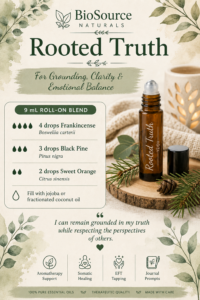 For Grounding, Clarity, and Emotional Balance
Rooted Truth is designed for moments when you want to stay connected to your own beliefs without becoming reactive or emotionally overwhelmed.
9 mL Roll-On Recipe
- 4 drops Frankincense Essential Oil
- 3 drops Black Pine Essential Oil
- 2 drops Sweet Orange Essential Oil
Fill the remainder of the bottle with jojoba oil or fractionated coconut oil.
How to Use:
Apply to your wrists, upper chest, or the back of your neck before or after conversations that leave you feeling emotionally unsettled.
As you inhale slowly, remind yourself:
I can remain grounded in my truth while respecting the perspectives of others.
Take three slow breaths and allow the aroma to become a reminder that you don’t have to abandon yourself in order to remain compassionate.
🧘♀️ Somatic Practice: Returning to Your Center
When conversations leave you feeling unsettled, your nervous system may remain activated long after the discussion has ended.
You might notice:
- tightness in your chest
- shallow breathing
- racing thoughts
- difficulty relaxing
- a lingering sense of emotional tension
Before trying to analyze the conversation, begin by helping your body feel safe again.
A Simple Somatic Reset (1–2 Minutes)
Place one hand over your heart and the other on your abdomen.
Take a slow breath in through your nose for a count of four.
Allow your exhale to last a little longer, counting to six or eight.
Repeat this gentle rhythm several times.
Now press both feet firmly into the floor.
Notice the support beneath you.
Slowly look around the room and name:
- three things you can see
- two things you can hear
- one thing you can physically feel
Allow yourself to return to the present moment.
As your breathing settles, quietly remind yourself:
I can remain grounded in my own truth without needing everyone to agree with me.
This simple practice helps shift your attention away from mental looping and back to the safety and steadiness of the present moment, allowing you to respond with greater clarity rather than emotional reactivity.
✨ EFT Tapping: Staying Grounded When Beliefs Differ
When someone sees the world differently than you do, it’s easy to question yourself, become defensive, or feel pressure to agree simply to preserve the relationship.
This tapping sequence is designed to help you release that internal tension while remaining connected to your own values with compassion and confidence.
Setup (Karate Chop Point)
Even though this difference in beliefs feels uncomfortable,
I honor how it feels in my mind, my body, and my heart,
and I choose to remain grounded in my own truth.
Even though part of me wants everyone to understand or agree with me,
I choose to approach this situation with clarity, compassion, and self-respect.
Tapping Points
Eyebrow
This feels uncomfortable.
Side of Eye
We don’t see the world the same way.
Under Eye
Part of me wishes things felt easier.
Under Nose
I don’t want conflict.
Chin
But I also don’t want to abandon myself.
Collarbone
I’m allowed to think differently.
Under Arm
I don’t have to defend every belief I hold.
Top of Head
I can stay grounded in who I am.
Reframe Round
Eyebrow
I respect their right to their beliefs.
Side of Eye
I respect my own experiences as well.
Under Eye
Different perspectives don’t have to create distance.
Under Nose
I choose understanding over proving a point.
Chin
I can listen without losing myself.
Collarbone
I trust my own inner wisdom.
Under Arm
I remain calm, grounded, and open.
Top of Head
I choose peace, clarity, and authentic connection.
✍️ Journal Prompts
Take a few quiet moments to reflect on these questions. There are no right or wrong answers. Simply notice what feels true for you today.
- When have I stayed silent because I was afraid a difference of opinion might damage a relationship?
- What beliefs or values feel most authentic to me, and how have they evolved over time?
- How does my body respond when I feel misunderstood or pressured to agree?
- Can I respect another person’s perspective without abandoning my own?
- Which relationships allow me to express myself openly, even when we don’t agree?
- Where might I benefit from setting healthier emotional boundaries around difficult conversations?
- What would it feel like to remain curious instead of defensive when beliefs differ?
- How do I respond when beliefs don’t align with someone I love?
💬 Affirmations
Take a slow breath before reading each affirmation. Allow the words to remind you that your beliefs and experiences have value, even when others see the world differently.
- I honor my experiences and trust my inner wisdom.
- I can respect another person’s beliefs without abandoning my own.
- I remain grounded in my truth with compassion and confidence.
- I choose understanding over the need to prove I’m right.
- Healthy relationships allow space for different perspectives.
- My worth is not determined by whether others agree with me.
- I can remain open-minded while staying true to myself.
- I choose peace, clarity, and authentic connection.
🌿 Final Reflection
Life has a way of introducing us to people whose beliefs, values, and perspectives differ from our own.
Sometimes those differences are small.
Sometimes they reshape the way we experience an entire relationship.
Not every difference needs to become a disagreement.
And not every disagreement needs to create distance.
There is wisdom in knowing when to listen with curiosity, when to speak with honesty, and when to quietly allow two different perspectives to exist without needing to reconcile them.
Staying grounded in your own truth isn’t about convincing others to see the world as you do.
It’s about honoring your own experiences while extending the same respect to theirs.
You don’t have to abandon your values to preserve a relationship.
And you don’t have to sacrifice a relationship simply because your beliefs have evolved.
Sometimes the deepest expression of emotional maturity is allowing both people the freedom to grow in different directions while remaining rooted in kindness, respect, and authenticity.
When beliefs don’t align, you can remain grounded in your own values without asking someone else to abandon theirs.
The American Psychological Association also offers resources on healthy communication and maintaining relationships through differing perspectives.
About the Author

🔍 Click Image to Enlarge and Read
Disclaimer: The information in this article is provided for educational purposes only and is not intended to diagnose, treat, cure, or prevent any disease or mental health condition. Aromatherapy, EFT tapping, somatic practices, journaling, affirmations, mindfulness, and other wellness practices are intended to complement your personal self-care routine and are not a substitute for professional medical or mental health care. If you are experiencing persistent emotional distress, anxiety, depression, relationship difficulties, or other concerns that are affecting your daily life, please consult a qualified healthcare professional or licensed mental health provider.