
Pure Essential Oils - Massage Oils - BioSource Naturals

Pure Aromatherapy for Body, Mind & Spirit

Essential Oils for Headaches & Migraine Headaches

DIY Headache Blend - Headache Relief Blend

Essential Oils for Headaches & Head Tension

Essential oils for headaches and head tension can be incorporated into topical aromatherapy and relaxation routines for cooling comfort, mental refreshment, and stress-related tension. Peppermint is particularly interesting because topical peppermint preparations have been evaluated in controlled human studies involving tension-type headaches.

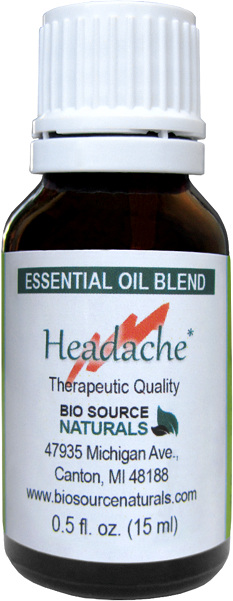
BioSource Naturals Temple Cooling Comfort Essential Oil Blend (formerly Headache Essential Oil Blend) combines Peppermint, Lavender, Eucalyptus globulus, Rosewood (Dalbergia spp.), and Rosemary essential oils in one refreshing aromatherapy formula.*

The cooling sensation of peppermint combines with calming lavender and fresh eucalyptus, rosewood, and rosemary to make this an easy blend to reach for when your head, neck, and shoulders feel tense or your mind simply needs a break.*

Peppermint Essential Oil and Tension Headaches: What Does the Research Say?

Peppermint essential oil is one of the more interesting essential oils for head-tension aromatherapy because topical peppermint preparations have been evaluated in human clinical research.

In a randomized, placebo-controlled, double-blind crossover study, researchers evaluated 164 tension-type headache episodes in 41 adults.

A 10% peppermint oil preparation in ethanol was applied across the forehead and temples and compared with placebo.

The researchers reported a significant reduction in headache intensity beginning 15 minutes after application, with the effect continuing throughout the one-hour observation period.

A later review of peppermint oil for acute tension-type headaches also concluded that topical peppermint oil has demonstrated effectiveness in controlled studies.

This evidence applies to the specific peppermint preparations and concentrations evaluated in those studies. It should not be interpreted as evidence that every peppermint-containing essential oil blend has been clinically proven to treat headaches.

Still, it provides a compelling scientific reason why peppermint continues to be one of the most popular essential oils for head-tension and cooling topical preparations.

Temple Cooling Comfort Essential Oil Blend

Temple Cooling Comfort Essential Oil Blend is formulated for moments when you want a cooling, refreshing aromatherapy ritual around the temples, forehead, neck, and shoulders.*

The formula combines five complementary essential oils:

Peppermint Essential Oil

Peppermint Essential Oil provides the blend’s distinctive cooling sensation.

Peppermint contains menthol, which interacts with cold-sensitive sensory receptors and creates the familiar cooling sensation associated with mint.*

It is also the ingredient in this formula with the most directly relevant clinical research involving topical use for tension-type headache.

Lavender Essential Oil

Lavender Essential Oil contributes a softer, calming aromatic dimension.

When head tension seems to accompany a stressful day, overstimulation, or difficulty unwinding, lavender makes Temple Cooling Comfort more than simply a cooling blend.*

Clinical research has also explored lavender inhalation for certain headache conditions, although the evidence is limited and should not be generalized to all types of headaches.

Eucalyptus Essential Oil

Eucalyptus globulus Essential Oil contributes a clean, penetrating aroma.

Its fresh aromatic profile pairs naturally with peppermint and helps create the distinctive clear, refreshing sensory experience of Temple Cooling Comfort.*

Rosewood Essential Oil

Rosewood (Dalbergia spp.) Essential Oil contributes a softer woody-floral aroma that balances the sharper peppermint, eucalyptus, and rosemary notes.*

Its aromatic character makes the formula feel more rounded and relaxing rather than simply intensely minty.

Rosemary Essential Oil

Rosemary Essential Oil adds a fresh, herbaceous aromatic note traditionally associated with alertness and mental refreshment.*

Together, these five oils create a balanced formula that moves from cooling → refreshing → calming, making it particularly well suited to head-tension self-care.

Benefits of Temple Cooling Comfort

Temple Cooling Comfort is designed to:

  • create a cooling sensation when appropriately diluted and applied around the temples, forehead, neck, or shoulders*
  • provide refreshing aromatherapy during occasional head tension*
  • complement relaxation during stressful or mentally demanding days*
  • provide a fresh aromatic experience when you feel mentally fatigued*
  • create a simple self-care ritual for head, neck, and shoulder tension*
  • offer a convenient roll-on option for travel, work, or your purse*

Rather than waiting until you’re completely overwhelmed, keep Temple Cooling Comfort nearby and make a few minutes of relaxation part of your normal wellness routine.

Head Tension and the Nervous System

Head tension doesn’t occur in isolation from the rest of the body.

Stress and prolonged concentration can be accompanied by muscle tension, particularly around the jaw, neck, scalp, and shoulders. Hunger, dehydration, fatigue, disrupted sleep, and environmental factors may also contribute to headaches in susceptible individuals.

That’s why an aromatherapy routine can involve more than simply putting oil on your temples.

When you notice tension building, use it as a cue to check in with your body.

Unclench your jaw.

Lower your shoulders.

Take a break from the screen.

Drink water if you haven’t been drinking enough.

Eat if you’ve skipped a meal.

Take several comfortable breaths.

Then incorporate Temple Cooling Comfort into your aromatherapy routine.

This doesn’t mean stress is the cause of every headache. Headaches have many different causes. Instead, it turns aromatherapy into a nervous-system restoration ritual rather than simply another product you apply and forget about.

How to Use Temple Cooling Comfort

Concentrated Essential Oil Blend

Dilute 3–4 drops of Temple Cooling Comfort Essential Oil Blend in 10 mL (approximately 2 teaspoons) of carrier oil.

Gently massage a small amount onto the temples, forehead, back of the neck, or shoulders.*

Keep the preparation well away from the eyes. Peppermint and eucalyptus vapors can be particularly uncomfortable when applied too close to the eye area.

For people with sensitive skin, use a more conservative dilution.

We offer a range of carrier oils, including jojoba, grapeseed, coconut, apricot kernel, sunflower, and sweet almond oil.

Temple Cooling Comfort Roll-On

For the simplest option, choose Temple Cooling Comfort Essential Oil Blend Roll-On.

The roll-on eliminates the need to dilute the concentrate each time you want to use it.

Apply according to product directions around the temple area or neck and gently massage.*

Avoid the eyes, eyelids, and broken or irritated skin.

The roll-on is especially convenient for keeping in your purse, desk, travel bag, or bedside table so refreshing aromatherapy is available when you want it.

A 5-Minute Head Tension Reset

Try pairing Temple Cooling Comfort with a simple restoration ritual.

Minute 1 – Pause

Step away from your computer or whatever you’ve been concentrating on.

Minute 2 – Apply

Apply your properly diluted Temple Cooling Comfort or use the Temple Cooling Comfort Roll-On according to directions.

Minute 3 – Release

Relax your jaw. Allow your tongue to rest comfortably. Drop your shoulders and gently move your neck within a comfortable range.

Minute 4 – Breathe

Breathe naturally and notice the cooling peppermint and fresh aromatic notes without forcing unusually deep breaths.

Minute 5 – Restore

Drink some water, close your eyes if comfortable, and give your nervous system another quiet minute before returning to your day.

Sometimes a five-minute interruption is exactly what an overstimulated body needs.

What Commonly Contributes to Headaches?

Different types of headaches have different causes, and triggers vary from person to person.

Common contributors or triggers can include:

Interestingly, aromatherapy itself can occasionally become a trigger. People who are sensitive to strong fragrances may find certain aromas aggravating rather than soothing.

For example, excessive use of strongly scented oils such as ylang ylang may be uncomfortable for some fragrance-sensitive individuals.

Listen to your body. Aromatherapy should make the experience more comfortable—not more intense.

Important Safety Information

Temple Cooling Comfort contains potent essential oils and should be used according to product directions.

  • For external use only.
  • Do not ingest.
  • Keep away from eyes and mucous membranes.
  • Do not apply to broken, irritated, hypersensitive, or diseased skin.
  • Keep out of reach of children and pets.
  • Follow the product-specific age recommendations.
  • Consult your healthcare professional before use during pregnancy or if you have epilepsy or another significant medical condition.
  • If you have GERD and find peppermint aggravates your symptoms, discontinue use.
  • Discontinue use if skin irritation, breathing discomfort, dizziness, or other unexpected symptoms occur.

Because this blend contains eucalyptus, use caution when diffusing around animals. Ensure good ventilation and allow pets to leave the area. Do not apply this product to pets.

See our Safety Information page for additional guidance when using essential oils.

When a Headache Needs Medical Attention

Most headaches are not medical emergencies, but some headache patterns require prompt evaluation.

Seek immediate medical attention for a sudden, extremely severe headache or a headache accompanied by symptoms such as confusion, fainting, weakness or numbness, difficulty speaking or walking, vision problems, high fever, stiff neck, or seizures.

A severe headache following a head injury also requires medical attention.

Consult a healthcare professional if headaches are becoming more frequent or severe, are changing from your usual pattern, don’t improve with appropriate self-care, or regularly interfere with work, sleep, or normal activities.

Essential oils should never delay medical evaluation of a new, severe, or unusual headache.

Frequently Asked Questions

What is the best essential oil for head tension?

Peppermint has some of the strongest directly relevant research. Controlled human studies have evaluated specific topical peppermint preparations for tension-type headaches, with encouraging results.

Where should I apply essential oils for head tension?

Properly diluted topical preparations are commonly applied around the temples, forehead, neck, and shoulders. Keep essential oils well away from the eyes and follow the individual product directions.

Can I put peppermint essential oil directly on my temples?

Using a properly formulated or appropriately diluted topical product is preferable to applying concentrated peppermint essential oil directly to the temples.

Temple Cooling Comfort Roll-On provides a convenient ready-to-use option.

Can essential oils help tension headaches?

Research has found that a specific 10% topical peppermint-oil preparation significantly reduced tension-type headache intensity compared with placebo. This evidence shouldn’t be generalized to every essential-oil product, but it provides meaningful human evidence for topical peppermint.

What is the difference between a headache and migraine?

Headache disorders include several different conditions. Tension-type headache and migraine are not interchangeable, and treatments that work for one may not necessarily work for another.

If you experience recurrent or severe headaches, getting an accurate diagnosis can help you choose appropriate treatment.

Learn More About Essential Oils for Physical Comfort

Looking for more information? Explore our comprehensive guide to Essential Oils for Pain Relief & Physical Comfort, including aromatherapy for sore muscles, joint comfort, back and neck tension, headaches, massage, relaxation, and everyday physical comfort.

Disclaimer

*For educational purposes only. These statements have not been evaluated by the FDA. Essential oils and other wellness practices are not intended to diagnose, treat, cure, or prevent headaches, migraines, or any disease and are not substitutes for professional medical care. Consult a qualified healthcare professional for frequent, severe, sudden, persistent, or worsening headaches or headaches accompanied by neurological symptoms.

References

Göbel H, Schmidt G, Dworschak M, Stolze H, Heuss D. Essential plant oils and headache mechanisms. Phytomedicine. 1995;2(2):93–102.

Göbel H, Fresenius J, Heinze A, Dworschak M, Soyka D. Effectiveness of Oleum menthae piperitae and paracetamol in therapy of headache of the tension type. Nervenarzt. 1996;67(8):672–681. doi:10.1007/s001150050040.

Göbel H, Heinze A, Heinze-Kuhn K, Göbel A. Peppermint oil in the acute treatment of tension-type headache. Schmerz. 2016;30(3):295–310. doi:10.1007/s00482-016-0109-6.

Borhani Haghighi A, Motazedian S, Rezaii R, et al. Cutaneous application of menthol 10% solution as an abortive treatment of migraine without aura: a randomised, double-blind, placebo-controlled, crossed-over study. International Journal of Clinical Practice. 2010;64(4):451–456. doi:10.1111/j.1742-1241.2009.02215.x.

Nasiri M, Asayesh H, Yousefi Khosroabadi Z, et al. Effects of aromatherapy with lavender (Lavandula angustifolia) on post-dural puncture headache: a randomized placebo-controlled trial. Alternative Therapies in Health and Medicine. 2022;28(5):12–19.

Mayo Clinic. Headache: When to See a Doctor. Accessed August 2026.