

Essential Oils for Respiratory Comfort | Aromatherapy for Clear, Refreshing Breathing
Essential oils for respiratory comfort are commonly used in aromatherapy to create a fresh, open-feeling breathing experience when seasonal changes, dry indoor air, or an occasional stuffy nose leave you feeling uncomfortable. Eucalyptus, peppermint, pine, rosemary, lavender, and other strongly aromatic essential oils are especially popular in diffusers, personal inhalers, and topical aromatherapy products.
Essential oils cannot prevent or cure colds, sinus infections, respiratory infections, or lung disease. However, certain aromatic compounds—particularly 1,8-cineole and menthol—have been studied for their effects on respiratory sensation and respiratory-related symptoms. Aromatherapy can therefore be a useful complementary comfort practice when used appropriately.
Breathe Clearly Essential Oil Blend
Eucalyptus, Lime, Lavender & Pine for Refreshing Aromatherapy
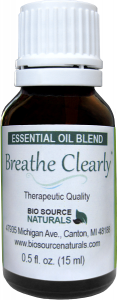
Breathe Clearly Essential Oil Blend combines Eucalyptus, Lime, Lavender, and Pine Essential Oils in a fresh botanical blend designed to create a clean, refreshing aromatic experience.
Each component contributes something different to the blend.
Eucalyptus Essential Oil
Eucalyptus Essential Oil is one of the best-known essential oils used in respiratory-oriented aromatherapy.
Eucalyptus oil is naturally rich in 1,8-cineole (eucalyptol), an aromatic compound that has been extensively investigated for respiratory applications. Clinical research involving standardized oral 1,8-cineole preparations has reported effects in several respiratory conditions, although those findings should not be attributed directly to inhaled eucalyptus essential oil or to finished aromatherapy products.
Eucalyptus’s strong, penetrating aroma nevertheless makes it especially popular when you want an invigorating, open-feeling aromatic experience.
Lime Essential Oil
Lime Essential Oil adds a bright citrus note that balances eucalyptus and pine.
Lime essential oil commonly contains limonene and other volatile terpenes that contribute to its fresh aroma. Citrus essential oils and their constituents have demonstrated antimicrobial activity in laboratory research, but this does not mean diffusing lime essential oil kills respiratory pathogens or prevents infections.
Some lime essential oils can also be phototoxic when applied topically, so follow the product’s sun-exposure precautions.
Lavender Essential Oil
Lavender Essential Oil softens the sharper eucalyptus, lime, and pine aromas in Breathe Clearly.
Lavender commonly contains linalool and linalyl acetate and is particularly well known for its use in relaxation-oriented aromatherapy.
This makes lavender a useful component when you’re looking for respiratory-oriented aromatherapy in the evening or simply want a less intensely medicinal-smelling blend.
Pine Essential Oil
Pine Essential Oil provides Breathe Clearly with its characteristic crisp, forest-like aroma.
Pine essential oil contains naturally occurring terpenes such as alpha-pinene and beta-pinene, depending on species and composition. These compounds have attracted scientific interest for numerous biological activities, but clinical evidence supporting pine essential oil as a treatment for colds or respiratory infections is insufficient.
Its fresh evergreen aroma makes pine particularly complementary to eucalyptus.
How to Use Breathe Clearly Essential Oil Blend
Breathe Clearly Essential Oil Blend can be incorporated into several aromatherapy routines.
Diffusion
Add Breathe Clearly to a diffuser according to the diffuser and product directions.
Intermittent diffusion in a well-ventilated room is generally preferable to continuous exposure.
Topical Aromatherapy
For topical use, dilute Breathe Clearly according to the product directions in an appropriate carrier oil or unscented lotion.
Apply to appropriate intact skin rather than directly beneath or inside the nostrils. Avoid the eyes, mucous membranes, and damaged or irritated skin.
Explore Breathe Clearly Essential Oil Blend for complete directions, ingredients, and safety information.
Essential Oils Commonly Used for Respiratory Aromatherapy
In addition to the oils in Breathe Clearly, several other essential oils are commonly incorporated into fresh, respiratory-oriented aromatherapy.
Peppermint Essential Oil
Peppermint Essential Oil contains high concentrations of menthol, which creates peppermint’s familiar cooling sensation.
Menthol is especially interesting because research indicates that it can alter the perception of nasal airflow. In other words, menthol can make breathing through the nose feel more open without necessarily producing an equivalent physical increase in nasal airflow.
That makes “refreshing” or “open-feeling breathing” more scientifically accurate than saying peppermint actually clears blocked nasal passages.
Rosemary Essential Oil
Rosemary Essential Oil has a strong, stimulating herbal aroma.
Depending on chemotype, rosemary may contain substantial amounts of 1,8-cineole, along with compounds such as alpha-pinene and camphor.
Its penetrating herbal character makes rosemary a natural aromatic partner for eucalyptus and pine.
Tea Tree Essential Oil
Tea Tree Essential Oil is naturally rich in terpinen-4-ol and is one of the most extensively studied essential oils for antimicrobial activity.
Tea tree has demonstrated activity against various microorganisms in laboratory research. However, laboratory antimicrobial activity does not establish that diffusing tea tree oil prevents colds, eliminates respiratory germs, or treats respiratory infections.
Its fresh herbal aroma can nevertheless be incorporated into diffuser blends when used appropriately.
Cedarwood Essential Oil
Cedarwood Essential Oil contributes a warm, woody aroma that can soften sharper respiratory-oriented oils such as eucalyptus, peppermint, and rosemary.
It is especially useful when you want a grounding diffuser blend rather than an intensely minty aroma.
Cypress Essential Oil
Cypress Essential Oil has a fresh woody-evergreen aroma and commonly contains naturally occurring alpha-pinene.
Cypress pairs well aromatically with pine, eucalyptus, lavender, and citrus essential oils.
DIY Respiratory Aromatherapy Diffuser Blend
For a fresh, invigorating room aroma, try:
- 2 drops Eucalyptus Essential Oil
- 2 drops Pine Essential Oil
- 1 drop Lavender Essential Oil
- 1 drop Peppermint Essential Oil
Adjust the number of drops according to your diffuser’s capacity and manufacturer’s instructions.
Diffuse intermittently in a well-ventilated room. Stop diffusion if anyone experiences headache, coughing, wheezing, eye irritation, or respiratory discomfort.
Essential Oils for Colds & Congestion: What Does the Research Say?
Essential oils are frequently marketed for colds, congestion, and sinus problems, but it’s important to separate aromatic comfort from medical treatment.
Eucalyptus and its primary constituent 1,8-cineole have received considerable scientific attention. However, many clinical trials involve standardized oral cineole preparations, not simply diffusing eucalyptus essential oil.
Menthol has also been extensively studied. Its cooling action can create a sensation of improved nasal airflow even when objective nasal resistance has not substantially changed.
Essential oils including eucalyptus, tea tree, pine, and citrus oils have also demonstrated antimicrobial activity in laboratory experiments. These findings are scientifically interesting but don’t establish that inhaling or diffusing these oils prevents or treats a cold, influenza, COVID-19, sinus infection, pneumonia, or another respiratory infection.
For aromatherapy, their strongest role is providing a fresh, cooling, invigorating sensory experience that some people find comforting when they don’t feel their best.
Frequently Asked Questions About Essential Oils for Respiratory Comfort
What are the best essential oils for respiratory aromatherapy?
Eucalyptus, peppermint, pine, rosemary, lavender, tea tree, cypress, and cedarwood are commonly used in respiratory-oriented aromatherapy.
Eucalyptus and rosemary can contain 1,8-cineole, peppermint provides menthol, and pine contributes pinene-rich evergreen aromatics.
Does eucalyptus essential oil help congestion?
Eucalyptus’s strong aroma can provide a refreshing sensory experience, and its major constituent 1,8-cineole has received substantial respiratory research interest.
However, evidence involving oral pharmaceutical cineole preparations should not be interpreted as proof that diffusing eucalyptus essential oil treats nasal congestion or respiratory disease.
Does peppermint actually open your nasal passages?
Peppermint’s menthol creates a strong cooling sensation and can make nasal breathing feel easier or more open.
Research suggests that this sensation doesn’t necessarily mean nasal airflow has objectively increased. This distinction is important when describing peppermint’s respiratory effects.
Can essential oils prevent colds?
There is insufficient evidence that diffusing or applying essential oils prevents the common cold.
Although several essential oils demonstrate antimicrobial activity under laboratory conditions, this does not establish that household aromatherapy prevents respiratory infections.
Can essential oils treat a sinus infection?
Essential oils should not be considered treatments for bacterial or viral sinus infections.
Aromatherapy may provide a pleasant sensory experience, but persistent or severe sinus symptoms should be appropriately evaluated.
Can I put eucalyptus or peppermint essential oil under my nose?
I would avoid putting concentrated essential oils directly beneath or inside the nostrils.
Essential oils can irritate sensitive skin, eyes, and mucous membranes. Use an appropriate diffuser, personal inhaler, or properly diluted topical preparation according to its directions instead.
What is a good BioSource Naturals blend for respiratory aromatherapy?
Breathe Clearly Essential Oil Blend combines eucalyptus, lime, lavender, and pine essential oils in one fresh, invigorating aromatherapy formula.
It provides a convenient alternative to purchasing and combining several individual essential oils.
Breathe Clearly Safety Information
Follow the current product label and BioSource Naturals Essential Oil Safety Information when using Breathe Clearly.
- For external and aromatic use only; do not ingest.
- Avoid contact with the eyes and mucous membranes.
- Do not apply essential oils inside the nose.
- Dilute appropriately before topical application.
- Avoid use on damaged or highly sensitive skin.
- Keep essential oils out of reach of children and pets.
- Follow product-specific age restrictions.
- Follow sun/UV precautions for phototoxic citrus oils.
- Consult an appropriate healthcare professional before essential-oil use during pregnancy or breastfeeding or when significant respiratory or medical conditions are present.
- Stop use if inhalation triggers coughing, wheezing, shortness of breath, headache, or irritation.
When Respiratory Symptoms Need Medical Attention
Aromatherapy should not delay medical care for significant respiratory symptoms.
Seek appropriate medical evaluation for difficulty breathing, shortness of breath, chest pain, blue or gray lips or skin, confusion, persistent high fever, coughing up blood, severe wheezing, or symptoms that are severe, worsening, or unusually persistent.
People with asthma or other chronic respiratory diseases should also be cautious with strongly aromatic products because fragrances and essential oils can trigger symptoms in some individuals.
Disclaimer
*These statements have not been evaluated by the Food and Drug Administration. BioSource Naturals products are not intended to diagnose, treat, cure, or prevent colds, influenza, sinus infections, nasal congestion, asthma, bronchitis, pneumonia, COVID-19, or any other disease or medical condition.
Research discussed on this page involving individual essential oils, isolated constituents such as 1,8-cineole or menthol, laboratory experiments, or pharmaceutical preparations does not establish that BioSource Naturals finished aromatherapy products produce the same effects.
References
- Juergens UR. Anti-inflammatory properties of the monoterpene 1,8-cineole: current evidence for co-medication in inflammatory airway diseases. Drug Research (Stuttg). 2014;64(12):638–646. doi:10.1055/s-0034-1372609.
- Kehrl W, Sonnemann U, Dethlefsen U. Therapy for acute nonpurulent rhinosinusitis with cineole: results of a double-blind, randomized, placebo-controlled trial. Laryngoscope. 2004;114(4):738–742. doi:10.1097/00005537-200404000-00027.
- Eccles R. Menthol and related cooling compounds. Journal of Pharmacy and Pharmacology. 1994;46(8):618–630.
- Eccles R, Griffiths DH, Newton CG, Tolley NS. The effects of menthol isomers on nasal sensation of airflow. Clinical Otolaryngology and Allied Sciences. 1988;13(1):25–29.
- Carson CF, Hammer KA, Riley TV. Melaleuca alternifolia (tea tree) oil: a review of antimicrobial and other medicinal properties. Clinical Microbiology Reviews. 2006;19(1):50–62. doi:10.1128/CMR.19.1.50-62.2006.
- Koulivand PH, Khaleghi Ghadiri M, Gorji A. Lavender and the nervous system. Evidence-Based Complementary and Alternative Medicine. 2013;2013:681304. doi:10.1155/2013/681304.
- National Center for Complementary and Integrative Health. Eucalyptus. National Institutes of Health.
