
Pure Essential Oils - Massage Oils - BioSource Naturals

Pure Aromatherapy for Body, Mind & Spirit

Essential Oils for Hair Growth

Stimulating Oils

Essential Oils for Hair Growth & a Healthy Scalp

Essential oils for hair growth are increasingly popular in natural scalp-care routines, with rosemary, lavender, cedarwood, thyme, and peppermint among the most frequently used oils. While essential oils cannot correct every cause of hair loss, research suggests that certain oils may have potential for supporting hair growth in specific types of hair loss when used consistently and appropriately.

One of the most interesting clinical studies used a combination of rosemary, lavender, cedarwood, and thyme essential oils—the same four primary essential oils found in BioSource Naturals Botanical Hair and Scalp Essential Oil Blend.

Hair loss, however, has many possible causes. Genetics, age, autoimmune conditions, hormonal changes, illness, medications, nutritional deficiencies, physical or emotional stress, childbirth, and damaging hair-care practices can all contribute to thinning or shedding.

That’s why essential oils are best viewed as part of a healthy scalp and hair-care routine, rather than a universal treatment for hair loss.

What Causes Hair Loss?

Before choosing an essential oil, it’s important to understand that not all hair loss is the same.

According to the American Academy of Dermatology, hereditary hair loss—also known as androgenetic alopecia—is the most common cause of hair loss worldwide. Other causes include alopecia areata, certain illnesses and medications, childbirth, significant physical stress, tight hairstyles, and damaging hair-care practices.

Temporary excessive shedding can also occur several months after illness, surgery, childbirth, significant weight loss, or other stressful events.

Determining the underlying cause matters because treatments that help one type of hair loss may have little effect on another.

If you notice sudden hair loss, bald patches, scalp inflammation, significant itching or scaling, or unexplained progressive thinning, consider consulting a dermatologist or healthcare professional.

Best Essential Oils for Hair Growth & Scalp Care

Rosemary Essential Oil

Rosemary essential oil is one of the most interesting essential oils for people researching natural approaches to hair growth.

In a randomized comparative trial involving 100 people with androgenetic alopecia, participants used either rosemary oil or 2% minoxidil for six months. Neither group showed a significant increase in hair count after three months, but both groups experienced a significant increase in hair count after six months, with no significant difference in hair count between the two groups.

This was a relatively small study and doesn’t establish rosemary oil as equivalent to FDA-approved hair-loss medications. However, it provides meaningful human clinical evidence supporting continued research into rosemary oil and hair growth.

For home use, incorporate properly diluted rosemary into a consistent scalp-massage routine.*

Lavender Essential Oil

Lavender essential oil brings another dimension to a hair and scalp routine.

Lavender was one of four essential oils used in a randomized controlled clinical trial involving people with alopecia areata. It also has a calming aroma, making it particularly appropriate for an evening scalp-massage ritual.*

Stress can be associated with certain forms of excessive hair shedding, although simply reducing stress does not treat all causes of hair loss.

Lavender’s value in a hair-care routine therefore goes beyond making the scalp smell wonderful—it creates an opportunity to combine scalp care with relaxation and nervous-system restoration.*

Cedarwood Essential Oil

Cedarwood essential oil was another essential oil included in the clinical aromatherapy study involving alopecia areata.

Its warm, woody aroma also provides an excellent aromatic counterpoint to herbal rosemary and thyme and floral lavender.

Use cedarwood properly diluted as part of a scalp-massage or hair-care routine.*

Thyme Essential Oil

Thyme essential oil was also included in the essential-oil combination studied in people with alopecia areata.

Thyme is a potent essential oil and should be properly diluted before applying it to the scalp.

Rather than using large amounts of thyme alone, it makes sense to incorporate it as one component of a carefully formulated scalp blend.*

Peppermint Essential Oil

Peppermint essential oil creates a distinctive cooling and invigorating sensation on the scalp.

Peppermint also attracts attention because a laboratory animal study found that topical peppermint oil promoted hair-growth-related changes in mice.

That’s intriguing preliminary research, but it is important to understand the limitation: the study was performed in mice, not people.

Peppermint remains an excellent addition to scalp-care aromatherapy for people who enjoy its fresh aroma and cooling sensory experience, but stronger human clinical research is needed before making specific hair-growth claims.

The Essential Oil Hair Growth Study

One of the most frequently cited studies involving essential oils and hair growth was published in Archives of Dermatology.

Researchers enrolled 86 people with alopecia areata in a randomized, double-blind, controlled seven-month trial.

The active group massaged a blend of:

  • Thyme essential oil
  • Rosemary essential oil
  • Lavender essential oil
  • Cedarwood essential oil

diluted in jojoba and grapeseed carrier oils into their scalps every day.

The control group performed the same daily scalp massage using only the carrier oils.

At the end of the study, 19 of 43 participants (44%) in the essential-oil group showed improvement, compared with 6 of 41 (15%) in the carrier-oil group.

The difference was statistically significant.

This is particularly interesting because Botanical Hair and Scalp Essential Oil Blend combines the same four essential oils studied in this clinical trial: rosemary, lavender, cedarwood, and thyme.

There is an important distinction, however: the study evaluated people diagnosed with alopecia areata. It should not be interpreted as proof that this combination will regrow hair from every type of thinning or hair loss.

Botanical Hair and Scalp Essential Oil Blend

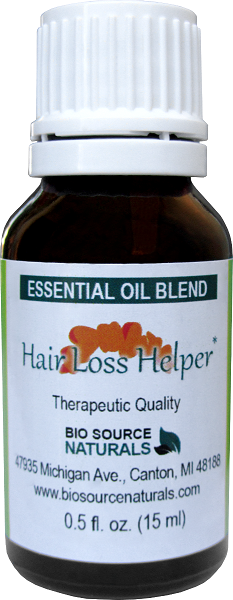
Botanical Hair and Scalp Essential Oil Blend (formerly Hair Loss Helper Essential Oil Blend) brings together four of the most interesting essential oils in natural scalp care:

Rosemary + Lavender + Cedarwood + Thyme

Even better, this isn’t simply a collection of oils chosen because they are popular on social media. This combination closely parallels the four essential oils evaluated together in the randomized clinical trial of people with alopecia areata.

That makes Botanical Hair and Scalp Blend an easy way to incorporate these four oils into one consistent scalp-care ritual.*

The concentrated formula is designed to be diluted before use, allowing you to customize it with the carrier oil that works best for your hair and scalp.

Use it to create a weekly hair mask, add an appropriate amount to your hair-care routine, or make scalp massage part of your evening self-care ritual.

Consistency matters. Both notable human studies involving essential oils and hair growth evaluated use over months, not days.

Natural hair care is a long-term practice.

How to Use Essential Oils on Your Scalp

Essential oils should generally be diluted before applying them to the scalp.

One simple approach is to add an appropriately diluted amount of your selected essential oil or Botanical Hair and Scalp Essential Oil Blend to a carrier oil such as jojoba, grapeseed, or sweet almond oil.

Massage gently into the scalp with your fingertips.

Leave on according to your chosen hair-care routine and then shampoo as needed.

You can also add an appropriately diluted amount to a hair-care product if its formulation is compatible with essential oils.

Avoid aggressively scratching or rubbing the scalp. Gentle massage is sufficient.

Scalp Massage as a Hair-Care Ritual

How you use your essential oils can be as important as which oils you select.

Scalp massage creates an opportunity to distribute your diluted oils while caring for the scalp without harsh pulling or friction.

Use your fingertips rather than your nails and work gently across the scalp.

This is also an ideal time to slow down.

Hair thinning can itself become a source of significant stress. Turning scalp care into a relaxing ritual with rosemary, lavender, cedarwood, and thyme creates a very different experience from anxiously checking the mirror for new growth every morning.

Apply. Massage. Breathe. Give your hair and scalp time.

How Long Does It Take to See Results?

Hair grows slowly, so expectations should be realistic.

In the rosemary study, researchers found no significant increase in hair count after three months. Significant increases were observed after six months.

The aromatherapy alopecia-areata study lasted seven months.

That doesn’t mean everyone will see improvement after six or seven months. It demonstrates why evaluating a hair-care routine after only a few days or weeks doesn’t tell you very much.

Take photographs under similar lighting periodically if you want a more objective way of monitoring changes.

Support Hair by Preventing Unnecessary Breakage

Supporting healthy-looking hair isn’t only about encouraging growth. Keeping the hair you already have from breaking matters too.

The American Academy of Dermatology recommends gentle hair care for people experiencing thinning or hair loss.

That includes using gentle shampoo, conditioning after shampooing, minimizing excessive heat, and avoiding hairstyles that repeatedly pull tightly on the hair.

Hair that is already thinning can be more fragile, so treat it accordingly.

A consistent routine combining gentle cleansing, conditioning, careful styling, and scalp care can help create the best possible environment for healthier-looking hair.

Botanical Hair and Scalp Essential Oil Blend Reviews

(formerly Hair Loss Helper Essential Oil Blend)

Reviews and testimonials reflect individual customer experiences only. Individual results vary, and testimonials are not evidence that the product will produce the same results for another person.

“Good product.” – M. Vasquez

“Love this! I’ve added it to my hair gloss, conditioner, and I put it in my palm with argan oil and rub it on my scalp at night. Smells wonderful and my hair looks and feels so much healthier.” – C. Ertmann

“I am really happy with this product. It seems to have slowed my hair loss and new growth is coming in. I use it several nights a week and leave it in all night.” – C.M. Brewster

“Very satisfied with the product and delivery.” – C.B.

“Actually works! This does work if you use it daily! I noticed new hair growing in 5 weeks.” – Dr. Frank J. Akawi

“Works great! I love the essential oils!” – A. Zarezadegan

“This was exactly what the doctor ordered. As a matter of fact, she took a picture of the bottle so her other patients could order the product.” – V.R.A.

“OMG… had surgery, hair was falling out… I add this to shampoo, and after 3 weeks I can feel the short little bristles regrowing.” – H.L.

When Hair Loss Should Be Evaluated

Essential oils aren’t appropriate as the only response to unexplained hair loss.

The American Academy of Dermatology emphasizes that identifying the cause of hair loss is important because there are many different causes and appropriate treatment depends upon the diagnosis.

Consider seeing a dermatologist or healthcare professional if you experience:

  • sudden or rapidly increasing hair loss
  • distinct bald patches
  • significant scalp itching, redness, scaling, sores, or pain
  • unexplained thinning that continues to progress
  • hair loss following a new medication
  • hair loss accompanied by other unexplained physical symptoms

Earlier identification of the cause may provide more treatment options.

Essential Oil Safety for Hair and Scalp

Essential oils are highly concentrated and should be used appropriately.

  • Dilute essential oils before applying them to the scalp.
  • Avoid the eyes and mucous membranes.
  • Do not apply to broken, inflamed, or damaged skin.
  • Patch test a new preparation before widespread use.
  • Discontinue use if burning, redness, itching, or other irritation occurs.
  • Keep essential oils out of reach of children.
  • Do not ingest.
  • Consult your healthcare professional before use during pregnancy or nursing or when significant medical conditions are present.

For Botanical Hair and Scalp Essential Oil Blend specifically:

  • Do not use if pregnant or nursing.
  • Do not apply to or near the face of infants or children.
  • Not recommended for children under six years of age.
  • Avoid use on hypersensitive, diseased, or damaged skin.
  • For external use only.

See our Safety Information page for additional guidance.

Frequently Asked Questions

What are the best essential oils for hair growth?

Rosemary has some of the most interesting human research for androgenetic alopecia. Rosemary, lavender, cedarwood, and thyme were also studied together in a randomized controlled trial involving alopecia areata. Peppermint has encouraging animal research, but human clinical evidence is more limited.

Does rosemary essential oil really help hair grow?

A small randomized comparative trial involving 100 participants with androgenetic alopecia reported significant increases in hair count after six months in both the rosemary-oil and 2% minoxidil groups, with no significant difference between groups. This is promising but limited evidence and shouldn’t be interpreted as proof that rosemary works for every form of hair loss.

How long should I use essential oils before evaluating my hair?

Hair growth takes time. The rosemary clinical trial evaluated participants for six months, while the aromatherapy alopecia-areata trial lasted seven months. Consistency and realistic expectations are important.

Can I put essential oils directly on my scalp?

Essential oils should generally be appropriately diluted before scalp application. Concentrated essential oils can irritate or sensitize the skin.

Why am I suddenly losing hair?

Hair loss can have many causes, including hereditary hair loss, illness, significant stress, childbirth, medications, autoimmune disease, nutritional problems, damaging hair practices, and other medical conditions. Sudden or unexplained hair loss deserves professional evaluation.

References

Hay IC, Jamieson M, Ormerod AD. Randomized trial of aromatherapy. Successful treatment for alopecia areata. Archives of Dermatology. 1998;134(11):1349–1352. doi:10.1001/archderm.134.11.1349.

Panahi Y, Taghizadeh M, Tahmasbpour Marzony E, Sahebkar A. Rosemary oil vs minoxidil 2% for the treatment of androgenetic alopecia: a randomized comparative trial. SKINmed. 2015;13(1):15–21.

Oh JY, Park MA, Kim YC. Peppermint oil promotes hair growth without toxic signs. Toxicological Research. 2014;30(4):297–304. doi:10.5487/TR.2014.30.4.297. Note: animal study.

American Academy of Dermatology Association. Hair Loss: Who Gets and Causes. Accessed August 2026.

American Academy of Dermatology Association. Hair Loss: Tips for Managing. Accessed August 2026.

Disclaimer

These statements have not been evaluated by the Food and Drug Administration. BioSource Naturals essential oils and aromatherapy products are intended for cosmetic, aromatherapy, and complementary wellness purposes and are not intended to diagnose, treat, cure, or prevent alopecia, hair loss, or any other disease. Individual results vary.

essential oils for hair growth