
Essential Oils for Hair Growth and Scalp Care: Rosemary, Lavender & DIY Scalp Oils
Essential oils for hair growth and scalp care have become increasingly popular among people looking for a more botanical approach to their daily beauty routine. Rosemary, lavender, cedarwood, thyme, bay, and peppermint essential oils are among the oils commonly incorporated into scalp massage preparations, shampoos, conditioners, and hair oils.
Interest in these botanical oils isn’t based solely on tradition. Rosemary essential oil and a combination of rosemary, lavender, thyme, and cedarwood essential oils have also been evaluated in human clinical research.[1,2]
That does not mean every essential oil—or every product containing these oils—has been proven to regrow hair. Hair thinning and hair loss have many possible causes, and appropriate treatment begins with identifying the cause.[3]
For everyday cosmetic care, however, properly diluted essential oils can be an enjoyable way to refresh the scalp, condition the hair and skin, and enhance a regular scalp-massage ritual.
Best Essential Oils for Hair Growth and Scalp Care
Different essential oils offer different aromatic and cosmetic benefits. Some have also attracted scientific interest for their potential role in scalp and hair research.
Rosemary Essential Oil
Rosemary is probably the best-known essential oil associated with hair and scalp care.
A randomized comparative clinical trial published in Skinmed evaluated rosemary oil and 2% minoxidil in people with androgenetic alopecia over six months. Researchers reported significant increases in hair count at six months in both groups, with no statistically significant difference between the groups in hair count at that time point.[1]
This is interesting preliminary evidence for rosemary oil itself, but it should not be interpreted to mean that every cosmetic product containing rosemary essential oil has been clinically demonstrated to treat hair loss.
In everyday aromatherapy and cosmetic formulations, rosemary offers a crisp, herbal aroma that makes it especially well suited to invigorating scalp-massage blends.
Lavender Essential Oil
Lavender Essential Oil brings a soft floral-herbal aroma to scalp oils and hair-care preparations.
Lavender was also one of four essential oils evaluated in a well-known randomized controlled trial involving people with alopecia areata.[2]
Beyond the research setting, lavender is an excellent addition to scalp oils because it blends beautifully with rosemary, cedarwood, and thyme while creating a relaxing aromatic experience.
Cedarwood Essential Oil
Woody and grounding, Cedarwood Essential Oil is frequently found in botanical hair and scalp preparations.
Cedarwood was included with rosemary, lavender, and thyme in the clinical aromatherapy study discussed below.[2]
Its rich base note also balances the sharper herbal aroma of rosemary and thyme, making it particularly useful in leave-on scalp oils.
Thyme Essential Oil
Thyme Essential Oil has an intensely herbal aroma and is traditionally incorporated into cleansing and invigorating aromatherapy preparations.
It was another component of the four-essential-oil mixture studied in people with alopecia areata.[2]
Because thyme essential oil can be irritating at excessive concentrations, careful dilution is particularly important.
Bay Essential Oil
Fresh, spicy Bay Essential Oil has long been used in traditional hair and scalp preparations.
Bay combines especially well with lavender and rosemary in aromatic scalp oils.
While it has a long history of traditional cosmetic use, evidence for bay essential oil and human hair growth is considerably more limited than the evidence available for rosemary.
That distinction is important when choosing ingredients based on research rather than tradition alone.
Peppermint Essential Oil
Peppermint creates the familiar cooling sensation that many people enjoy in scalp products.
Its fresh aroma makes it popular in shampoos, scalp oils, and invigorating hair-care formulations.
Human clinical evidence establishing peppermint essential oil as a hair-growth treatment is limited, however, so we prefer to describe Peppermint Essential Oil for its sensory and cosmetic role rather than as a treatment for hair loss.
What Does the Research Say About Essential Oils and Hair?
There are two frequently cited human studies that make essential oils particularly interesting in hair and scalp research.
Rosemary Oil and Androgenetic Alopecia
In 2015, Panahi and colleagues conducted a randomized comparative trial involving rosemary oil and 2% minoxidil in participants with androgenetic alopecia.
After three months, neither group experienced a significant change in hair count. After six months, both groups showed significant increases in hair count compared with baseline. There was no significant difference in hair count between the rosemary and minoxidil groups at that point.[1]
The researchers also reported more frequent scalp itching in the minoxidil group.[1]
This study is promising, but it has important limitations and should not be interpreted as proof that rosemary essential oil—or a cosmetic product containing rosemary—will regrow hair for everyone.
Additional research is needed.
Rosemary, Thyme, Lavender and Cedarwood
An earlier randomized controlled trial published in Archives of Dermatology investigated aromatherapy in people diagnosed with alopecia areata, an autoimmune form of hair loss.[2]
Participants in the active group massaged a combination of:
- rosemary essential oil;
- thyme essential oil;
- lavender essential oil; and
- cedarwood essential oil
in carrier oils into the scalp daily.
The control group used carrier oils alone.
The researchers reported improvement in 19 of 43 participants in the essential-oil group compared with 6 of 41 participants in the control group.[2]
This is particularly interesting because rosemary, thyme, lavender, and cedarwood are the same four primary essential oils featured in our Botanical Hair and Scalp Essential Oil Blend.
However, BioSource Naturals Botanical Hair and Scalp Essential Oil Blend itself was not the product tested in this study, and the study involved a specific medical condition and research protocol.
The study therefore should not be interpreted as evidence that the BioSource product diagnoses, treats, or cures alopecia or any other form of hair loss.
Botanical Hair and Scalp Essential Oil Blend
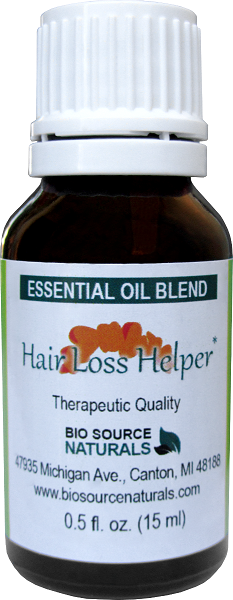
Botanical Hair and Scalp Essential Oil Blend (formerly Hair Loss Helper Essential Oil Blend) is our concentrated aromatherapy formula for people who want to incorporate botanical essential oils into their regular scalp and hair-care routine.
The formula features:
- Rosemary (Rosmarinus officinalis)
- Lavender Essential Oil
- Cedarwood Essential Oil
- Thyme Essential Oil
These herbal, floral, and woody essential oils create a fresh, invigorating botanical aroma ideal for scalp massage, customized hair oils, and personal hair-care rituals.
Because it is a concentrated essential oil blend, it should be appropriately diluted before application to the scalp.
Ways to Use Botanical Hair and Scalp Essential Oil Blend
Depending upon your hair-care routine, the concentrate can be incorporated into a suitable carrier oil for a scalp massage or used according to the directions supplied with the product.
Scalp massage provides an opportunity to work the diluted botanical oils gently across the scalp while creating a relaxing or invigorating self-care ritual.
Consistency matters more than aggressive massage. Use gentle fingertip pressure rather than scratching the scalp with the fingernails.
Botanical Hair and Scalp Essential Oil Blend Reviews
Customers have incorporated Botanical Hair and Scalp Essential Oil Blend into a variety of personal hair-care routines.
Reviews reflect individual customer experiences. Statements concerning treatment of hair loss or hair regrowth are not claims made by BioSource Naturals and should not be interpreted as evidence that this cosmetic/aromatherapy product treats a medical condition.
“Good product.” – M. Vasquez
“Love this! I’ve added it to my hair gloss, conditioner, and I put it in my palm with argan oil and rub it on my scalp at night. Smells wonderful and my hair looks and feels so much healthier.” – C. Ertmann
“Very satisfied with the product and delivery.” – C.B.
“Works great! I love the essential oils!” – A. Zarezadegan
Editor’s note: We have intentionally omitted customer testimonials making specific claims about stopping hair loss or causing new hair growth. Hair loss can have medical causes, and a cosmetic/aromatherapy product should not be represented as a treatment for alopecia or other hair-loss disorders.
DIY Essential Oil Scalp Massage Blend
Want to create your own botanical scalp oil?
This recipe combines four of the most popular essential oils used in aromatic scalp care.
Ingredients
- 2 drops Thyme Essential Oil
- 2 drops Cedarwood Essential Oil
- 3 drops Lavender Essential Oil
- 3 drops Rosemary Essential Oil
- 4 teaspoons Carrier Oil
Directions
Add the essential oils to a clean glass bottle or jar.
Add the carrier oil and mix thoroughly.
Apply a small amount to the scalp and gently massage with the fingertips for several minutes.
Avoid scratching or aggressively rubbing the scalp.
Depending upon your hair type and preference, allow the oil to remain on the scalp briefly before shampooing or use a small amount as part of your normal scalp-care routine.
Always patch test a new topical preparation before widespread use.
Bay and Lavender Scalp Massage Oil
Bay Essential Oil and Lavender Essential Oil make an aromatic pairing for a refreshing scalp massage.
Instead of adding undiluted essential oils directly to your scalp, combine them with an appropriate carrier oil before use.
Massage the diluted oil gently over the scalp with your fingertips.
We do not recommend routinely adding multiple drops of undiluted bay essential oil directly to a bottle or handful of shampoo without calculating the final concentration. Essential oils are concentrated substances, and appropriate dilution helps reduce the likelihood of skin irritation or sensitization.
Does Scalp Massage Help Hair?
Scalp massage is easy to incorporate into a hair-care routine and does not require aggressive pressure.
The goal is simply to move the fingertips gently over the scalp.
Massage also provides a practical way to distribute a properly diluted hair or scalp oil.
For people experiencing actual hair loss, however, scalp massage and cosmetic products shouldn’t substitute for determining why the hair is thinning.
The American Academy of Dermatology emphasizes that successful treatment of hair loss begins with determining its cause.[3]
Why Am I Losing Hair?
Hair loss is not a single condition.
Changes in hair density or shedding can have many possible causes, including hereditary pattern hair loss, autoimmune disease, physical or emotional stressors, medications, nutritional deficiencies, hormonal changes, illness, inflammatory scalp disorders, and damaging hair-care practices.[3,4]
That is why someone experiencing sudden, unexplained, patchy, severe, or persistent hair loss should consider seeing a dermatologist or other qualified healthcare professional.
Identifying the cause is especially important before spending substantial amounts of money on products marketed for hair growth.
Frequently Asked Questions About Essential Oils for Hair
What is the best essential oil for hair and scalp care?
Rosemary is one of the most researched essential oils in connection with human hair.
Lavender, thyme, and cedarwood are also noteworthy because they were studied together with rosemary in a randomized trial involving participants with alopecia areata.[2]
For ordinary cosmetic use, the best choice may ultimately depend on your scalp sensitivity, hair type, preferred aroma, and how you plan to use the oil.
Does rosemary oil grow hair?
A human clinical trial found increased hair counts after six months among participants using rosemary oil, making rosemary one of the more interesting botanical oils in this area of research.[1]
However, one study does not establish that every rosemary product will cause hair growth, and cosmetic products containing rosemary should not be considered treatments for hair loss.
Is rosemary oil as effective as minoxidil?
The 2015 study found significant increases in hair count in both the rosemary-oil and 2% minoxidil groups after six months and did not find a significant difference between the groups in hair count at that point.[1]
That finding is frequently summarized online as “rosemary works as well as minoxidil,” but that statement is too broad.
The study involved one rosemary preparation, one concentration of minoxidil, a particular study population, and a relatively limited clinical trial. It does not establish equivalence between rosemary oil and FDA-approved hair-loss medications generally.
Can I put essential oils directly on my scalp?
We recommend diluting concentrated essential oils appropriately before applying them to the scalp unless the specific finished product has been professionally formulated for direct topical use.
The scalp is skin, and essential oils can cause irritation or sensitization when used improperly.
Learn more about choosing and using carrier oils for essential oils.
Can I put rosemary essential oil in shampoo?
Essential oils can be incorporated into properly formulated cosmetic products, but simply dropping essential oils into an entire bottle of shampoo does not necessarily ensure uniform dispersion or an appropriate final concentration.
A pre-formulated scalp oil or properly diluted preparation offers greater control over application.
How long does rosemary oil take to work for hair?
In the clinical trial discussed above, a significant increase in hair count was not observed at three months but was observed at six months.[1]
That does not mean an individual using rosemary oil should expect hair growth within six months. The finding describes the study population and should not be turned into a guaranteed timetable for individual results.
Can essential oils balance hormones that cause hair loss?
There is insufficient evidence to claim that applying essential oils to the scalp “balances hormones” responsible for hair loss.
That claim should be avoided.
Hormonal and endocrine conditions can contribute to some forms of hair loss, but those conditions require appropriate medical evaluation rather than treatment with a cosmetic essential oil product.
Creating a Healthy Hair and Scalp Routine
Beautiful-looking hair begins with treating both the hair and scalp gently.
Choose shampoos and conditioners appropriate for your hair type, minimize practices that repeatedly damage fragile hair, and avoid excessive pulling, heat, or harsh chemical processing when breakage is a concern.[4]
For a botanical addition to your routine, a properly diluted scalp oil can provide conditioning, aroma, and an enjoyable opportunity for gentle scalp massage.
If you’d rather skip measuring and blending several individual oils, Botanical Hair and Scalp Essential Oil Blend combines rosemary, lavender, cedarwood, and thyme in one concentrated botanical formula.
Use it as part of your regular cosmetic hair and scalp-care ritual—not as a substitute for medical evaluation or treatment when unexplained hair loss occurs.
Essential Oil Safety for Hair and Scalp Use
Essential oils are highly concentrated botanical extracts.
- Dilute concentrated essential oils appropriately before scalp application.
- Patch test new topical preparations.
- Avoid hypersensitive, irritated, diseased, or damaged skin.
- Keep essential oils away from the eyes and mucous membranes.
- For external use only unless a product is specifically manufactured and labeled otherwise.
- Stop using a product if significant irritation develops.
- Children, pregnant or nursing individuals, and people with medical conditions should follow oil-specific safety precautions.
- See BioSource Naturals Safety Information for additional guidance.
Botanical Hair and Scalp Essential Oil Blend Safety
- Do not use if pregnant or nursing.
- Do not apply to or near the face of infants or children.
- Not recommended for children under 6 years of age.
- Avoid hypersensitive, diseased, or damaged skin.
- Keep away from eyes and mucous membranes.
- For external use only. Do not ingest.
*These statements have not been evaluated by the Food and Drug Administration. This product is not intended to diagnose, treat, cure, or prevent any disease.
You may wish to read these related articles.
Essential Oils for Hair Loss – DIY Hair Loss Blend
DIY Dry Shampoo With Essential Oils – Made 2 Ways
DIY Hair Detangler Using Essential Oils
Beautiful Hair Recipes with Essential Oils
References
- Panahi Y, Taghizadeh M, Marzony ET, Sahebkar A. Rosemary oil vs minoxidil 2% for the treatment of androgenetic alopecia: a randomized comparative trial. Skinmed. 2015;13(1):15–21. PMID: 25842469.
- Hay IC, Jamieson M, Ormerod AD. Randomized trial of aromatherapy: successful treatment for alopecia areata. Archives of Dermatology. 1998;134(11):1349–1352. doi:10.1001/archderm.134.11.1349.
- American Academy of Dermatology Association. Hair Loss: Diagnosis and Treatment. AAD. Accessed 2026.
- American Academy of Dermatology Association. Tips for Healthy Hair and Hair Loss: Tips for Managing. AAD. Accessed 2026.
You can also visit the BioSource Naturals References page for additional aromatherapy resources.