Essential oils can give emotional support during withdrawal of many types of addiction. Addiction includes things like drugs, alcohol, tobacco, and pharmaceuticals. But it’s possible to be addicted to less threatening substances, like pop, sugar, candy, food. There are also addictive activities, like pornography, gambling, or other bad habits that people develop a dependency upon. This dependency can lead to health issues, guilt, anxiety, and withdrawal symptoms of headaches, nausea, sickness, cravings, an ger, and more.
Essential oils can be very useful and help reduce many of the negative symptoms of withdrawal, as well as assist in letting go of the addiction. See below for specific essential oils to use depending upon your addiction.*
If you’re looking for an essential oil good for many addictions, basil and grapefruit are two of the most universal oils used for emotional support and cravings. You can inhale these with a diffuser or inhaler or dilute with a carrier oil and use topically.
Essential Oils for Addictions / Emotional Support
- Alcohol: Rosemary, basil, frankincense, and chamomile essential oils
- Anxiety: Ylang ylang and lavender essential oils
- Caffeine: Basil and grapefruit essential oils
- Cravings: Grapefruit, clove, cilantro (coriander), cinnamon, and peppermint essential oils
- Drugs: Grapefruit, chamomile, and basil (for marijuana) essential oils
- Eating Disorders: Grapefruit, bergamot, and cinnamon essential oils
- Food: Grapefruit and basil essential oils
- Porn: Frankincense essential oil
- Sex: Geranium and sandalwood essential oils
- Sugar: Grapefruit essential oil
- Tobacco: Clove, basil, black pepper essential oils
- Withdrawal Symptoms: Marjoram, sandalwood, orange, grapefruit, lavender, and other citrus essential oils
- Work Addiction: Basil, ylang ylang, orange, and lavender essential oils
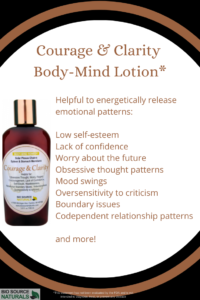 Body Mind Courage and Clarity Lotion with Bach Flower Essences, Pure Essential Oils & Gem Elixirs
Courage & Clarity Body-Mind Lotion
Body Mind Courage and Clarity Lotion helps support emotional repatterning to strengthen the solar plexus chakra and support confidence and boundaries in relationships. It was formulated to support hefollowing chakras and meridians:
Chakra: Solar Plexus
Meridians: Spleen & Stomach
Details: An artisan clean, warm, and slightly citrus essential oil scented organic lotion made with Bach Flower Essences of larch, beech, vervain, gorse, and gentian. Contains pure essential oils of ginger root, frankincense, and myrrh; gem elixir of tourmaline. Colored charged for healing energy. Reiki charged. Helpful to energetically release emotional patterns which include:*
- Low self-esteem and lack of confidence
- Worry about the future
- Obsessive thought patterns
- Mood swings
- Oversensitivity to criticism
- Attempt to “fix” people and their problems
- Concerned about how other people see you
- Boundary issues Codependent relationship patterns
Directions: Apply to left side under breast and on stomach above navel in the morning and before bed. Improvement of emotional patterns within one to two weeks is typical. Avoid during pregnancy.
More Info: How They Work, Why a Lotion?
Courage and Clarity Lotion comes with a free Emotional Freedom Techniques – EFT Tapping script which corresponds to these emotional issues. Combining the EFT and Body Mind Lotions and essential oils helps support emotional repatterning.
*This statement has not been evaluated by the FDA and is not intended to diagnose, treat, or prevent any disease.
Helpful Essential Oil Blends for Addictions
Calming Massage Oil for Anxiety
The best way to use essential oils for anxiety is to apply oils to the chest, wrists, or third eye. Calming massage oil uses a blend of energy balancing and calming essential oils of lavender, rose geranium, cedarwood and lemongrass oils. Our massage oils are created with a harmonious blend of sunflower, apricot kernel and sweet almond oil.*
Calming Essential Oil Blend
Calming Essential Oil Blend contains pure essential oils which are relaxing, calming and help reduce anxious moods, mood swings and supports hormone balance.* Calming Essential Oil Blend contains the pure essential oils of lavender, rose geranium, cedarwood and lemongrass.
Calming Essential Oil Blend Safety Tips
- Possible drug interaction with diabetes medications. Potential teratogenic effects in high doses.
- Do not use during pregnancy or while nursing.
- Possible skin sensitization. May affect hypersensitive, diseased or damaged skin. A recommended dermal maximum of 0.7% to avoid skin sensitization.
- Do not use on children under 2 years of age.
- For external use only. See our Safety Information page for further details when using essential oils.
See our references at the bottom of this page for additional information.
*This statement has not been evaluated by the FDA and is not intended to diagnose, treat, or prevent any disease.
Clearing Generational Patterns Essential Oil Blend Spray to Release Inherited Emotional Patterns
Clearing Generational Patterns Essential Oil Blend Spray contains pure essential oils which help to unlock emotional baggage from cellular memory and inherited emotional patterns. We have also added the flower essence / gem elixir to our water based spray Fireweed® Combo by Alaskan Essences which further helps to clear inherited emotional patterns. Essential oils stimulate the emotional centers of the brain, allowing repatterning to occur. Flower essences and gem elixirs shift us vibrationally as beings, allowing new growth.* This spray is in a distilled water base with witch hazel.
Clearing Generational Patterns Essential Oil Blend Spray contains a proprietary blend of essential oils cedarwood, orange, ylang ylang I, sandalwood, tangerine, rose geranium, rose, french lavender, vetiver, and frankincense.
If you wish to break unhealthy inherited emotional patterns in your family, apply Clearing Generational Patterns Essential Oil Blend and practice the free Emotional Freedom Techniques EFT Tapping script. Use it several times per day for two to three months.
Clearing Generational Patterns Essential Oil Blend Safety Tips
- Do not use while pregnant or nursing. Not for children under 2 years of age.
- Avoid on hypersensitive, diseased or damaged skin.
- Phototoxic, so avoid using it when exposed to sunlight 12 hours prior to topical application.
- For external use only. See our Safety Information page for further details when using essential oils.
See our references at the bottom of this page for additional information.
*This statement has not been evaluated by the FDA and is not intended to diagnose, treat, or prevent any disease.
Healing Oils of the Bible – Special Set of 9
The use of plant oils for spiritual, emotional, and physical healing has been used since Ancient times. Plant oils for healing is mentioned over six hundred times in the Holy Bible for many purposes. The ancients did not use what we use today–technically “essential oils” which is a termed used to describe oils derived by mostly by steam distillation. This technology was only more recently invented in human history. Instead, plant infused oils were used for spiritual, emotional, and physical healing. Below is a list and description of the modern counterparts.
See our references at the bottom of this page for additional information.
*This statement has not been evaluated by the FDA and is not intended to diagnose, treat, or prevent any disease.
Joy Essential Oil Blend
Joy Essential Oil Blend helps to bring joy into your life when it feels like it is out of reach.* Originally developed by our naturopath for a family member who lost her spouse of many years. Later, her clients were helped by it too.
Energetically, all citrus oils support the solar plexus chakra which is our energy center for self-esteem, self-confidence, responsibility, personal protection, and the source of our personal power. This chakra also manages the often complex relationship with our chosen profession, life’s work or legacy.
Joy Essential Oil Blend is packaged as a concentrate in 15, 30, 60, 120 ml bottles. Also available in a pre-diluted, skin safe roll on and Reiki charged spray.
Joy Essential Oil Blend Safety Tips
- Do not use while pregnant or nursing.
- Avoid use on hypersensitive, diseased or damaged skin.
- Phototoxic, so avoid using it when exposed to sunlight 12 hours prior to topical application.
- For external use only.
- See our Safety Information page for further details when using essential oils.
See our references at the bottom of this page for additional information.
*This statement has not been evaluated by the FDA and is not intended to diagnose, treat, or prevent any disease.
Serenity Massage Oil / Edible Massage Oil
Properties: This massage oil has a blend of therapeutic quality essential oils of Lavender, Rosemary, Orange, Lemon, Lime and Ylang Ylang to give a deep serene mind. Our massage oils are created with a harmonious blend of Sunflower, Apricot Kernel and Sweet Almond Oil. This exquisite formula allows hands to glide over the skin and achieve deep penetration.
Packaged: 8 fl. oz. (227 ml) amber plastic bottle with pump, safety shrink wrap. Free flip top cap available if requested.
See our references at the bottom of this page for additional information.
*This statement has not been evaluated by the FDA and is not intended to diagnose, treat, or prevent any disease.
Emotional Wellness Massage Oil Package, each 8 fl oz (227 ml) (3 Pack)
This 3 pack of our massage oils includes Relaxing, Serenity, and Calming blends that contain essential oils with healing, soothing, and calming properties. 3 pack, packaged priced
Some massage oils leave you feeling greasy after a massage. Our massage oils are made from natural, plant oils which absorb quickly into the skin. They contain sweet almond oil, apricot kernel oil, and sunflower oil, allowing hands to glide over the skin and achieve deep penetration. Our massage oils contain therapeutic quality essential oils for aromatherapy benefits. Edible massage oils contain pure essential oils and/or flavor oils. All of our massage oils are scented for an aromatherapy massage and some are warming types.
See our references at the bottom of this page for additional information.
*This statement has not been evaluated by the FDA and is not intended to diagnose, treat, or prevent any disease.
Pure Essential Oils – Emotional Healing Therapeutic Kit of 10
Our pure essential oils which are known to support emotional healing, all packaged in 0.5 oz (15 ml) amber bottles with Euro plugs. No droppers required.
Get 50% more with our 15 ml bottles than the 10 ml bottles of other brands!
Perfect for emotional healing practitioners, ministers, diffusing in high stress environments.
All products are 100% pure essential oils, suitable for therapeutic purposes.
Priced at a discount for the package.
See our references at the bottom of this page for additional information.
*This statement has not been evaluated by the FDA and is not intended to diagnose, treat, or prevent any disease.
Pure Essential Oils – Therapeutic Kit of 45 – 0.5 oz (15 ml)
Set of 45 pure essential oils, all packaged in 0.5 ounce (15 ml) amber bottles with Euro plugs. No droppers required. Get 50% more with our 15 ml bottles than the 10 ml bottles of other brands!
Perfect for a home remedy kit or for practitioners.
All products are 100% pure essential oils, first distillation, suitable for therapeutic purposes.
Priced at a discount for the package.
See our references at the bottom of this page for additional information.
*This statement has not been evaluated by the FDA and is not intended to diagnose, treat, or prevent any disease.
Chakra Balancing – Total Transformation Set
This comprehensive kit, to be used over the course of six to twelve months, is intended to create a total transformation of mind and spirit. Each product corresponds to a specific chakra, and is listed below:
The set is priced at 20% off if purchased separately.
See our references at the bottom of this page for additional information.
*This statement has not been evaluated by the FDA and is not intended to diagnose, treat, or prevent any disease.