
Pure Aromatherapy for Body, Mind & Spirit
Outgrowing an Environment When You Can’t Leave Yet
How to Protect Your Energy, Preserve Your Identity, and Prepare for Change Before You Can Move On
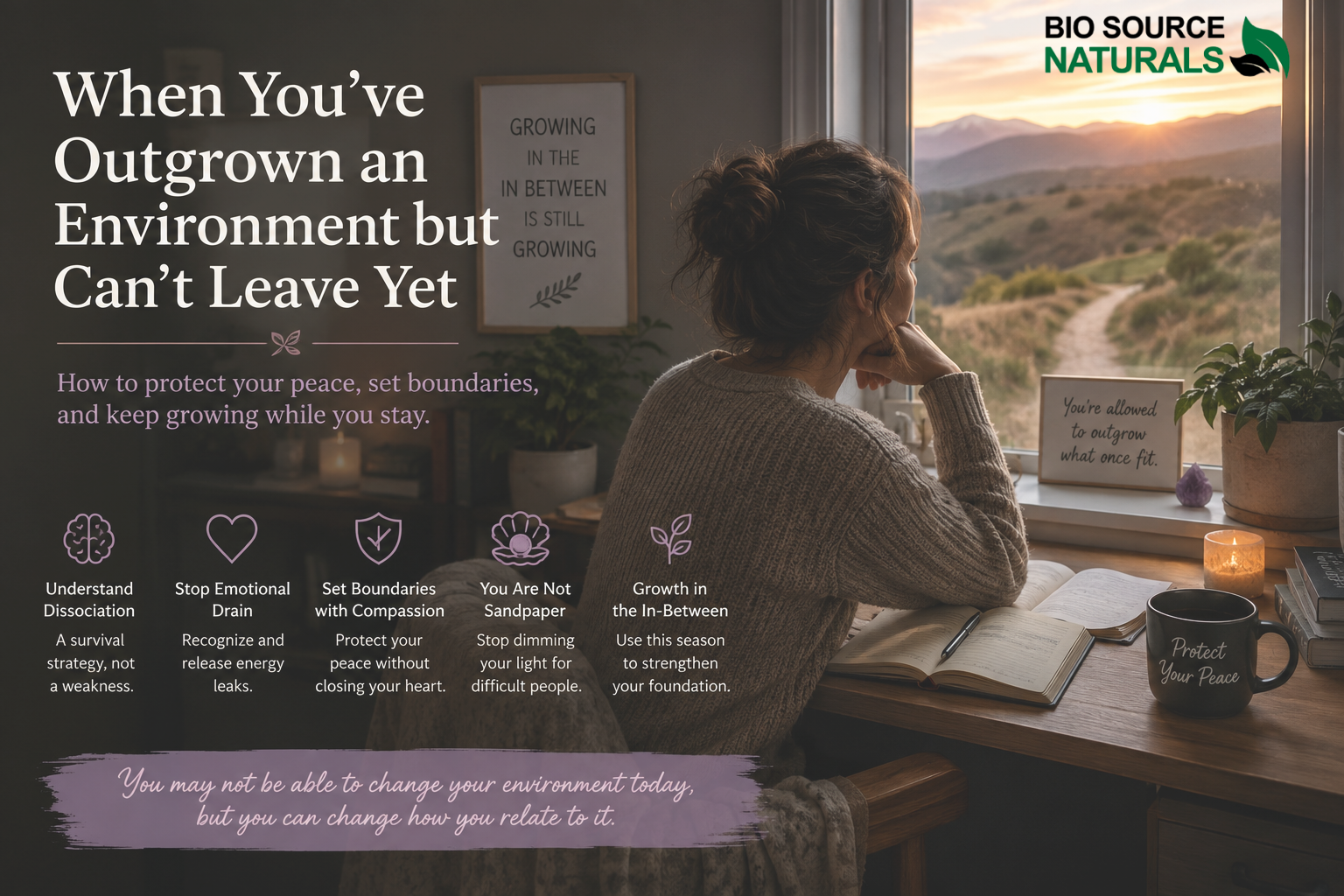
Outgrowing an environment can begin long before you are actually able to leave it. You may recognize that a workplace, relationship, family dynamic, friendship, community, or another part of your life no longer fits who you are becoming. Perhaps you have changed. Perhaps the environment has changed. Or perhaps you have simply become conscious of patterns you spent years accommodating without realizing how much they were costing you.
And yet recognizing that you have outgrown an environment does not mean you can immediately leave it. For many people, “just leave” is neither compassionate nor practical advice.
People have mortgages, children, health insurance, financial responsibilities, caregiving responsibilities, careers, shared histories, people they love, and countless other reasons that make immediate change impossible.
Sometimes there simply isn’t a clear next step yet.
There can be an enormous period of life between recognizing that something no longer fits and actually being able or ready to change it.
Those years matter.
Your life does not have to remain emotionally suspended while you wait for your circumstances to change.
You can begin changing your relationship with yourself now.
You can learn ways to support nervous system regulation.
You can become aware of the ways you have adapted.
You can strengthen boundaries.
You can stop assuming responsibility for every emotional atmosphere you enter.
You can rediscover interests and parts of yourself that became buried beneath responsibility.
You can understand other people with compassion without continually reorganizing yourself around them.
And perhaps most importantly:
You do not have to wait until your circumstances change to begin becoming more fully yourself.
Sometimes the Problem Isn’t That an Environment Is “Toxic”
Modern conversations about emotional health often divide relationships and environments into simple categories.
Healthy or toxic.
Good or bad.
Stay or leave.
Real life is usually much more complicated.
Someone can have wonderful qualities and still exhaust you.
A workplace can provide income, purpose, friendships, intellectual stimulation, and opportunities while simultaneously requiring an enormous amount of emotional adaptation.
A relationship can contain genuine love while also containing patterns that repeatedly leave you unsettled or depleted.
A person can have good intentions while still having a difficult impact on you.
I explore this idea in Sandpaper People & the Pearls You Carry.
Some people aren’t villains.
They’re sandpaper.
The difficulty comes from repeated friction: communication differences, emotional blind spots, unpredictability, subtle invalidation, incompatible needs, or the constant need to compensate.
Over time, constant friction matters.
Recognizing that complexity can actually make our decisions more compassionate.
We don’t have to demonize someone in order to recognize that a dynamic is costing us too much.
And we don’t have to deny everything good about an environment in order to acknowledge what it requires from us.
The Hidden Work of Constantly Adapting Yourself
One of the least visible forms of exhaustion is continual self-calibration.
You monitor the room.
You notice shifts in tone.
You anticipate reactions.
You think carefully about how something should be said.
You determine when to speak and when silence will create less conflict.
You soften something that might otherwise be perceived as threatening.
You calculate how much confidence is safe to show.
You know which subjects to avoid.
You recognize who needs reassurance.
You prepare yourself before certain interactions.
And after doing this for years, you may become extraordinarily good at it.
In fact, other people may perceive you as exceptionally competent.
But competence doesn’t necessarily mean ease.
In The Cost of Competence in Unsafe Systems: Dissociation as a Survival Strategy, I explore how people can learn to function extremely well in environments that require continual vigilance and adaptation.
What originally required conscious effort can become automatic.
You perform.
You manage.
You succeed.
But somewhere along the way, you may become increasingly disconnected from a much simpler question:
What do I actually feel?
Outgrowing an Environment – When Competence Becomes a Survival Strategy
Competence is a wonderful quality.
But sometimes competence develops another function.
It becomes protection.
If you can anticipate the problem, perhaps you can prevent the conflict.
If you can keep everyone organized, perhaps things will remain stable.
If you can perform exceptionally well, perhaps you will be safe from criticism.
If you understand everyone’s motivations, perhaps you can predict what happens next.
If you remain calm enough, perhaps you can keep the entire system calm.
These strategies can work remarkably well.
That’s precisely why they can become so deeply embedded.
The difficulty comes when you begin applying the strategy everywhere.
You don’t simply do your job well.
You feel responsible for the emotional climate surrounding the job.
You don’t simply care about another person.
You begin monitoring their emotional state.
You don’t simply resolve problems.
You continually scan for problems that haven’t happened yet.
Eventually, you may not recognize how much energy this requires because it has become your normal way of moving through the world.
Why You May Feel Exhausted Even When Nothing Dramatic Happened
Not every emotionally draining situation contains a major traumatic event. Sometimes exhaustion develops through accumulation.
One difficult interaction. Then another.
Another moment of swallowing what you wanted to say.
Another conversation you mentally replay afterward.
Another boundary you considered establishing but decided wasn’t worth the reaction.
Another person’s mood you tried not to disturb.
Another evening when your body finally begins to relax because nobody needs anything from you.
This is one reason some relationships are so difficult to explain to outsiders.
Nothing dramatic happened today. And yet you are exhausted.
In Why Am I So Emotionally Drained by Someone?, I explore the cumulative emotional cost of relationships that repeatedly require self-regulation, interpretation, accommodation, or recovery.
Sometimes it is the repetition that becomes exhausting.
When You’ve Outgrown the Role You Learned to Play
There is another layer to outgrowing an environment.
Sometimes what you’ve actually outgrown is your role within it.
Perhaps you were the peacemaker.
The competent one.
The emotional translator.
The dependable one.
The person who didn’t need much.
The fixer.
The person who could handle difficult personalities.
The person who could always see everyone’s perspective.
The stabilizer.
These identities often contain genuine strengths.
But strengths can become burdens when we begin believing we must perform them constantly.
You may eventually realize:
I can be compassionate without fixing this.
I can be competent without carrying everything.
I can understand someone without continually accommodating them.
I can be calm without being responsible for making everyone else calm.
That realization can feel liberating.
It can also feel frightening.
Because changing your role changes the system around you.
When Calm Becomes Something Other People Depend Upon
This can become especially complicated in workplaces.
High-pressure environments naturally create strong interpersonal bonds.
People work long hours together.
They solve difficult problems.
They experience uncertainty together.
They celebrate victories and absorb setbacks together.
And people can have a powerful regulating effect on one another.
In When Calm Is Mistaken for Chemistry: A Nervous System Perspective on Workplace Emotional Enmeshment, I explore how a calm, emotionally steady person can gradually become a stabilizing presence for someone else.
The connection may be completely genuine without being romantic.
Someone may simply feel safer, clearer, or more capable when another person is present.
The difficulty begins when co-regulation becomes emotional reliance.
The person providing stability can gradually feel responsible for maintaining it.
Professional boundaries become less clear.
Emotional processing becomes intertwined with strategy.
Availability expands.
And stepping back can feel strangely consequential.
You are allowed to be a calming presence without becoming another person’s emotional infrastructure.
Understanding Someone Does Not Mean You Must Absorb Their Impact
One of the more complicated consequences of becoming emotionally aware is that the better you understand people, the easier it becomes to explain their behavior.
You recognize someone’s insecurity.
You understand their history.
You see the fear beneath their defensiveness.
You recognize the experiences that shaped them.
You understand why authority makes them uncomfortable.
You see why they need reassurance.
You may even recognize the wound beneath behavior that repeatedly hurts or exhausts you.
This kind of understanding can create genuine compassion.
But it can also create a trap.
Understanding why someone behaves a certain way does not mean you must continually absorb the impact of that behavior.
I explore this distinction more deeply in Emotional Boundaries: Understanding Someone Doesn’t Mean Staying Available to Them.
Two things can be true simultaneously:
I understand why you behave this way.
And this behavior still affects me.
Your mind may be able to explain another person’s behavior beautifully while your body continues responding to the pattern.
Repeated unpredictability, emotional withdrawal, disappointment, conflict, or the feeling that you must continually monitor another person’s emotional state may leave you tense, exhausted, overthinking, or bracing for what comes next.
That doesn’t necessarily mean you lack compassion.
It may simply mean that your body is recognizing something your intellect has become very skilled at explaining away.
This distinction becomes particularly important when you cannot leave an environment.
If you must continue working with someone, living with someone, caring for someone, or participating in a difficult system, your goal doesn’t have to be eliminating compassion.
Instead, you can begin separating compassion from responsibility.
You can think:
I understand why this person is struggling, but I don’t have to solve the struggle.
I can care about someone’s feelings without becoming responsible for regulating them.
I can recognize someone’s wounds without allowing those wounds to determine my boundaries.
I can be compassionate without continually abandoning myself.
For someone who must remain in a difficult environment for practical reasons, that distinction can become an important form of internal freedom.
Outgrowing the Environment – Compassion Without Self-Abandonment
There is a significant difference between compassion and accommodation.
Compassion says:
I can see your humanity.
Accommodation can gradually become:
I must continually rearrange myself because of your pain.
For highly empathetic, responsible, or emotionally perceptive people, the transition between the two can happen almost invisibly.
You make an exception because you understand.
Then another.
You take on an additional responsibility because someone is struggling.
You don’t establish a boundary because you know how the person will react.
You soften your needs because theirs seem greater.
Eventually, understanding another person can become a reason for repeatedly overriding yourself.
Healthy emotional boundaries aren’t punishment, cruelty, or rejection.
They allow you to recognize another person’s experience without making yourself responsible for carrying it.
Sometimes a remarkably powerful realization is simply:
I can understand you without becoming responsible for you.
You may not be able to change the people around you. You may not be able to change an organizational structure.
You may not be able to eliminate every difficult interaction.
But you can gradually change how much of yourself you surrender in order to manage those interactions.
Difficult Relationships Can Produce Growth Without Making the Difficulty Sacred
There is another truth worth holding carefully.
Some of our greatest emotional and spiritual growth can occur because difficult people force us to develop capacities we might otherwise never have developed.
They may teach us boundaries.
Discernment.
Self-trust.
Emotional regulation.
Patience.
The courage to speak.
The wisdom to remain silent.
The ability to recognize what belongs to us—and what doesn’t.
BioSource Naturals explores this perspective in How Difficult Relationships Spark Spiritual Growth.
But this does not mean the pain was required.
It does not mean someone hurt you for a divine reason.
And it certainly doesn’t mean you need to remain in a painful dynamic because it is helping you grow.
Growth belongs to you.
You created meaning from the experience.
You developed wisdom in response to it.
The difficult person does not own the person you became.
The Sandpaper Person and the Pearl
I use the metaphor of a pearl because it captures something important about difficult relationships.
A pearl forms in response to irritation.
Layer by layer, something beautiful develops around what once caused friction.
Human beings sometimes do something similar.
We develop patience because patience was required.
Discernment because we learned what happens without it.
Boundaries because eventually we recognized the cost of having none.
Emotional intelligence because understanding the room once helped us navigate it.
These are the pearls.
But eventually there is another stage of growth:
You don’t need continued irritation to prove that the pearl exists.
You are allowed to keep the wisdom without continually exposing yourself to the circumstances that created it.
Outgrowing the Environment When You Really Can’t Leave Yet?
This is where many conversations about emotional health become unrealistic.
Recognizing a problem and having the resources to change it are entirely different things.
You may know exactly what is happening.
You may understand the relationship.
You may recognize that the job is no longer right for you.
You may know you’ve outgrown the environment.
And you may still need to stay.
For now.
So what do you do?
You begin creating internal freedom before external freedom becomes possible.
1. Stop Requiring Yourself to Solve the Entire Situation
You don’t have to know exactly how the story ends.
You only need to know what supports you today.
Sometimes asking:
“Should I leave?”
creates enormous pressure.
Try asking:
“What would make this situation 10% easier for me?”
Perhaps it’s closing your office door.
Taking lunch outside.
Not answering a nonurgent message immediately.
Declining one unnecessary obligation.
Taking five minutes alone after a difficult meeting.
Using a grounding practice before walking into an interaction you know will be demanding.
Small changes can restore a sense of agency.
And agency matters.
2. Create Small Islands of Safety
If your environment cannot yet change, create experiences within your day that belong to you.
A morning ritual.
A walk.
Music during your commute.
Aromatherapy.
Breathwork.
EFT tapping.
Journaling.
Exercise.
Gardening.
Prayer or meditation.
Ten minutes sitting outside.
A hobby nobody in that environment participates in.
These practices aren’t meant to convince you that an unhealthy situation is healthy.
They can simply remind you:
This environment is part of my life. It is not all of my life.
3. Regulate Without Using Regulation to Gaslight Yourself
Nervous system regulation can be enormously supportive.
But regulation should never become another standard you use against yourself.
The goal isn’t:
“If I were healed enough, this wouldn’t bother me.”
Sometimes something bothers you because it genuinely conflicts with your needs, values, boundaries, or sense of self.
Breathing exercises, grounding, aromatherapy, EFT, movement, meditation, and other practices may help you become present enough to make clearer choices.
They are not tools for teaching yourself to tolerate everything indefinitely.
Regulation should help you hear yourself more clearly, not silence yourself more effectively.
4. Learn the Difference Between What Is Yours and What Belongs to Someone Else
Before entering a difficult interaction, ask:
What am I actually responsible for here?
Perhaps you are responsible for:
- communicating clearly
- doing your work
- behaving respectfully
- honoring commitments
- stating a boundary
- acknowledging a mistake
- listening
You are probably not responsible for:
- another adult’s disappointment
- someone’s interpretation of your confidence
- another person’s need for reassurance
- preventing every conflict
- managing everyone’s emotional response
- keeping another adult regulated
That distinction can release an extraordinary amount of invisible labor.
5. Practice Boundaries Before You Need the Biggest Boundary
Boundaries don’t have to begin with dramatic confrontations.
Practice small ones.
- “I can’t do that today.”
- “I’ll get back to you tomorrow.”
- “I need some time to think about that.”
- “I don’t agree.”
- “I won’t be available this evening.”
- “No, thank you.”
Small boundaries can gradually teach you:
I can choose myself and remain okay.
Over time, that experience can help build self-trust.
6. Build a Life That Exists Outside the Environment
One of the dangers of an overwhelming environment is that it gradually occupies more and more psychological space.
Work becomes your identity.
A difficult relationship becomes the central emotional story of your life.
The problem becomes what you think about while driving, showering, exercising, eating dinner, and trying to sleep.
Begin deliberately expanding the parts of your identity that have nothing to do with the environment.
- Learn something.
- Create something.
- Reconnect with someone.
- Travel.
- Garden.
- Read.
- Take a class.
- Start a business idea.
- Volunteer.
- Make art.
- Explore your spirituality.
- Develop a physical practice.
- Your life becomes larger.
And as your life becomes larger, the difficult environment can become proportionally smaller.
7. Allow Yourself to Grow Even If Nobody Around You Is Growing With You
This can be one of the loneliest stages.
You begin seeing patterns other people don’t see.
You stop participating in dynamics that once felt normal.
You become less reactive.
You explain less.
You need less approval.
You begin wanting different things.
And the people around you may not understand why you’ve changed.
That’s okay.
Growth doesn’t always happen collectively.
Sometimes one person changes first.
You don’t need everyone around you to validate your development before it becomes real.
8. Let Compassion and Boundaries Exist Together
You don’t need anger to establish a boundary.
You don’t need to decide someone is terrible.
You don’t need to rewrite the entire history of a relationship.
You can recognize:
They did the best they could. And it wasn’t enough for what I needed.
They contributed something meaningful to my life. And the relationship also cost me something.
I understand why they behave this way. And I don’t want to continue participating in this pattern.
These aren’t contradictions.
Compassion and boundaries can exist together.
9. Quietly Prepare for Possibility
If you suspect that eventually you may leave, you don’t have to make a dramatic declaration today.
Preparation itself can restore agency.
- Save money.
- Update your résumé.
- Learn a skill.
- Develop relationships outside the environment.
- Research possibilities.
- Strengthen your support system.
- Create independent interests.
- Notice opportunities.
- Imagine alternatives without requiring yourself to act immediately.
Sometimes external change becomes possible only after years of internal and practical preparation.
Those years weren’t wasted.
They were part of the transition.
Aromatherapy Support for the In-Between Years When Outgrowing the Environment
When you cannot immediately change an environment, small practices that help you reconnect with yourself can become especially valuable.
Aromatherapy isn’t intended to make an unhealthy situation acceptable or convince you to tolerate more.
Instead, scent can become part of a personal ritual that marks a transition from the demands of the environment back into your own internal space.*
You might use aromatherapy:
- before a difficult conversation
- after a stressful meeting
- during your commute home
- while journaling
- before EFT tapping
- during meditation or grounding
- at the end of the workday as a symbolic signal that the day is over
Several BioSource Naturals blends fit naturally with this type of emotional support.
Suggested Aromatherapy
Peace Essential Oil Blend
Peace can be used as part of a calming ritual after conflict, tension, or emotional overstimulation.* This may be especially useful when your mind continues replaying an interaction long after it has ended. Rather than continuing to mentally solve the situation, inhale the aroma, breathe slowly, and remind yourself:
The interaction is over. I am here now.
Calming Essential Oil Blend
Calming may be incorporated into relaxation practices when you feel tense, overstimulated, or emotionally overloaded.* Pair it with slow breathing, a short walk, meditation, or EFT tapping when you need enough internal space to think more clearly.
The intention isn’t to suppress what you feel. It is to create room between the feeling and your response.
Serenity Essential Oil Blend
Serenity can be used during moments of quiet, reflection, meditation, or an end-of-day ritual.* It may be especially meaningful when the external situation has stopped but your mind is still carrying it.
Use the aroma as a cue:
Work is over. The conversation is over. This moment belongs to me.
Forgiveness Essential Oil Blend
Forgiveness can be incorporated into personal rituals when you are working through resentment, disappointment, anger, or emotional release.* Forgiveness does not mean excusing harmful behavior. It does not mean restoring access. It does not mean forgetting what happened. And it does not mean abandoning boundaries.
Sometimes forgiveness is simply the gradual decision:
I don’t want to keep carrying this inside me every day.
The Forgiveness blend can be paired with reflection, meditation, journaling, prayer, or EFT while maintaining whatever boundaries are appropriate for you.*
Ready-to-Use Massage Oils / Personal Body Oils
Create an Aromatherapy Transition Ritual
One practical approach is to establish a consistent transition ritual.
At the end of the workday or after a difficult interaction:
Choose Peace, Calm, Serenity, or Forgiveness, depending upon what you need.*
Pause and inhale the aroma according to the product directions.
Take several comfortable breaths.
Notice where you’re holding tension.
Then remind yourself:
I am no longer responsible for managing what happened today.
Intentionally move into the next part of your life.
The ritual doesn’t erase the circumstances.
It simply creates a boundary between the difficult environment and everything else that belongs to you.
EFT Tapping for Difficult Environments and Emotional Overload
EFT, or Emotional Freedom Techniques, combines gentle tapping on specific acupressure points with focused attention on thoughts, emotions, and physical sensations.
For someone living or working inside a difficult environment, EFT can provide a structured way to acknowledge what happened without forcing yourself to immediately think positively.
You might use tapping to explore:
- frustration after a difficult interaction
- fear about setting a boundary
- resentment about carrying too much responsibility
- anxiety about another person’s reaction
- exhaustion from constantly monitoring an environment
- guilt about wanting distance
- uncertainty about whether you should stay or eventually leave
A Simple EFT Tapping Sequence
Begin by identifying one specific feeling or situation.
Instead of:
“My whole job is stressful.”
Try:
“I feel tense every time I have to talk to this person.”
Or:
“I keep replaying what happened in the meeting.”
Or:
“I feel responsible for keeping everyone calm.”
Rate the intensity from 0 to 10.
Karate Chop Point
While gently tapping the side of the hand, repeat three times:
“Even though I feel this tension when I think about this situation, I acknowledge how difficult this has been for me.”
Or:
“Even though part of me feels responsible for keeping everyone calm, I am open to recognizing what is actually mine to carry.”
Then gently tap through the remaining points.
Eyebrow
“All this tension.”
Side of Eye
“I’ve been carrying so much.”
Under Eye
“I’m always watching what everyone else is feeling.”
Under Nose
“Part of me thinks I have to manage it.”
Chin
“It has been exhausting.”
Collarbone
“Maybe I don’t have to carry all of this.”
Under Arm
“Maybe some of this belongs to other people.”
Top of Head
“I’m open to giving myself a little more space.”
Pause, breathe, and notice what has changed.
You may discover another feeling underneath the first one.
If so, you can tap on that next.
EFT for Establishing Boundaries
If boundaries create anxiety, tap on the anxiety rather than forcing yourself to feel confident.
For example:
“Even though I’m afraid this person will be upset if I say no, I acknowledge that fear.”
Then tap through thoughts such as:
“I’m afraid of their reaction.”
“I don’t want conflict.”
“I’m used to keeping things smooth.”
“Part of me thinks their disappointment means I did something wrong.”
Then gradually introduce:
“Their reaction belongs to them.”
“I can be respectful without saying yes.”
“I am allowed to have limits.”
“I can allow someone to be disappointed with me.”
This may be particularly useful when you intellectually understand boundaries but still experience a strong emotional or physical reaction when trying to establish one.
EFT for Emotional Enmeshment
If you notice yourself continually monitoring another person’s emotional state, begin with:
“Even though I feel responsible for how this person is feeling, I am open to recognizing that I cannot regulate another adult for them.”
Then:
“I’m watching their mood.”
“I’m waiting for something to happen.”
“I’m trying to prevent discomfort.”
“I’m carrying their emotional state inside me.”
Gradually move toward:
“I can care without carrying.”
“I can support without becoming responsible.”
“I can allow them to have their own experience.”
“I am allowed to return to myself.”
EFT for Forgiveness Without Reconciliation
Forgiveness can also be approached gently.
You don’t have to begin with:
“I forgive this person.”
That may feel completely untrue.
Instead, begin where you actually are:
“Even though I’m still angry about what happened, I acknowledge that anger.”
“Part of me doesn’t want to let this go.”
“Part of me thinks letting go means saying it was okay.”
Then explore:
“Maybe releasing some of this pain doesn’t excuse what happened.”
“Maybe I can keep the lesson without carrying the emotional charge forever.”
“Maybe forgiveness can be something I do for my own freedom.”
This work can pair naturally with the Forgiveness aromatherapy blend as part of a personal reflection or tapping ritual.*
Pairing Aromatherapy With EFT
Aromatherapy and EFT can be used together simply.
Choose a blend that reflects your intention:
Calm — for moments of activation or overwhelm.*
Peace — after conflict or emotional agitation.*
Serenity — for quiet, grounding, and reflection.*
Forgiveness — while working through resentment or emotional release.*
Use the aroma according to the product directions before beginning.
Then identify what you actually feel and tap on that experience rather than what you believe you should be feeling.
Afterward, pause and notice whether anything has shifted.
The goal doesn’t necessarily have to be making an emotion disappear.
Sometimes meaningful progress is simply:
“I can think about this now without feeling completely consumed by it.”
These Practices Are Supports, Not Instructions to Stay
This distinction matters.
Aromatherapy, EFT, meditation, breathwork, journaling, and other wellness practices should support greater self-awareness and clarity.
They should not become ways of continually overriding your own signals.
If you require increasingly elaborate strategies simply to tolerate an environment, that information matters too.
Sometimes greater regulation helps us stay.
Sometimes it helps us communicate differently.
Sometimes it helps us establish boundaries.
And sometimes greater clarity helps us recognize:
I am ready for something different.
The purpose of these practices isn’t to determine the answer for you.
It is to help you remain connected enough to yourself to hear your own answer more clearly.
You May Not Realize How Much You Were Carrying Until It Stops
Something surprising can happen when circumstances finally change.
You expect immediate relief.
And there may be relief.
But there can also be exhaustion.
Grief.
Anger.
Confusion.
Physical tiredness.
Memories.
Questions about why you stayed so long.
A strange loss of identity.
When someone has spent years adapting to an environment, everything doesn’t necessarily reset the day the environment changes.
Sometimes there is finally enough distance to recognize what you’ve been carrying.
That doesn’t mean leaving was wrong.
It may simply mean there is now space to process experiences that previously required you to keep functioning.
You Don’t Have to Hate the Past to Outgrow It
Perhaps one of the most freeing realizations is that leaving something behind does not require condemning it.
You may be grateful for a career and know that it is finished.
You may love someone and recognize that the relationship needs different boundaries.
You may appreciate what an organization taught you while acknowledging what it cost you.
You may honor the person you once were without continuing to live the life that person built.
Growth doesn’t always require anger.
Sometimes it simply requires truth.
This mattered.
This shaped me.
There was good here.
There was also a cost.
And I am becoming someone who needs something different now.
When Staying Becomes a Choice Rather Than a Sentence
There is an interesting transformation that can happen even before circumstances change.
Once you begin restoring boundaries, supporting your nervous system, building an identity outside the environment, and recognizing that other people’s emotions aren’t yours to manage, staying can begin to feel different.
You may still be there.
But internally, you are no longer completely organized around the system.
You have choices.
You have an inner life.
You have perspective.
You have plans.
You have yourself.
Sometimes that internal shift eventually makes leaving possible.
Sometimes it changes the existing situation enough that leaving becomes unnecessary.
Either outcome can be valid.
The goal isn’t departure.
The goal is becoming increasingly able to live as yourself.
When the Time Eventually Comes to Leave
Sometimes, despite everything you’ve learned and changed, you know.
The chapter is complete.
At that point, leaving may become less about escaping and more about alignment.
BioSource Naturals’ Clean Break Series explores that next stage: recognizing unhealthy patterns, strengthening boundaries, supporting emotional regulation, releasing emotional attachment, and moving forward with greater clarity.
But you don’t have to be there yet.
This article is for the years before that moment.
The middle.
The period when you know something is changing but your external life hasn’t caught up yet.
That period isn’t failure.
It isn’t wasted time.
And it doesn’t have to be passive.
You can use it to build the internal and external resources that may eventually make greater freedom possible.
You Can Begin Becoming Yourself Before You Leave
If you’ve outgrown an environment but cannot leave yet, your task isn’t to force yourself to love it.
Nor is it to spend every day desperately trying to escape it.
There is another possibility.
Learn yourself.
Protect your energy.
Understand your nervous system.
Practice boundaries.
Develop self-trust.
Create small places of freedom.
Stop carrying emotional responsibilities that aren’t yours.
Allow difficult relationships to teach you without making difficulty your permanent teacher.
Keep the wisdom.
Keep the compassion.
Keep the pearls.
And continue becoming yourself.
Because sometimes the most profound transition doesn’t begin when you finally walk through the door.
It begins years earlier, when you quietly stop abandoning yourself while you’re still inside the room.
Questions & Answers About Outgrowing an Environment
How do I know if I’ve outgrown an environment?
You may notice that remaining in the environment requires increasing amounts of self-monitoring, emotional suppression, accommodation, or recovery. You may also find that values, behaviors, or roles that once felt normal no longer fit the person you are becoming.
Outgrowing an environment doesn’t necessarily mean the environment is bad.
Sometimes you and the environment have simply developed in different directions.
What if I know a workplace or relationship isn’t right for me but I can’t leave?
Begin with what you can influence.
Strengthen small boundaries. Create parts of your life that exist outside the environment. Reduce unnecessary emotional labor. Develop supportive relationships. Practice grounding and other nervous system supportive techniques.
If leaving may eventually be appropriate, quietly begin building the practical resources that could give you more choices later.
You don’t have to change everything at once for meaningful change to begin.
Can staying in a difficult environment affect the nervous system?
Ongoing interpersonal stress and uncertainty can contribute to a sustained stress response. Some people may experience tension, vigilance, difficulty relaxing, mental overactivity, emotional exhaustion, or the feeling that they are continually preparing for the next interaction.
Nervous system practices may help support emotional regulation, but they should not be used to convince yourself that an environment is healthy when your experience repeatedly tells you otherwise.
Why do I feel emotionally drained by certain people?
Sometimes emotional exhaustion comes from what happens around an interaction rather than the conversation itself.
You may be anticipating the person’s reaction, choosing words carefully, interpreting changes in mood, suppressing your own response, providing reassurance, or replaying the interaction afterward.
Read Why Am I So Emotionally Drained by Someone? for a deeper exploration.
Can I have compassion for someone and still distance myself emotionally?
Yes.
Understanding someone’s history, wounds, limitations, or motivations does not require unlimited emotional availability.
Healthy emotional boundaries allow compassion and self-protection to exist simultaneously.
Read Emotional Boundaries: Understanding Someone Doesn’t Mean Staying Available to Them for more about this distinction.
Is setting boundaries selfish?
Healthy boundaries aren’t about controlling or punishing another person.
They clarify what you will participate in, what you are responsible for, and what you need to protect your own well-being.
For someone accustomed to over-functioning, even a reasonable boundary may initially feel selfish simply because it is unfamiliar.
What is workplace emotional enmeshment?
Workplace emotional enmeshment can occur when professional relationships begin carrying levels of emotional responsibility that extend beyond the work itself.
For example, one person may gradually become responsible for calming, reassuring, emotionally stabilizing, or continually supporting another person.
Read When Calm Is Mistaken for Chemistry: A Nervous System Perspective on Workplace Emotional Enmeshment for a deeper discussion.
Can difficult relationships help us grow?
They can.
Difficult relationships sometimes reveal where we need stronger boundaries, greater self-trust, clearer communication, or greater awareness of our own patterns.
But growth doesn’t mean the difficult relationship was necessary, nor does it mean you must remain in it.
You can keep what you learned without continuing to expose yourself to the circumstances that taught it.
Read Sandpaper People & the Pearls You Carry for more about this perspective.
Does nervous system regulation mean learning to tolerate difficult situations?
No. Regulation can help you become calm enough to understand what you’re experiencing and make thoughtful choices.
It shouldn’t become another form of self-abandonment:
“If I were more healed, this wouldn’t bother me.”
Sometimes discomfort contains useful information.
The goal isn’t to become so regulated that nothing affects you. The goal is to develop enough internal steadiness that you can recognize what affects you without losing yourself inside the reaction.
Can EFT help when I’m emotionally overwhelmed by a difficult relationship or workplace?
EFT tapping may be used as a complementary self-care practice for exploring emotional responses such as stress, frustration, fear, resentment, or anxiety.
Rather than forcing yourself to think positively, EFT allows you to begin with the experience you’re actually having and gradually explore different perspectives.
EFT is not a substitute for appropriate medical or mental health treatment.
How can I use aromatherapy during a stressful workday?
Aromatherapy can become part of a brief personal ritual.*
For example, you might use an appropriate aromatherapy product before a difficult interaction, during a break, after work, while journaling, or before EFT tapping.
The scent can become a reminder to pause, breathe, and return your attention to yourself.
Always follow the individual product’s directions and safety precautions.
What if it takes years before I can leave?
Then those years can still contain growth.
You can strengthen financial independence, develop skills, rebuild self-trust, expand your identity, create healthier relationships, establish boundaries, and gradually reduce the amount of emotional responsibility you carry.
External freedom may take time.
Internal freedom can begin much earlier.
What if I eventually decide to stay?
That can also be a valid outcome.
The purpose of this work isn’t to convince everyone to leave.
Sometimes stronger boundaries, greater self-awareness, changed expectations, reduced emotional enmeshment, and improved coping fundamentally change how someone experiences an environment.
The important question isn’t simply:
“Did I leave?”
It may be:
“Can I increasingly live here without abandoning myself?”
Related BioSource Naturals Articles
The Cost of Competence in Unsafe Systems: Dissociation as a Survival Strategy
Why Am I So Emotionally Drained by Someone?
Emotional Boundaries: Understanding Someone Doesn’t Mean Staying Available to Them
Sandpaper People & the Pearls You Carry
How Difficult Relationships Spark Spiritual Growth
When Calm Is Mistaken for Chemistry: A Nervous System Perspective on Workplace Emotional Enmeshment
References
American Psychological Association. Stress effects on the body. American Psychological Association.
National Institute of Mental Health. I’m So Stressed Out! Fact Sheet. National Institute of Mental Health.
Cohen, S., Janicki-Deverts, D., & Miller, G. E. (2007). Psychological stress and disease. JAMA, 298(14), 1685–1687.
McEwen, B. S. (2007). Physiology and neurobiology of stress and adaptation: Central role of the brain. Physiological Reviews, 87(3), 873–904.
McEwen, B. S., & Akil, H. (2020). Revisiting the stress concept: Implications for affective disorders. Journal of Neuroscience, 40(1), 12–21.
Porges, S. W. (2022). Polyvagal theory: A science of safety. Frontiers in Integrative Neuroscience, 16, 871227.
Herz, R. S. (2009). Aromatherapy facts and fictions: A scientific analysis of olfactory effects on mood, physiology and behavior. International Journal of Neuroscience, 119(2), 263–290.
Important Note
The concepts discussed in this article are intended for education and self-reflection. Difficult workplaces and relationships exist on a wide spectrum. Situations involving abuse, threats, violence, coercive control, or immediate danger require considerations beyond the self-regulation and boundary practices discussed here. Professional support and appropriate safety resources may be important.
FDA Disclaimer
These statements have not been evaluated by the Food and Drug Administration. This information and any referenced products are not intended to diagnose, treat, cure, or prevent any disease. Aromatherapy, EFT, and other complementary wellness practices are not substitutes for appropriate medical or mental health care.
About the Author

🔍 Click Image to Enlarge and Read