
Pure Aromatherapy for Body, Mind & Spirit
The Cost of Competence in Unsafe Systems
The Cost of Competence in Unsafe Systems
Dissociation as a Professional Survival Strategy and How the Nervous System Relearns Safety
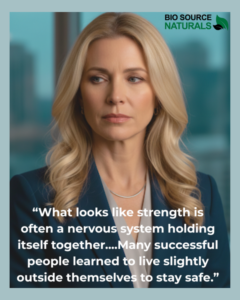 In high-pressure professional environments, dissociation can function as a survival strategy rather than a psychological failure. Many individuals learn to manage tone, perception, and power dynamics through constant vigilance, which allows them to perform effectively while distancing from their internal experience. This article explores how dissociation develops as a form of nervous system adaptation, why hyperawareness becomes invisible labor in certain systems, and how sensory practices such as aromatherapy, body-mapped self-care, and nervous system regulation tools may help the body gradually relearn safety and restore a felt sense of presence. In certain professional environments, safety is not guaranteed by competence alone. This pattern is often described as dissociation as a survival strategy in high-pressure systems.
It is maintained through constant calibration.
Tone.
Timing.
Presence.
Distance.
For individuals working in systems with uneven power dynamics, success often depends not just on skill, but on the ability to manage perception in real time. This kind of vigilance is rarely acknowledged as labor, yet it consumes enormous cognitive and emotional resources.
Over time, the nervous system adapts.
What emerges is not dysfunction, but a functional survival strategy: a partial distancing from internal experience that allows performance without full embodiment.
This adaptation works, often for decades.
But it carries a cost.
Dissociation as a Survival Strategy, Not a Failure
Dissociation is commonly framed as a trauma response something that happens when the system is overwhelmed.
In many professional environments, it functions instead as a learned regulation strategy.
It allows individuals to:
- remain composed under pressure
- manage volatility without escalation
- stay relationally engaged without becoming vulnerable
This form of dissociation doesn’t look dramatic.
It looks like competence.
The self becomes distributed rather than centered with attention-oriented outward to maintain safety.
The Tightrope Effect
Many high-functioning professionals learn to walk an invisible tightrope:
Be capable – but not intimidating.
Be personable – but not misinterpreted.
Be decisive – but never dominant.
This constant calibration teaches the nervous system that missteps carry consequences. Over time, vigilance becomes continuous rather than situational.
This isn’t anxiety in the conventional sense.
It is attunement under pressure.
Hyperawareness Is Labor and It Lives in the Body
Tracking tone, mood, timing, and relational shifts is often mistaken for emotional intelligence. When it is one-sided and unrelenting, it becomes something else entirely.
It becomes labor.
The nervous system does not distinguish between professional and personal vigilance. It registers duration and repetition. Over time, internal signals are dampened to conserve energy.
Presence becomes functional rather than felt.
Over-Responsibility and Chronic Vigilance
One of the most common patterns that emerges from long-term hyperawareness is over-responsibility — the sense that safety depends on holding everything together.
When the nervous system is stuck in chronic responsibility, insight isn’t enough; it needs a physical signal of safety.
That’s why Stress Relief Body-Mind Lotion is used as a grounding support in this pattern.
It is body-mapped to the spleen and stomach meridians — areas associated with worry, vigilance, and over-functioning — and helps the body register:
I don’t have to manage everything right now.
This isn’t about “letting go.”
It’s about allowing the nervous system to stand down.
Boundaries That Feel Unsafe
Another common adaptation is difficulty with boundaries, not because boundaries aren’t understood, but because the body associates them with threat.
Saying no once carried consequences.
Disagreeing required vigilance.
Self-trust felt risky.
When the nervous system is stuck in boundary overwhelm, insight isn’t enough; it needs a physical signal of safety.
That’s why Courage & Clarity Body-Mind Lotion is used for this pattern.
It supports the solar plexus and kidney meridians associated with fear, self-trust, and decision-making, and helps the body register:
I can choose myself without danger.
Emotional Residue: When Old Reactions Linger
Even after environments change, emotional residue often remains. Resentment, frustration, and suppressed anger are not cognitive failures; they are unfinished nervous system responses.
When the nervous system is carrying emotional residue, insight isn’t enough; it needs a physical signal of release.
That’s why Purification Body-Mind Lotion is used in this context.
It is mapped to the liver and gallbladder meridians, areas associated with emotional processing and release, and helps the body register:
This doesn’t need to stay stored here.
This isn’t about erasing the past.
It’s about preventing old emotions from occupying new space.
Why Collapse Often Comes After Safety
One of the most confusing experiences for high-functioning individuals occurs after the pressure lifts.
When safety finally arrives, many expect relief.
Instead, they experience exhaustion, grief, and emotional flooding.
This is not regression.
It is deferred processing.
When the nervous system leaves survival mode, insight isn’t enough; it needs a physical signal of safety.
That’s why Open Heart Body-Mind Lotion is often used during post-survival grief.
It supports the heart and lung meridians, associated with grief and guardedness, and helps the body register:
Softening no longer puts me at risk.
Dissociation and the Loss of Presence
For some, long-term vigilance leads to dissociation, sense of being “not quite in the body.”
This isn’t disconnection by choice.
It’s a protective narrowing of awareness.
When the nervous system is stuck in dissociation, insight isn’t enough; it needs a physical signal of presence.
That’s why Grounding / Nervous System Reset is used in this pattern.
It supports grounding pathways in the body and helps the nervous system register:
I’m here; and it’s safe to inhabit myself again.
Re-Entry Is Reorientation, Not Healing
Reclaiming presence after long-term self-distance is not about fixing anything.
There is nothing broken.
It is about allowing the nervous system to update its assumptions about safety, gradually, through experience rather than effort.
Sensory tools work here not because they explain anything, but because they give the body something real to respond to.
A Final Reframe
Dissociation in unsafe systems is not failure.
Burnout after success is not weakness.
Grief after stability is not confusion.
These are signs of a nervous system completing a cycle.
Presence does not need to be earned.
It only needs permission and a signal that it is safe to return.
The nervous system adapts to perceived safety and threat patterns (see polyvagal theory overview: https://www.polyvagalinstitute.org/whatispolyvagaltheory)
This article is part of the BioSource Naturals emotional healing and personal growth library. Explore our complete guide, Outgrowing an Environment When You Can’t Leave Yet, for compassionate guidance on protecting your energy, strengthening boundaries, preserving your identity, regulating your nervous system, and preparing for change before you are able to move on.
*These statements have not been evaluated by the Food and Drug Administration. This product is not intended to diagnose, treat, cure, or prevent any disease.