
Pure Aromatherapy for Body, Mind & Spirit
When Beliefs Become Emotional Survival Systems
When Beliefs Become Emotional Survival Systems
 Why do some beliefs feel impossible to question? Sometimes beliefs become more than opinions—they become emotional survival systems that help people create certainty, meaning, identity, or a sense of safety during life’s challenges. This article explores how understanding the emotional role of beliefs can help you respond with greater compassion while maintaining healthy boundaries. You’ll also discover how aromatherapy, EFT tapping, somatic practices, and mindful reflection may support nervous system regulation, emotional resilience, and the ability to understand without absorbing another person’s emotional intensity.
Shop supportive essential oils and aromatherapy products and free resources mentioned in this article near the bottom of the page.
Understanding Without Emotional Survival Systems Without Absorbing
There comes a point, especially if you’re intuitive, compassionate, or emotionally aware, when you begin to notice something important about the people around you.
Not every strongly held belief is simply an opinion.
Sometimes, it serves a much deeper purpose.
A person’s beliefs may help them feel safe during uncertainty, create meaning from painful experiences, or provide a sense of identity and stability when life feels overwhelming.
Recognizing this can completely change the way you experience difficult conversations.
Instead of asking, “Why are they so certain?” you begin to wonder,
“What emotional need might this belief be supporting?”
That shift doesn’t require you to agree.
It simply creates room for greater understanding without becoming emotionally entangled.
Learning to recognize the difference allows you to remain compassionate while protecting your own emotional well-being.
You can care deeply about another person’s experience without taking responsibility for carrying it.
That’s where healthy boundaries, nervous system regulation, and self-awareness begin to work together.
🌬️ It’s Not Just About What They Believe
When someone speaks with great certainty, it’s easy to focus on the belief itself.
You may find yourself wondering whether they’re right or wrong, open-minded or rigid, reasonable or unreasonable.
But sometimes, the belief isn’t the most important part of the conversation.
What’s happening beneath the belief may matter even more.
Whether the topic is:
- religion
- politics
- health and healing
- spirituality
- family traditions
- or deeply held personal values
a strongly held belief can provide something far beyond information.
It can offer stability during uncertainty.
It can help explain painful experiences.
It can create a sense of belonging and identity.
And it can make an unpredictable world feel a little more understandable.
For some people, a belief becomes part of the way they regulate difficult emotions.
It isn’t simply something they think.
It’s something that helps them feel safe.
Recognizing this doesn’t mean you have to agree with their perspective.
It simply allows you to respond with greater compassion and curiosity while remaining grounded in your own experiences and beliefs.
Sometimes understanding what a belief is doing emotionally is more valuable than debating whether the belief itself is correct.
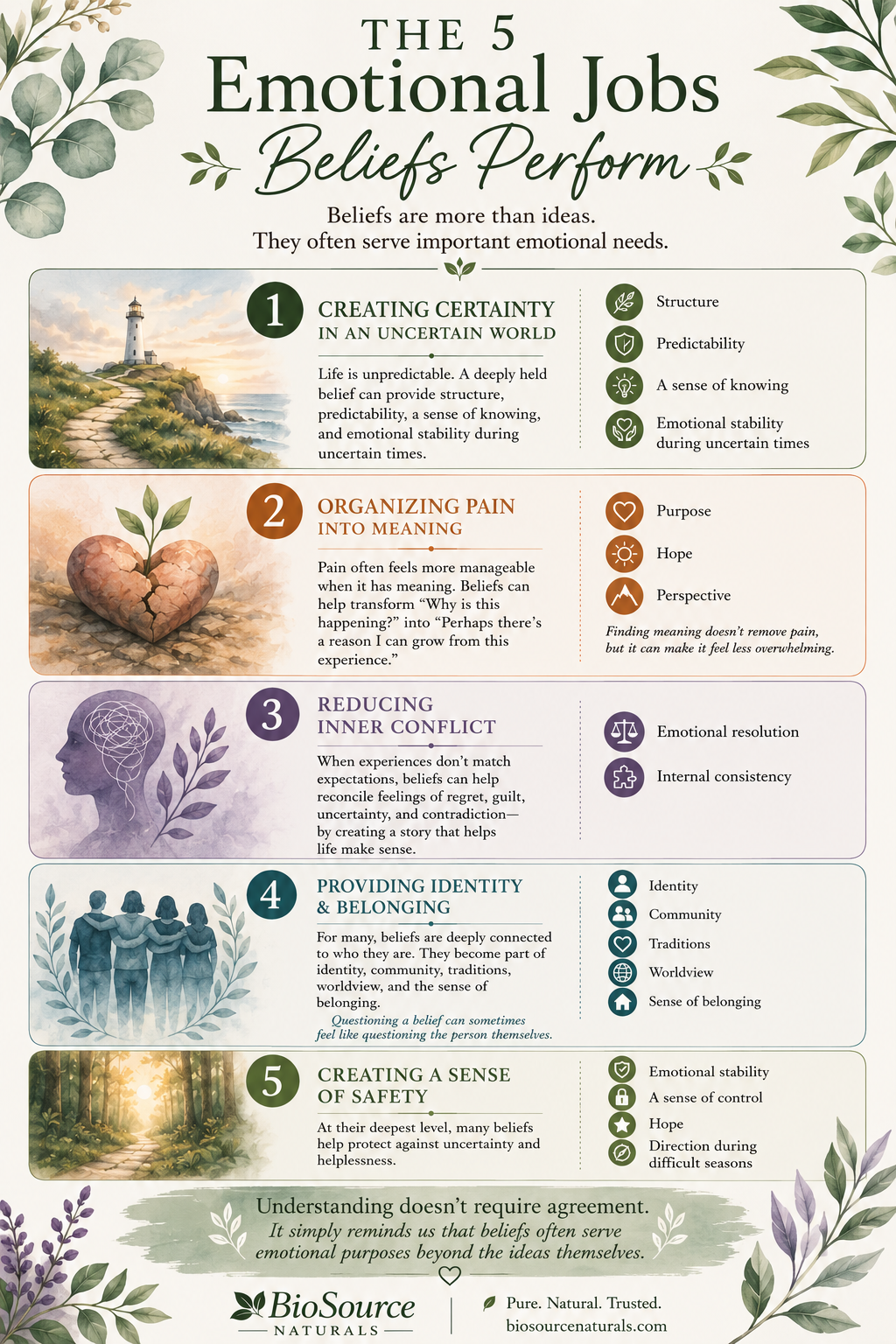
⚖️ Why These Beliefs Feel So Intense
When you encounter someone who is:
- highly certain
- emotionally charged
- resistant to other perspectives
It’s easy to assume:
“They’re just being rigid or closed-minded.”
But often, what you’re actually seeing is:
👉 a belief that is carrying emotional weight.
If that belief begins to loosen…
what it’s has been holding together may begin to surface.
Understanding this doesn’t require agreement.
It simply reminds us that some beliefs are doing far more than expressing an opinion.
They’re helping someone feel safe, make sense of life, or protect something deeply personal.
Recognizing that allows you to respond with greater compassion…
without absorbing the emotional intensity yourself.
🌬️ Understanding Emotional Survival Systems Without Absorbing
This is where many sensitive, thoughtful people get stuck.
You can feel:
- the emotional charge
- the underlying pain
- the need behind the belief
And your instinct may be to:
- explain
- soften the conversation
- offer another perspective
- or quietly adapt to keep the peace
But there is another way.
You can seek understanding…
without taking responsibility for changing the other person.
Compassion doesn’t require agreement.
And understanding doesn’t require you to absorb someone else’s emotional intensity.
Sometimes the healthiest response is simply to remain present, grounded, and true to your own experience.
🌿 A Grounded Internal Shift
Instead of asking:
“Is this belief right or wrong?”
Try asking:
“What might this belief be doing for them?”
That simple shift creates space for curiosity instead of judgment.
It helps you recognize that a belief may be serving an emotional purpose…
without requiring you to agree with it.
Understanding doesn’t mean adopting another person’s perspective.
It simply allows you to respond with greater compassion while staying grounded in your own experience
🔥 The Boundary That Changes Everything
You can hold this gentle reminder within yourself:
“I can respect that this belief serves them…without needing to take it on or participate in it.”
This simple boundary creates space to:
- stay compassionate
- remain present
- keep your own nervous system regulated
- and respond without becoming emotionally entangled
Healthy boundaries aren’t about shutting people out.
They’re about remaining connected to yourself while allowing others to have their own experiences.
Sometimes the most compassionate thing you can do is understand…
without carrying what was never yours to hold.
🌱 Flexible vs. Rigid Beliefs
Not all strong beliefs are unhealthy.
The key difference is often flexibility.
A flexible belief might sound like:
“This is what I believe today, and I’m open to learning and growing.”
A rigid belief often sounds like:
“I need this to be true in order to feel okay.”
The difference isn’t always the belief itself.
It’s the emotional dependence placed upon it.
When a belief becomes the only way someone feels safe, understood, or in control, it may become difficult to consider another perspective.
Recognizing that distinction allows you to respond with compassio
🌿 Recognizing Emotional Survival Systems in Yourself
This isn’t just about understanding others.
As you reflect, you may begin to notice how emotional survival systems show up in your own life—not as something to judge, but as something to better understand.
It’s also an invitation to gently reflect on yourself.
Ask yourself:
- Where do I become defensive about my own beliefs?
- When do I feel uncomfortable if someone challenges my perspective?
- What emotional need might one of my beliefs be supporting?
- Am I open to growth, or am I holding tightly because it helps me feel safe?
These questions aren’t meant to weaken your beliefs.
They’re an opportunity to better understand them.
Greater self-awareness doesn’t require you to let go of what matters to you.
It simply allows you to hold your beliefs with both confidence and humility.
Developing greater self-awareness and emotional flexibility can help us recognize when emotional survival systems influence our reactions rather than our values. The American Psychological Association offers additional information about building emotional resilience and psychological flexibility.
✨ A Regulating Thought to Carry Forward
When you find yourself in conversations like this, return to this gentle reminder:
“Not every belief I encounter is an invitation to engage.
Some are simply windows into how another person is holding themselves together.”
Pause.
Take a slow breath.
Allow yourself to become curious instead of reactive.
You don’t have to solve the conversation.
You don’t have to change another person’s perspective.
Sometimes your greatest contribution is simply remaining calm, compassionate, and grounded in your own experience.
🌿 Aromatherapy Support: Understanding Without Absorbing
When you’re around someone whose emotions or beliefs feel especially intense, it’s easy to become emotionally entangled.
This grounding 9 mL roll-on blend is designed to help you remain present, compassionate, and connected to yourself without absorbing another person’s emotional energy.
This blend is designed for moments when emotional survival systems create emotionally intense conversations.

Click to Enlarge and Read
🌿 Grounded Presence Essential Oil Blend
For Emotional Boundaries, Clarity, and Nervous System Support
Grounded Presence is designed for moments when you want to listen with compassion while remaining rooted in your own experience.
9 mL Roll-On Recipe
- 3 drops Frankincense Essential Oil
- 3 drops Black Pine Essential Oil
- 2 drops Vetiver Essential Oil
- 1 drop Sweet Orange Essential Oil
Fill the remainder of the bottle with jojoba oil or fractionated coconut oil.
How to Use
Apply to your wrists, upper chest, or the back of your neck before or after emotionally charged conversations.
As you inhale slowly, remind yourself:
I can understand another person’s experience without making it my own.
Allow the aroma to become a gentle reminder that compassion doesn’t require you to carry what belongs to someone else.
✨ Other Ways to Enjoy This Blend
Diffuser Blend
- 3 drops Frankincense Essential Oil
- 3 drops Black Pine Essential Oil
- 2 drops Vetiver Essential Oil
- 1 drop Sweet Orange Essential Oil
Diffuse during journaling, meditation, quiet reflection, or after emotionally challenging conversations.
2 oz Room Spray
- 10 drops Frankincense Essential Oil
- 10 drops Black Pine Essential Oil
- 6 drops Vetiver Essential Oil
- 4 drops Sweet Orange Essential Oil
- Fill with distilled water plus an appropriate solubilizer or dispersant. Shake well before each use.
Fill with distilled water and a dispersant or solubilizer if desired. Shake well before each use.
Mist your personal space, office, or bedroom when you want to create a calming, grounded atmosphere.
✨ EFT Tapping: Understanding Without Absorbing
Setup (Karate Chop Point)
Even though I can feel the intensity of their beliefs,
I choose to remain grounded in my own experience.
Even though part of me wants to explain, fix, or carry what they’re feeling,
I allow myself to stay centered and protect my own peace.
Tapping Points
- This emotional intensity…
- I can feel what they’re carrying…
- I don’t have to absorb it…
- I can stay grounded in myself…
- Compassion doesn’t require agreement…
- Their experience is theirs…
- My experience is mine…
- I choose understanding without absorbing.
✍️ Journal Prompts
Take a few quiet moments to reflect without judging your answers.
- When have I found myself absorbing someone else’s emotional intensity?
- What helps me stay grounded when a conversation becomes emotionally charged?
- Are there beliefs I hold because they genuinely resonate with me, or because they help me feel safe?
- Where might I benefit from greater emotional boundaries?
- How can I remain compassionate without taking responsibility for another person’s emotional experience?
- Where have I noticed emotional survival systems influencing my own reactions or relationships?
💬 Affirmations
Take a slow breath and allow these affirmations to remind you that compassion and boundaries can exist together.
- I can understand emotional survival systems without absorbing.
- I remain grounded in my own experience.
- Compassion does not require agreement.
- I release what isn’t mine to carry.
- I honor my boundaries with kindness.
- I choose clarity, peace, and emotional balance.
🌿 Final Reflection
Every person carries beliefs shaped by their experiences, relationships, hopes, fears, and the ways they’ve learned to navigate life.
Sometimes those beliefs become sources of comfort.
Sometimes they become anchors during uncertainty.
And sometimes they become emotional survival systems.
Understanding this doesn’t require you to agree.
It simply invites you to see another person’s humanity with greater compassion.
At the same time, compassion doesn’t require you to absorb another person’s emotional intensity or set aside your own truth.
You are allowed to remain present without becoming emotionally entangled.
You are allowed to understand…
without carrying.
Sometimes the healthiest response isn’t changing another person’s beliefs.
Understanding emotional survival systems helps us respond with greater compassion while maintaining healthy boundaries.
It’s protecting your own peace while allowing them the dignity of their own journey.

🔍 Click Image to Enlarge and Read
Disclaimer: The information in this article is provided for educational purposes only and is not intended to diagnose, treat, cure, or prevent any disease or mental health condition. Aromatherapy, EFT tapping, somatic practices, journaling, affirmations, mindfulness, and other wellness practices are intended to complement your personal self-care routine and are not a substitute for professional medical or mental health care. If you are experiencing persistent emotional distress, anxiety, depression, relationship difficulties, or other concerns that are affecting your daily life, please consult a qualified healthcare professional or licensed mental health provider.