
Pure Aromatherapy for Body, Mind & Spirit
Permission to Want Peace: Why Simplifying Life Isn’t Giving Up
Permission to Want Peace: Why Simplifying Life Isn’t Giving Up
By Lezlie Cebulski is a Traditional Naturopath and the founder of BioSource Naturals. Her work blends science, spirit, and emotional healing through essential oils, EFT, and vibrational formulas.
 Simplifying life does not mean giving up. It may mean your responsibilities have become heavier and your priorities have changed. This article explores why choosing peace, reducing commitments, and letting go of guilt may create more room for rest, enjoyment, and what matters most. Wanting a simpler life does not mean you have stopped caring. It may mean your responsibilities have grown heavier and your priorities have changed. Explore the difference between giving up and letting go, and why choosing peace can be an act of wisdom.
Shop the essential oils and aromatherapy products mentioned in this article at the bottom of the page.
Table of Contents
ToggleWhen Simplifying Life Begins to Feel Necessary
Simplifying life does not mean you stopped caring. It may mean your responsibilities have grown heavier and your priorities have changed. This article explores the difference between giving up and letting go, why guilt may appear when you choose less, and how a simpler life can create more room for rest, joy, and peace.
There comes a season in many lives, often quietly and without announcement, when you look around and realize you are carrying far more than you expected.
Responsibilities.
Expectations.
Animals to care for.
Homes to maintain.
Businesses to run.
Children, even grown children, who still need support.
Partners with changing health.
Financial concerns.
Aging bodies.
Dreams that once felt exciting but now feel heavy.
For many people, especially women who have spent decades nurturing, caregiving, organizing, and stabilizing families, an uncomfortable realization begins to surface:
I am tired.
Not weak.
Not ungrateful.
Not incapable.
Simply tired.
Often, another thought follows. It may feel almost forbidden:
What if I want less?
What if I want peace?
For some people, that thought immediately triggers guilt.
Many of us were taught that worth comes from sacrifice. Good people keep giving. Responsible people endure. Loving people carry more than their share.
When we begin reducing commitments, simplifying schedules, saying no, or letting go of something we once loved, a troubling inner voice may appear:
“Am I giving up?”
“Am I becoming selfish?”
“Shouldn’t I be able to handle this?”
“Why can’t I keep doing what I used to do?”
Choosing peace is not failure.
Sometimes it is wisdom.
Sometimes it is maturity.
Sometimes it is a sign that your needs and priorities have changed.
It may be one of the most loving decisions you can make for yourself and the people around you.
The Difference Between Giving Up and Letting Go
Giving up often grows from hopelessness.
Letting go can grow from clarity.
Those are very different experiences.
Giving up says:
“Nothing matters.”
Letting go says:
“This no longer supports the life I want.”
Giving up feels defeated.
Letting go may feel heartbreaking, but it can also be thoughtful and intentional.
You may love gardening but no longer want to maintain several acres.
You may adore animals but recognize that caring for them has become physically or emotionally difficult.
You may cherish family traditions but realize they now create more stress than joy.
You may deeply love family members while acknowledging that you cannot continue carrying every responsibility for everyone.
Simplifying life does not mean you stopped caring.
Sometimes it means you finally included your own wellbeing in the decisions you make.
How Simplifying Life Changes What Peace Looks Like
Earlier in life, many people seek expansion:
More experiences.
More projects.
More achievement.
More activity.
More possessions.
As we move through midlife and beyond, priorities often shift.
Health changes, caregiving seasons, loss, retirement, and simple exhaustion may lead us to ask different questions:
- What actually matters to me now?
- What brings me peace?
- What regularly drains me?
- What am I maintaining out of guilt?
- Which responsibilities are truly mine?
- Which responsibilities am I carrying because I always have?
- What would I like to have time to enjoy?
These are not selfish questions.
They are honest questions.
They may arise after an illness or health scare. They may appear when children grow up, when retirement approaches, or after the loss of someone important.
Sometimes they surface after feeling exhausted for far too long.
The Hidden Cost of Constant Responsibility
Long-term caregivers and family organizers often become experts at endurance.
They solve.
Organize.
Support.
Manage.
Anticipate.
Prevent problems.
Carry emotional weight.
Over time, they may stop asking, “What do I need?” because someone else’s needs always seem more urgent.
Eventually, you may notice:
- Fatigue
- Resentment
- Withdrawal
- Irritability
- Loneliness
- A longing for quiet
- A desire for a simpler life
- Less enjoyment in responsibilities you once valued
These experiences are not proof that you are weak or uncaring. They are not a diagnosis either.
They may be a reason to look more closely at your current pace, responsibilities, and needs.
Perhaps you need less.
Perhaps you need rest.
Perhaps you need joy.
Perhaps you need space.
Peace Is Not Laziness
Some people confuse peace with passivity.
But creating peace often requires courage.
Peace may require:
- Disappointing someone
- Reducing commitments
- Changing familiar routines
- Setting boundaries
- Saying no
- Allowing others to manage their own responsibilities
- Tolerating judgment
- Asking for help
Peace is not always easy.
Sometimes chaos feels familiar. Doing more than your share may feel safer than stepping back.
People who have spent years holding everything together may even feel uncomfortable when life becomes quieter.
Rest can make exhaustion easier to notice.
Stillness can bring grief or loneliness into view.
That does not mean quiet is wrong. It may be the first opportunity you have had in a long time to notice what you need.
Why Simplifying Life Can Bring Guilt
Guilt often appears when we begin removing burdens.
You might feel guilty about:
- Selling property
- Finding a suitable new home for an animal you can no longer care for
- Stepping back from caregiving
- Reducing volunteer work
- Retiring
- Choosing fewer commitments
- Declining invitations
- Resting
The mind may say:
“You should be able to do more.”
A gentler question might be:
“What if doing less and simplifying life allows me to live more fully?”
Guilt is not always evidence that a decision is wrong.
Sometimes guilt appears because you are challenging an old expectation.
Wanting Peace Does Not Mean You Love Less
A parent can love an adult child deeply and still feel tired.
A spouse can love their partner and still crave simplicity.
A caregiver can be compassionate and still need boundaries.
A person can adore animals and still choose a lifestyle with fewer daily demands.
Love and limits can coexist.
Love and exhaustion can coexist.
Love and change can coexist.
This can be one of the hardest truths for a lifelong caregiver to accept.
Reclaiming Enjoyment Is Not Frivolous
After years of responsibility, some people forget that enjoyment matters.
Simple enjoyment.
Sitting on a clean patio.
Drinking morning coffee outside.
Swimming.
Walking.
Laughing.
Spending relaxed time with a spouse.
Watching birds.
Enjoying a quiet evening.
Feeling sunlight on your face.
Pleasure does not have to be extravagant.
It may simply be a moment that feels peaceful and genuinely yours.
There is wisdom in asking:
“What would make daily life easier?”
“What would create more room for enjoyment?”
These are worthy questions.
A Gentle Aromatherapy Ritual for Choosing Peace
Relief and grief can appear at the same time when you release a responsibility,
A familiar aroma can offer a comforting pause while you reflect. It does not need to fix the feeling. The ritual simply creates a moment to notice what is present.
Aromas you might consider when simplifying life may include:
- Frankincense Essential Oil – Its warm, resinous aroma is often used during reflection, meditation, or quiet spiritual practices.
- Bergamot Essential Oil – Its fresh citrus scent is often chosen when someone wants to create a brighter atmosphere.
- Cypress Essential Oil – Its fresh, woody aroma pairs naturally with personal rituals centered on transition and change.
- Lavender Essential Oil – Its soft floral scent is commonly used to create a calm setting for rest or reflection.
- Sweet Orange Essential Oil – Its bright citrus aroma can add warmth and lightness to a room.
Simple Peace Ritual
Choose one familiar essential oil or blend.
 Use it in a diffuser or personal aromatherapy inhaler according to the directions. If applying an essential oil topically, use a properly diluted or ready-to-use product and follow all label and safety instructions.
Sit in a comfortable position. Notice where your body feels supported.
Ask yourself:
- What am I carrying from obligation?
- What am I carrying from love?
- What could be released?
- What deserves to remain?
Take several comfortable breaths.
There is no pressure to answer immediately. Sometimes clarity comes slowly.
Complete Your Peace Ritual
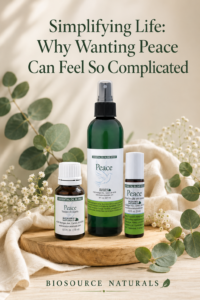
Peace Essential Oil Blend has a grounding, relaxing aroma made with cedarwood, orange, patchouli, tangerine, and ylang ylang.
Each Peace product includes a digital bonus bundle with 8 EFT tapping scripts, affirmations, and journal prompts for personal reflection and emotional wellness.
Choose the format that works best for your routine:
- Peace Essential Oil Blend Concentrate: For diffusion or properly diluted personal use
- Peace Essential Oil Blend Roll-On: A ready-to-use option for a simple personal ritual
- Peace Essential Oil Blend Spray: An easy way to bring the aroma into your space
About the Author

🔍 Click Image to Enlarge and Read
Journal Prompts
Consider exploring:
- Which responsibilities currently bring me joy?
- Which responsibilities create resentment or exhaustion?
- What have I maintained because of guilt?
- What would a peaceful season of life look like?
- If choosing ease did not make me selfish, what would I change?
- What am I afraid might happen if I choose simplifying life?
- What would I like to have more time to enjoy?
An Affirmation for Releasing Excess Burden
- I am allowed to create a life with more peace.
- Simplifying life does not mean I have failed.
- Releasing what no longer fits does not erase love.
- I honor what I have carried, and I give myself permission to rest.
- I choose peace without guilt.
Final Thoughts: The Quiet Courage of Wanting Less
There is bravery in achievement.
There is bravery in perseverance.
There is also bravery in looking honestly at your life and saying:
“I want more peace.”
“I want less stress.”
“I want time to enjoy what remains.”
“I want lighter days.”
“I want to start simplifying life.”
That is not surrender.
It may be wisdom arriving.
Sometimes simplifying life means recognizing that the next meaningful chapter may not come from adding more.
Sometimes it begins when you gently set something down.
Beneath the burden, there may still be space for joy.
Space for connection.
Space for quiet.
Space for peace.
After years of carrying so much, perhaps wanting peace was never selfish.
Perhaps it was needed all along.
Aromatherapy Safety and Educational Resources
Aromatherapy is generally practiced through inhalation or by applying properly diluted essential oils to the skin. Review the BioSource Naturals Essential Oil Safety Information before using a new oil or application method.
Additional general resources include the NCCIH Aromatherapy Overview and the Alliance of International Aromatherapists safety guidance.
These statements have not been evaluated by the Food and Drug Administration. This information is for educational purposes only and is not intended to diagnose, treat, cure, or prevent any disease. Essential oils are not a substitute for professional medical advice or care.
About BioSource Naturals
BioSource Naturals was founded in 2006 by Lezlie Cebulski, Traditional Naturopath, aromatherapist, EFT practitioner, Reiki Master Teacher, and formulator. Her background combines decades of experience in essential oil formulation, holistic wellness, and wet chemistry.
* Statements made on this website have not been evaluated by the FDA, and are not intended to diagnose, treat, cure, or prevent any disease. The information provided on this website is for informational purposes. Information is not intended as a substitute for advice from a qualified health care professional that you trust, it and should not be construed as individual medical advice. If you are under a doctor’s care, please consult with her/him prior to use of these products. If a condition persists, please contact a qualified health care professional for advice.