
Pure Aromatherapy for Body, Mind & Spirit
The Guilt That Shows Up When You Choose Yourself
The Guilt That Shows Up When You Choose Yourself
 Many people experience guilt when choosing yourself, setting a boundary, saying no, taking time for yourself, or making a decision that supports your own well-being.
They expect to feel relief.
Instead, they feel uncomfortable, uncertain, or even deeply guilty.
This can be confusing, especially when the decision was healthy, necessary, and aligned with their values.
So why does choosing yourself sometimes feel wrong?
The answer often has less to do with the decision itself and more to do with long-standing emotional conditioning and nervous system patterns that have developed over time.
In this article, we’ll explore why guilt often appears during periods of personal growth, how to distinguish between true guilt and conditioned guilt, and how EFT tapping, aromatherapy, journaling, and somatic practices can support greater self-trust and emotional well-being.
Why Does Guilt When Choosing Yourself Feel So Uncomfortable?
Most people assume guilt means:
👉 “I did something wrong.”
But that’s not always true.
Sometimes guilt means:
👉 “I did something different than I’m used to.”
Especially if you’ve spent years:
- helping
- accommodating
- anticipating other people’s needs
- prioritizing harmony over honesty
Over time, your nervous system may become conditioned to believe:
👉 Being a good person means being available.
So when you choose yourself, set a boundary, or prioritize your own well-being, it can feel like you’re breaking a rule.
The discomfort isn’t always a sign that you’ve made the wrong choice.
Sometimes it’s a sign that you’re stepping outside a familiar pattern.
The Conditioning Behind the Guilt
For many women, guilt when choosing yourself didn’t begin with a single relationship or situation.
They often develop over years of experiences, expectations, and messages about what it means to be a good person.
You may have learned:
- Being helpful means being loved
- Being easygoing means being accepted
- Being selfless means being good
Over time, your sense of worth can become connected to how much you give, how available you are, or how well you meet the needs of others.
As a result, choosing yourself may feel uncomfortable, even when it is healthy and appropriate.
Instead of asking:
👉 “What feels aligned with my needs and values?”
You may find yourself asking:
👉 “How will everyone else feel about my decision?”
This is one reason guilt can appear so quickly when you set a boundary, decline a request, or prioritize your own well-being.
The feeling isn’t always about the choice itself.
Sometimes it’s about challenging an identity that was built around being needed, helpful, or available to others.
The Nervous System Reality
Guilt when choosing yourself is not just an emotional experience.
It can also feel very physical.
When you choose yourself, set a boundary, or make a decision that breaks an old pattern, your body may respond before your mind fully understands what’s happening.
You might notice:
- Tightness in your chest
- Unease in your stomach
- Restlessness or tension
- An urge to explain, fix, or reverse your decision
This happens because your nervous system is accustomed to familiar patterns.
For some people, those patterns involve quickly restoring connection, avoiding disappointment, or putting other people’s needs ahead of their own.
So when you make a different choice, your system may temporarily interpret that change as uncomfortable or unfamiliar.
That doesn’t mean you’ve made the wrong decision.
It may simply mean your nervous system is adjusting to a new way of responding.
Understanding this can help you approach guilt with more compassion and less self-judgment.
The Important Reframe
This is where many people experience a powerful shift in perspective.
When guilt when choosing yourself appears, the automatic assumption is often:
👉 I should go back.
👉 I should fix this.
👉 I should change my mind.
But guilt is not always a signal that you’ve made a mistake.
Sometimes it’s a signal that you’re growing.
You are:
- Changing long-standing patterns
- Redefining your role in relationships
- Learning to honor your own needs
- Choosing alignment over habit
And your nervous system is adjusting to those changes.
Growth doesn’t always feel empowering in the moment.
Sometimes it feels uncomfortable.
Sometimes it feels uncertain.
And sometimes it feels like guilt.
The presence of guilt does not automatically mean you’ve made the wrong choice.
It may simply mean you’re doing something different than you’ve done before.
The Two Types of Guilt
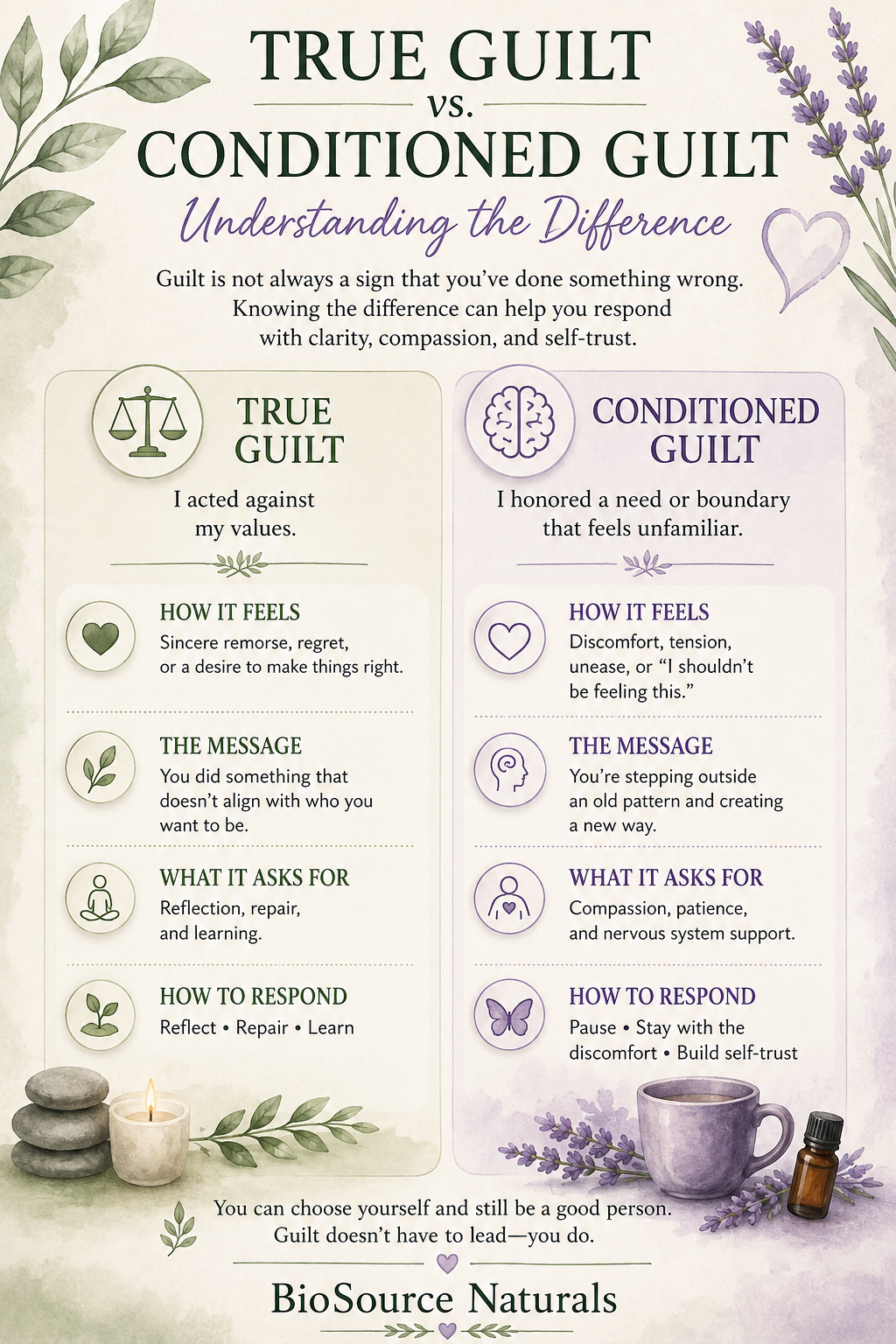
Click to Enlarge
Learning to distinguish between different types of guilt can be incredibly helpful.
Not all guilt is the same.
1. True Guilt
True guilt occurs when you act in a way that goes against your values.
For example:
- You knowingly hurt someone
- You act dishonestly
- You violate a commitment that matters to you
In these situations, guilt can serve as a helpful signal that something needs attention, repair, or reflection.
2. Conditioned Guilt
Conditioned guilt is different.
It appears when you honor your needs, set a boundary, or make a healthy choice that feels unfamiliar.
You may experience guilt because:
- You’re used to saying yes
- You’re accustomed to putting others first
- You’re stepping outside a long-standing role
- Your nervous system is adjusting to a new pattern
The discomfort can feel intense, but it doesn’t necessarily mean you’ve done anything wrong.
It may simply mean you’re doing something different.
For many people, the guilt that appears after choosing themselves is not true guilt.
It’s conditioned guilt.
And recognizing that distinction can make it easier to stay aligned with the decisions that support your well-being.
What Happens When You Push Past the Guilt?
One of the most surprising things about conditioned guilt is that it often becomes less intense when you stop trying to make it disappear immediately.
When you stay with the discomfort instead of rushing to fix it, explain yourself, or reverse your decision, something begins to change.
Over time:
- The intensity of the guilt when choosing yourself decreases
- Your nervous system adapts to the new pattern
- Your boundaries become stronger
- Your self-trust begins to grow
This doesn’t happen overnight.
Like any new habit, it takes repetition and practice.
But each time you honor a healthy boundary without abandoning yourself, you teach your system something important:
👉 It is safe to choose what aligns with your well-being.
On the other hand, if you repeatedly override your needs simply to relieve the discomfort of guilt, the old pattern remains in place.
The temporary relief may feel good in the moment, but it often reinforces the belief that your needs should come second.
Growth happens when you stay with the discomfort long enough for your nervous system to learn something new.
The Quiet Truth
You are allowed to:
- Choose rest
- Choose space
- Choose not to engage
- Choose what aligns with your values and well-being
Even if someone else:
- Doesn’t understand
- Feels disappointed
- Would prefer a different outcome
- Disagrees with your decision
Many people believe their choices are only valid if everyone approves of them.
But healthy boundaries do not require universal agreement.
You can care about someone and still say no.
You can love someone and still create distance.
You can be compassionate and still honor your own needs.
Choosing yourself is not the same as rejecting others.
Sometimes it is simply an act of self-respect.
And self-respect is an important part of emotional well-being, healthy relationships, and lasting personal growth.
This Is What Growth Feels Like
Many people expect personal growth to feel empowering, confident, and clear.
Sometimes it does.
But growth doesn’t always feel good in the moment.
Sometimes it feels uncomfortable.
Sometimes it feels uncertain.
And sometimes it feels like guilt.
When you’re changing long-standing patterns, setting healthier boundaries, or learning to prioritize your own well-being, your nervous system may need time to adjust.
That adjustment period can feel unfamiliar.
But unfamiliar does not mean wrong.
Over time, your system learns that choosing yourself is safe.
And as that happens, self-trust becomes stronger than guilt.
What feels uncomfortable today may eventually become your new normal.
Not because you’ve stopped caring about others.
Continue Exploring Emotional Healing: This article is part of our comprehensive guide, Emotional Healing With Essential Oils: A Complete Guide to Nervous System Regulation, Emotional Release and Growth. Explore aromatherapy, EFT tapping, emotional processing, healthy boundaries, nervous system support and practical pathways toward healing and personal growth.
Aromatherapy Support for Guilt When Choosing Yourself & Restoring Inner Permission
When guilt when choosing yourself appears after setting a boundary or making a healthy choice, it can be helpful to engage the senses in ways that encourage calm, grounding, and emotional balance.
Aromatherapy is commonly used to support relaxation, self-reflection, and emotional well-being during periods of change and personal growth.
The following essential oils are traditionally used in aromatherapy for these purposes:
- Sweet Orange Essential Oil – Sweet Orange is often used to promote a sense of emotional lightness and positivity. Its bright, uplifting aroma can be especially comforting during periods of self-doubt or emotional heaviness.
- Lavender Essential Oil – Lavender is one of the most widely used essential oils for relaxation and emotional balance. It is commonly used in aromatherapy to support calm feelings and help ease occasional tension.
- Melissa (Lemon Balm) Essential Oil – Melissa is traditionally used to support emotional comfort and a sense of inner calm. Its gentle aroma is often chosen during times of overwhelm, transition, or emotional stress.
Simple Aromatherapy Blend
Combine:
- 3 drops Sweet Orange Essential Oil
- 3 drops Lavender Essential Oil
- 1 drop Melissa Essential Oil (optional)
Mix with an appropriate carrier oil before topical use.
This blend may be used while journaling, practicing EFT tapping, resting, or reflecting on a recent boundary or decision.
EFT Tapping Script for Releasing Guilt While Choosing Yourself
Emotional Freedom Techniques (EFT), often called tapping, is a self-help practice that combines focused awareness with gentle tapping on specific acupressure points.
Many people use EFT to support emotional regulation, reduce feelings of stress, and create a greater sense of calm during challenging situations.
If guilt has appeared after setting a boundary or making a decision that supports your well-being, try the following tapping sequence.
Setup Statement (Karate Chop Point)
- Even though I feel guilty for choosing myself,
- and part of me thinks I’ve done something wrong,
- I’m open to seeing this differently.
- Even though this feels uncomfortable,
- I honor what I’m feeling,
- and I allow myself to stay with my choice.
Tapping Points
Eyebrow:
I feel guilty
Side of Eye:
Like I did something wrong
Under Eye:
Even though I know I needed this
Under Nose:
Even though it was the right choice for me
Chin:
There’s still this feeling
Collarbone:
This heaviness
Under Arm:
This urge to go back
Top of Head:
To fix it
Eyebrow:
But what if this is just new
Side of Eye:
What if this is just unfamiliar
Under Eye:
What if my system is adjusting
Under Nose:
To a different way of being
Chin:
I don’t have to rush to remove this feeling
Collarbone:
I can sit with it
Under Arm:
I can breathe through it
Top of Head:
And let it pass
Eyebrow:
I am allowed to choose myself
Side of Eye:
Even if it feels uncomfortable
Under Eye:
Even if others don’t understand
Under Nose:
Even if guilt shows up
Chin:
I trust myself
Collarbone:
I honor my needs
Under Arm:
I stay with my decision
Top of Head:
And allow my system to catch up
Somatic Practice: Staying With the Guilt Without Reversing Your Decision
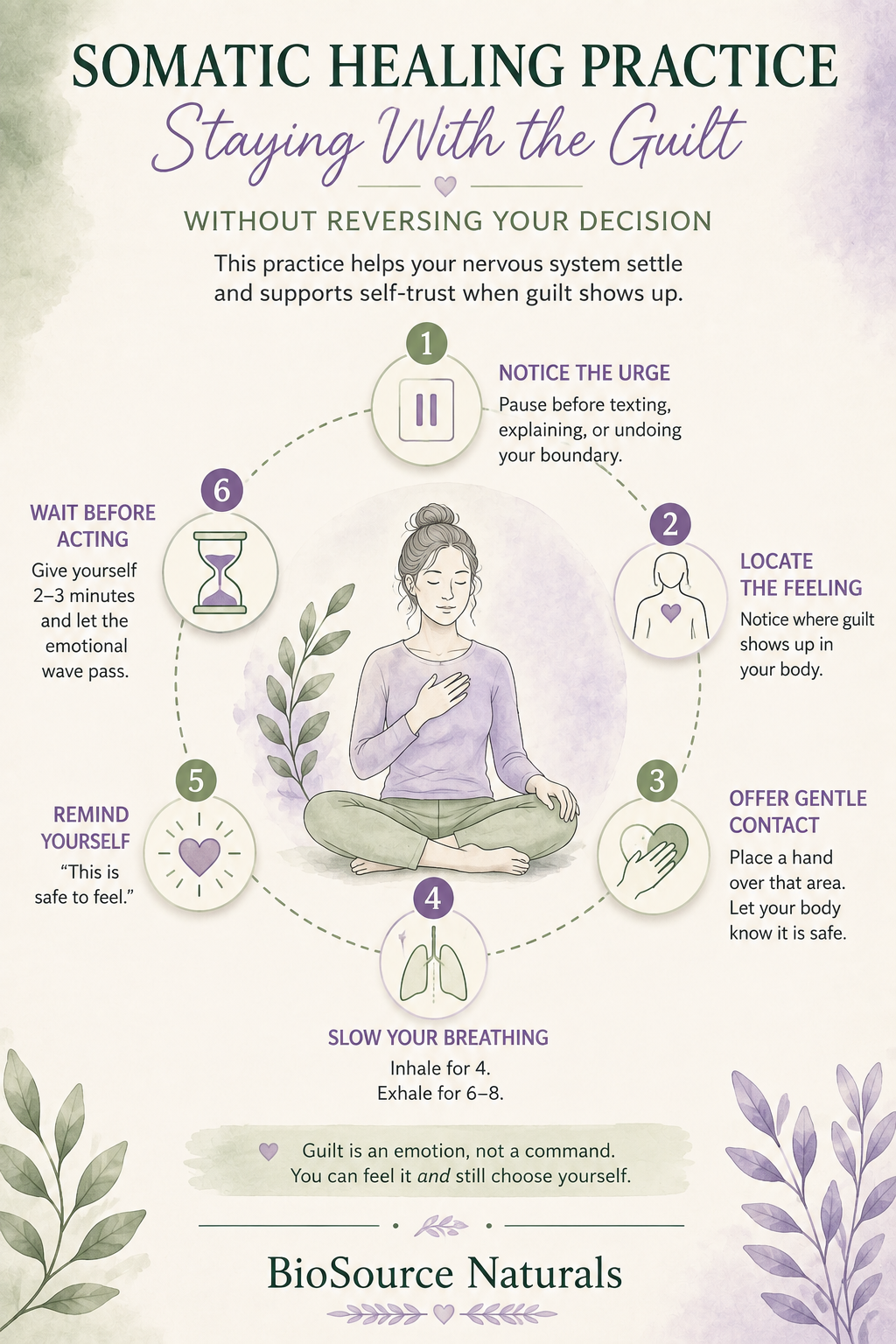
Click to Enlarge
Sometimes the strongest urge after setting a boundary is not the boundary itself.
It’s the urge to undo it.
You may feel pulled to explain more, apologize unnecessarily, change your mind, or return to an old pattern simply to relieve the discomfort.
This practice is designed to help you pause, reconnect with your body, and create space between the feeling and the reaction.
The goal is not to make the guilt when choosing yourself disappear immediately.
The goal is to allow the feeling to move through you without abandoning yourself in the process.
Staying With the Guilt Without Reversing
1. Notice the Urge
Do you want to:
- Text back?
- Explain your decision?
- Undo your boundary?
Pause before taking action.
2. Locate the Feeling
Where do you feel the guilt in your body?
Notice any sensations without trying to change them.
3. Place a Hand Over That Area
Allow yourself to bring gentle awareness to the sensation.
4. Slow Your Breathing
Inhale for a count of 4.
Exhale for a count of 6 to 8.
5. Repeat This Statement
“This is safe to feel.”
6. Wait Before Acting
Give yourself 2 to 3 minutes before responding, texting, explaining, or making a new decision.
Allow the emotional wave to pass before deciding what comes next.
Affirmations for Self-Trust and Healthy Boundaries
Affirmations can help reinforce new ways of thinking and support the emotional shifts that occur when you’re learning to prioritize your own needs.
While affirmations do not eliminate discomfort, they can serve as reminders of the values, boundaries, and beliefs you are working to strengthen.
Choose one or two that resonate with you and repeat them during journaling, EFT tapping, meditation, or quiet reflection.
- I am allowed to choose myself without guilt.
- Discomfort does not mean I made the wrong choice.
- I trust my decisions even when they feel new.
- I release the need to over-explain my boundaries.
- My needs are valid and worthy of respect.
Over time, these small reminders can help strengthen self-trust and support healthier patterns of responding to guilt, boundaries, and personal growth.
Journal Prompts for Exploring Guilt and Self-Trust
Journaling can be especially helpful when exploring guilt when choosing yourself and learning to trust your decisions.
Journaling can help bring awareness to the beliefs, expectations, and emotional patterns that may be contributing to feelings of guilt.
As you work through these prompts, try to answer with curiosity rather than judgment.
The goal is not to find the “right” answer.
The goal is to better understand your experience and strengthen your connection to your own needs, values, and self-trust.
- What decision, boundary, or choice triggered this feeling of guilt?
- Does this guilt suggest I did something wrong, or something different?
- What messages did I learn about putting myself first?
- What am I afraid might happen if I continue choosing myself?
- What would self-trust look like in this situation?
You may discover that the guilt you’re experiencing has less to do with the decision itself and more to do with the patterns you’re learning to change.
Awareness is often the first step toward creating healthier boundaries and greater emotional freedom.

Click to Enlarge
Ready for Your Next Step?
The Clean Break Companion Workbook is a free guided resource designed to help you reflect, create clearer boundaries, calm your nervous system, and take practical steps toward moving forward.
Get your free Clean Break Companion Workbook here.
Closing Reflection
Choosing yourself can feel uncomfortable when you’ve spent years prioritizing the needs, expectations, and feelings of others.
That discomfort does not automatically mean you’ve made the wrong choice.
Sometimes it means you’re creating a new pattern.
Guilt often appears when you begin setting healthier boundaries, honoring your needs, and making decisions that align with your well-being.
Over time, your nervous system can learn that self-respect, balance, and healthy limits are safe.
The goal is not to stop caring about others.
The goal is to care about yourself, too.
As you continue building self-trust, you may discover that what once felt like guilt was actually growth in disguise.
If you’re experiencing guilt when choosing yourself, you’re not alone.
For additional information about stress and emotional well-being, visit the Cleveland Clinic.
Explore the Complete Guide
Guilt can be one of the strongest forces keeping overgiving patterns in place, especially when choosing yourself feels unfamiliar or uncomfortable. Explore our complete guide to how to stop overgiving and set healthy boundaries to understand how conditioned guilt, emotional responsibility, self-abandonment, nervous system patterns, and healthy boundaries work together.

Click to Enlarge
Get Your Free Companion Workbook
Enter your name and email below, and we'll send the From Overgiving to Emotional Freedom Companion Workbook (20 pgs.) directly to your inbox.
By submitting this form, you are consenting to receive marketing emails from BioSource Naturals. You can unsubscribe at any time using the SafeUnsubscribe® link found at the bottom of every email. Emails are serviced by Constant Contact.
This article is part of our Clean Break Series exploring emotional healing, boundaries, nervous system regulation, and personal growth.
*These statements have not been evaluated by the Food and Drug Administration. This product is not intended to diagnose, treat, cure, or prevent any disease.
About the Author

🔍 Click Image to Enlarge and Read