
Pure Aromatherapy for Body, Mind & Spirit
Building the Capacity for a Steady, Supportive Marriage or Partnership
Building the Capacity for a Steady, Supportive Marriage or Partnership
How Nervous System Regulation in Relationships, Somatic Awareness, EFT, and Aromatherapy Support Lasting Connection
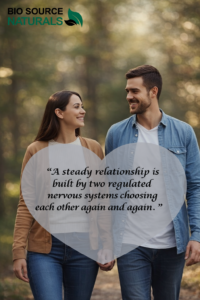 Understanding nervous system regulation in relationships can help couples communicate more clearly, recover from conflict, and build a steady partnership over time. For many people, the phrase “marriage is hard” is almost automatic.
It’s repeated so often that it’s taken as a given, as if difficulty is simply the nature of long-term relationships.
But if we pause and look a little more closely, we begin to see something important.
Marriage itself is not inherently hard.
What often feels hard are the unregulated nervous systems, unhealed emotional patterns, chronic stress, and misaligned expectations that two people bring into the relationship.
Understanding nervous system regulation in relationships helps explain why some partnerships become reactive and exhausting, while others develop the capacity to remain steady and supportive even during difficult seasons.
When these factors are present, the relationship can feel strained.
But when these patterns are addressed, or when two people develop enough internal and relational capacity to navigate them, the relationship may begin to feel very different:
👉 steady
👉 supportive
👉 respectful
👉 resilient
👉 and deeply companionate
This kind of partnership isn’t about perfection or the absence of stress.
It’s about capacity.
Developing nervous system regulation in relationships allows couples to move through stress, conflict, and change with greater emotional stability and mutual understanding.
What Do We Mean by “Capacity” in a Relationship?
Capacity refers to your ability to:
- stay emotionally regulated during stress
- tolerate differences without feeling threatened
- express your needs without shutting down or attacking
- stay connected to yourself while remaining open to your partner
- repair after disconnection or conflict
In many ways, this reflects nervous system regulation in relationships, the ability to remain in, or return to, a calm and socially engaged state when stress arises.
In nervous system terms, this is sometimes described in polyvagal theory as the ventral vagal state.
When we are in this state, we can:
- listen
- respond thoughtfully
- feel empathy
- and experience connection
When we become dysregulated, the body may shift into protective responses such as:
- fight (criticism, anger, control)
- flight (anxiety, overthinking, distancing)
- freeze (shutdown, numbness, withdrawal)
If one or both partners frequently move into these protective states, the relationship can begin to feel like a cycle of reactivity and recovery.
But when both partners develop the ability to regulate, repair, and reconnect, the relationship can become a stable base instead of a stressor.
Why Some Marriages Feel Easier Than Others
When couples describe their marriage as “not that hard,” they often share several important qualities:
- shared core values and priorities
- mutual respect
- emotional safety
- a willingness to grow
- the ability to give each other space
- and the ability to repair after conflict
Even when life brings significant stressors, caregiving, career changes, health challenges, or grief, couples with these capacities often experience the relationship as supportive rather than draining.
In other words:
👉 It’s not that they avoided life’s challenges
👉 It’s that they were aligned and regulated enough to face them together
👉 It’s that they were aligned and regulated enough to face them together
The Role of the Nervous System in Long-Term Relationships
Many relationship researchers and therapists now recognize that a healthy marriage is strongly influenced by the nervous system state of both partners. When two people have the ability to regulate stress and return to calm after conflict, communication becomes clearer and connection becomes easier to maintain. Practices that support nervous system regulation in relationships such as somatic awareness, EFT tapping, and supportive tools like aromatherapy can help couples build the emotional stability needed for long-term partnership.
Developing nervous system regulation in relationships allows couples to move through stress, conflict, and change with greater steadiness and mutual understanding.
Our nervous system constantly scans for safety or threat, both in our environment and in our relationships.
If a partner’s tone of voice, facial expression, or behavior is interpreted as threatening, even unconsciously, the nervous system may react quickly.
This reaction can show up as:
- irritability
- defensiveness
- shutting down
- needing to escape the conversation
- or becoming overly controlling
These responses are not moral failures.
They are protective nervous system adaptations.
However, when these patterns dominate a relationship over time, they can weaken emotional connection.
The goal is not to eliminate all stress or reactivity.
The goal is to build the capacity to notice activation, regulate the nervous system, and return to connection.
Developing nervous system regulation in relationships allows partners to move through challenges with greater steadiness and understanding.
The nervous system plays a central role in emotional regulation and connection, a concept explored in polyvagal theory developed by Dr. Stephen Porges.
Somatic Awareness: The Body as the Bridge
Somatic awareness focuses on the body’s sensations and signals as a pathway toward regulation.
In relationships, somatic awareness helps you notice early signs of activation before they escalate into conflict.
Common early signals include:
- tightening in the chest
- shallow breathing
- clenched jaw
- tension in the shoulders
- heat or pressure in the face
When these signals are noticed early, it becomes possible to gently support nervous system regulation before the interaction becomes reactive.
Simple Somatic Regulation Practices
1. Lengthen the exhale
Inhale for 4, exhale for 6–8.
Longer exhales encourage the body’s natural relaxation response.
2. Hand on heart, hand on belly
This posture can create a sense of grounding and internal safety.
3. Orienting to the room
Slowly look around your environment and name three to five neutral or pleasant objects.
This helps signal to the brain that the environment is safe.
4. Grounding through the feet
Feel your feet on the floor and press gently downward.
This helps anchor attention in the present moment.
5. Gentle movement
Rolling the shoulders, stretching the hips, or walking can help release accumulated tension in the body.
Over time, simple practices like these help build nervous system resilience.
EFT Tapping for Emotional Regulation and Repair
Emotional Freedom Techniques (EFT) combines gentle tapping on acupressure points with focused statements.
Many people find EFT helpful for:
- interrupting emotional overwhelm
- processing hurt feelings
- releasing old relational patterns
- supporting repair after conflict
Example EFT Setup Statement
- Even though I feel triggered and overwhelmed right now,
- I’m open to calming my body and responding with care.
Sample Tapping Round (abbreviated)
- All this activation in my body
- This tightness in my chest
- My urge to defend myself
- My system trying to protect me
- I can slow my breath
- I can feel my feet on the ground
- I can stay connected to myself
- And still stay open to connection
EFT for Repair
After a difficult interaction, you might tap with:
- Even though that moment hurt and I reacted,
- I’m willing to repair and reconnect.
Developing the ability to repair after conflict is widely considered one of the most important factors in long-term relationship satisfaction.
Aromatherapy for Nervous System Support and Emotional Balance
Aromatherapy can be a supportive tool when working with emotional regulation and relational connection.
Scent communicates with the limbic system, an area of the brain involved in memory, emotion, and stress response.
Essential Oils Often Used for Self-Regulation
- Lavender – traditionally associated with calm and relaxation
- Frankincense – supports stillness and deeper breathing
- Vetiver – grounding and stabilizing
- Sweet Orange – uplifting and softening emotional tension
Essential Oils Often Associated with Emotional Openness
- Bergamot – encourages emotional flexibility
- Rose – connected with compassion and heart-centered awareness
- Ylang Ylang – softens emotional intensity
- Geranium – balancing and harmonizing
Essential Oils for Emotional Reset
- Cypress – traditionally associated with emotional release
- Clary Sage – supports emotional clarity
- Sandalwood – grounding and centering
Blends that combine grounding, heart-opening, and clarifying oils such as Divine Essential Oil Blend can be especially supportive during practices like reflection, journaling, or intentional communication.
Many people find that calming aromatic blends can support relaxation and emotional balance during stressful moments. Blends such as Calming Essential Oil Blend and Precious Essential Oil Blend are often used during meditation, reflection, or relaxation practices that support emotional regulation.
A Simple Daily Ritual to Build Relationship Capacity
Small daily practices can create meaningful long-term change.
Here is a simple 5–7 minute ritual you can incorporate into your day.
Morning: Regulation and Intention
- Apply a calming or uplifting oil blend.
- Take three slow breaths with a long exhale.
- Place your hand on your heart and say:
- “Today I choose calm, clarity, and respectful connection.”
Midday: Reset
- Pause briefly.
- Notice your breathing.
- Release your shoulders and jaw.
- Reapply your oil if desired.
Evening: Reflection and Release
Do one round of EFT tapping.
Journal briefly:
- Where did I stay regulated today?
- Where did I need more support?
Over time this daily rhythm helps build nervous system flexibility and relational awareness.
The Power of Alignment and Shared Values
Beyond nervous system regulation, one of the most stabilizing forces in a relationship is alignment.
When two people share:
- core values
- life priorities
- similar perspectives on major topics
- and a sense of “we’re on the same team”
…the relationship often experiences less internal friction.
Instead of:
you vs me
it becomes:
us vs the problem
This shared orientation creates a foundation where both partners feel supported, respected, and understood.
Marriage as a Regulated Partnership
A steady, supportive marriage is not the absence of conflict or stress.
It is the presence of:
- emotional safety
- mutual respect
- self-awareness
- repair skills
- and shared direction
It is two people who can:
- regulate themselves
- co-regulate with each other
- and return to connection after disconnection
When these capacities are present, the relationship becomes a place of restoration rather than depletion.
A Closing Reflection
If you grew up around conflict, instability, or emotional unpredictability, the idea of a calm and steady marriage may feel unfamiliar or even out of reach.
But the capacity for this kind of relationship is not fixed.
It can be developed gradually through:
- somatic awareness
- emotional processing tools such as EFT
- supportive practices like aromatherapy
- and conscious relational intention
Over time, these practices help the nervous system learn a new message:
👉 connection can be safe
👉 communication can be respectful
👉 partnership can feel supportive rather than exhausting
A healthy, regulated relationship does not mean life will always be easy.
It means two people have the capacity to walk through life together, side by side, with steadiness, compassion, and respect.
And that is a deeply meaningful form of love.
Further Explore Emotional Healing in: Emotional Healing With Essential Oils: A Complete Guide to Nervous System Regulation, Emotional Release and Growth. Explore aromatherapy, EFT tapping, emotional processing, healthy boundaries, nervous system support and practical pathways toward healing and personal growth.
These statements have not been evaluated by the Food and Drug Administration. The products and information mentioned are not intended to diagnose, treat, cure, or prevent any disease.
About the Author

🔍 Click Image to Enlarge and Read