
Pure Aromatherapy for Body, Mind & Spirit
When Words and Actions Don’t Match – The Quiet Clarity of Redefining the Relationship
When Words and Actions Don’t Match – The Quiet Clarity of Redefining the Relationship
 When words and actions don’t match, it can leave you questioning where you stand in a relationship. Whether it’s a friend, family member, adult child, coworker, or someone else important in your life, inconsistent relationships can leave you feeling hurt, confused, and emotionally exhausted. Learning to recognize the difference between words and actions can help you set healthier expectations while protecting your own emotional well-being. This article explores aromatherapy, EFT tapping, journaling, breathwork, and mindfulness practices that may support emotional balance during difficult relationships.
Shop supportive aromatherapy and free resources mentioned in this article near the bottom of the page.
When Words and Actions Don’t Match Repeatedly
When words and actions don’t match, disappointment often follows. There is a unique kind of disappointment that doesn’t begin with conflict.
It begins with inconsistency.
Someone tells you they care.
They say they want to spend time with you.
They express appreciation for your presence in their life.
Yet when the opportunity comes to follow through, something always seems to get in the way.
Not just once.
But repeatedly.
At first, it’s easy to explain.
“They’re busy.”
“They have a lot going on.”
“It’s just bad timing.”
Sometimes those explanations are true.
But when disappointment becomes a pattern rather than an exception, something quietly begins to change within you.
You stop asking why.
You stop trying to make sense of every excuse.
Instead, you begin noticing what someone’s actions consistently communicate.
That awareness isn’t about blame.
It isn’t about becoming bitter.
It’s about the quiet clarity of redefining the relationship.
Not by ending it.
Not by demanding more.
But by gently allowing your expectations to align with what someone has repeatedly shown they are able—or willing—to offer.
Sometimes the greatest act of self-respect isn’t changing another person.
It’s changing how you choose to relate to them.
This Isn’t About One Missed Visit
One canceled plan doesn’t define a relationship.
Life happens.
People get busy.
Unexpected circumstances arise.
Healthy relationships have room for grace, understanding, and flexibility.
But when disappointment becomes a recurring pattern, it’s worth paying attention—not with judgment, but with curiosity.
Sometimes people genuinely care.
They simply don’t have the capacity to offer the kind of relationship you hope for.
Sometimes their priorities have changed.
Sometimes they consistently overpromise and underdeliver.
And sometimes their actions quietly reveal what their words never could.
People don’t always communicate their availability with conversations.
Often, they communicate it through consistency.
Recognizing that difference isn’t about assigning blame.
It’s about accepting what is being shown to you, so you can respond with greater clarity instead of continued confusion.
That clarity doesn’t mean you stop caring.
It simply means you stop expecting someone to give what they have consistently shown they cannot.
From there, you can begin redefining the relationship in a way that honors both your heart and your emotional well-being.
Why Words and Actions Don’t Match Can Be So Painful
There often comes a moment when you stop focusing on what someone says and begin paying closer attention to what they consistently do.
Words and actions don’t match.
It isn’t a dramatic realization.
It usually happens quietly.
You notice you’re the one who always reaches out.
You’re the one rearranging your schedule.
You’re the one hoping that this time will be different.
And then something shifts.
Not because you’ve stopped caring.
But because you’ve stopped arguing with reality.
You begin to understand that accepting someone’s actions doesn’t mean giving up on them.
It means allowing their actions—not your hopes—to guide your expectations.
That realization isn’t about rejection.
It’s about clarity.
It’s about recognizing that you deserve relationships built on mutual effort, consistency, and genuine presence.
Sometimes the healthiest choice isn’t to end a relationship.
It’s to redefine it.
To appreciate it for what it is instead of continually grieving what you wish it could be.
That quiet shift often brings something unexpected:
less disappointment,
less emotional chasing,
and more peace.
 Sacred Session: The Space Between Words and Actions
When words and actions don’t match, it’s easy to question yourself instead of simply observing the pattern.
Find a quiet place where you won’t be interrupted.
Take a slow, gentle breath in.
And another.
Allow your shoulders to soften.
Notice where your body is holding disappointment.
Is it in your chest?
Your throat?
Your stomach?
Simply observe it without trying to change it.
Now ask yourself:
What have I been hoping would be different?
What expectations have I continued to hold, even when someone’s actions have shown me something else?
There is no need to judge yourself.
Hope is a beautiful part of being human.
But sometimes peace begins when we stop asking people to become who we wish they were and begin accepting who they consistently show themselves to be.
As you breathe, consider this gentle truth:
People reveal what is available to you through their actions, not just their words.
Accepting that reality isn’t giving up.
It isn’t becoming bitter.
It’s allowing yourself the quiet clarity of redefining the relationship.
Not by closing your heart.
But by opening your eyes.
Take one more slow breath.
As you exhale, imagine releasing the weight of unmet expectations and making space for greater peace, healthier boundaries, and relationships that feel reciprocal and genuine.
🌿 Aromatherapy Support for Emotional Discernment and Healthy Boundaries
When words and actions don’t match, it’s easy for the nervous system to become caught between hope and disappointment. You may find yourself replaying conversations, questioning intentions, or hoping someone will eventually show up differently. Aromatherapy offers an opportunity to pause, reconnect with yourself, and respond from a place of clarity rather than emotional reactivity.
Aromatherapy offers an opportunity to pause, reconnect with yourself, and respond from a place of clarity rather than emotional reactivity.
The following 9 mL roll-on blends are designed to encourage discernment, emotional comfort, healthy boundaries, and the confidence to redefine relationships in ways that support your well-being.
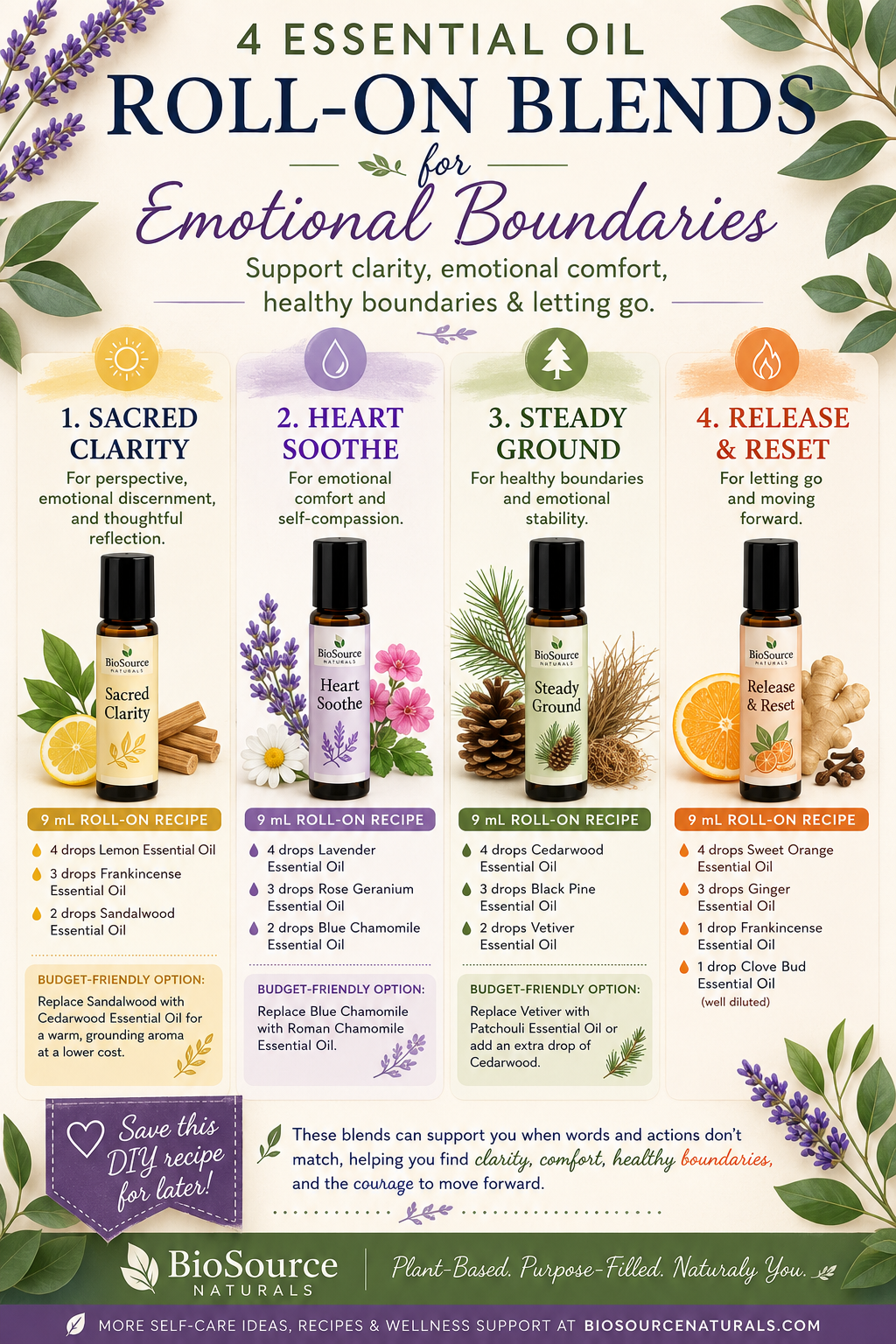
Click to Enlarge and Read
🌿 Blend 1: Sacred Clarity
For Perspective, Emotional Discernment, and Thoughtful Reflection
When emotions are running high, this blend is designed to encourage moments of clarity before responding. Many people enjoy using it before difficult conversations, important decisions, or journaling.
9 mL Roll-On Recipe
- 4 drops Lemon Essential Oil
- 3 drops Frankincense Essential Oil
- 2 drops Sandalwood Essential Oil
- Fill the remainder of the bottle with jojoba oil or fractionated coconut oil.
Budget-Friendly Option: Replace Sandalwood with Cedarwood Essential Oil for a warm, grounding aroma at a lower cost.
How to Use
Clarity comes before reaction.
🌸 Blend 2: Heart Soothe (Water Element – Emotional Comfort)
For Emotional Comfort and Self-Compassion
Disappointment often leaves us carrying sadness long after the moment has passed. Heart Soothe was created for those times when your heart simply needs a little extra kindness.
9 mL Roll-On Recipe
- 4 drops Lavender Essential Oil
- 3 drops Rose Geranium Essential Oil
- 2 drops Blue Chamomile Essential Oil
Fill with jojoba oil or fractionated coconut oil.
Budget-Friendly Option: Replace Blue Chamomile with Roman Chamomile Essential Oil.
How to Use
Apply to your heart center or wrists during moments of disappointment, grief, or emotional vulnerability.
As you inhale, quietly remind yourself:
I deserve the same compassion I so freely give to others.
🌲 Blend 3: Steady Ground (Earth Element – Healthy Boundaries)
For Healthy Boundaries and Emotional Stability
Healthy boundaries allow us to care deeply without carrying the emotional weight of every relationship.
9 mL Roll-On Recipe
- 4 drops Cedarwood Essential Oil
- 3 drops Black Pine Essential Oil
- 2 drops Vetiver Essential Oil
Fill with jojoba oil or fractionated coconut oil.
Budget-Friendly Option: Replace Vetiver with Patchouli Essential Oil or add an extra drop of Cedarwood.
How to Use
Apply to the soles of your feet, lower back, or wrists before situations where you want to remain grounded while protecting your peace.
Take a slow breath and remind yourself:
Healthy boundaries create healthier relationships.
🍊 Blend 4: Release & Reset (Fire Element – Moving Forward)
For Letting Go and Moving Forward
Sometimes healing begins by releasing what you’ve been carrying and creating space for something new.
9 mL Roll-On Recipe
- 4 drops Sweet Orange Essential Oil
- 3 drops Ginger Essential Oil
- 1 drop Frankincense Essential Oil
- 1 drop Clove Bud Essential Oil
Fill with jojoba oil or fractionated coconut oil.
Sensitive skin? Omit the Clove Bud Essential Oil or replace it with an additional drop of Frankincense Essential Oil for a gentler blend.
How to Use
Apply to your wrists before journaling, breathwork, or quiet reflection.
As you breathe deeply, remind yourself:
I release what no longer serves me and make space for peace.
✨ EFT Tapping: Releasing Disappointment and Embracing Clarity
Relationships that feel one-sided can leave us questioning our worth, replaying conversations, and hoping things will change. This tapping sequence is designed to help you acknowledge those emotions while gently creating space for acceptance, healthier expectations, and inner peace.
Setup (Karate Chop Point)
Even though I feel disappointed that this relationship isn’t what I hoped it would be,
I deeply and completely honor how I feel,
and I’m open to finding greater clarity and peace.
Even though part of me keeps hoping things will be different,
I choose to support myself with compassion,
and I’m willing to see this relationship more clearly.
Tapping Points
Eyebrow
This disappointment.
Side of Eye
I really thought it would be different.
Under Eye
Part of me feels hurt.
Under Nose
I keep hoping things will change.
Chin
I’m beginning to see the pattern.
Collarbone
I don’t have to chase connection.
Under Arm
I can honor my feelings without losing myself.
Top of Head
I’m open to peace and clarity.
Reframe Round
Eyebrow
I can appreciate what this relationship is.
Side of Eye
I release what it has never consistently been.
Under Eye
I choose healthier expectations.
Under Nose
I don’t need to force connection.
Chin
I deserve relationships that feel reciprocal.
Collarbone
I can care deeply while protecting my peace.
Under Arm
I trust what actions continue to show me.
Top of Head
I choose clarity, compassion, and self-respect.
🌬️ Breathwork: Creating Space Between Emotion and Response
When disappointment arises, it’s natural for the nervous system to become activated. Before responding, give yourself permission to pause.
This simple breathing practice can help settle emotional tension and create space for greater clarity before deciding how you want to move forward.
Try this breathing pattern:
Inhale for 4 seconds
Hold for 4 seconds
Exhale slowly for 6 seconds
Repeat for 2 to 3 minutes.
With each slow exhale, imagine releasing:
- unmet expectations
- emotional tension
- the need to understand everything
- the pressure to make someone else respond differently
As your breathing slows, gently remind yourself:
I cannot control another person’s choices. Words and actions don’t match only I can choose how I care for myself.
Allow your next decision to come from a place of calm rather than disappointment.
For additional information about healthy relationship patterns and emotional well-being, visit the American Psychological Association’s relationship resources.
🌿 Final Reflection
Not every relationship unfolds the way we hope.
Some people genuinely care, yet they aren’t able—or willing—to show up in the ways we need.
That realization can be painful.
But it can also become an invitation to see more clearly.
Redefining a relationship doesn’t always mean ending it.
Sometimes it simply means letting go of expectations that no longer match reality.
You may continue to care.
You may continue to love.
But you no longer have to carry the disappointment of hoping someone will become who they’ve consistently shown they are not.
That quiet clarity creates space for something new:
greater peace,
healthier boundaries,
deeper self-respect,
and relationships built on mutual care, consistency, and presence.
Sometimes the greatest gift you can give yourself isn’t changing another person.
It’s allowing yourself to respond to the relationship with wisdom, compassion, and the freedom to choose what supports your own emotional well-being.
When words and actions don’t match, you don’t have to stop caring. You can simply begin relating to the person differently.
About the Author

🔍 Click Image to Enlarge and Read
Disclaimer: The information in this article is provided for educational purposes only and is not intended to diagnose, treat, cure, or prevent any disease or mental health condition. Aromatherapy, EFT tapping, breathwork, journaling, mindfulness, affirmations, and other wellness practices are intended to complement your personal self-care routine and are not a substitute for professional medical or mental health care. If you are experiencing persistent emotional distress, relationship challenges, anxiety, depression, or other concerns that are affecting your daily life, please consult a qualified healthcare professional or licensed mental health provider.