
Pure Aromatherapy for Body, Mind & Spirit
Understanding People Without Excusing Them: Somatic Healing, Tapping, and Aromatherapy for Clearer Boundaries
Understanding People Without Excusing Them: Somatic Healing, Tapping, and Aromatherapy for Clearer Boundaries
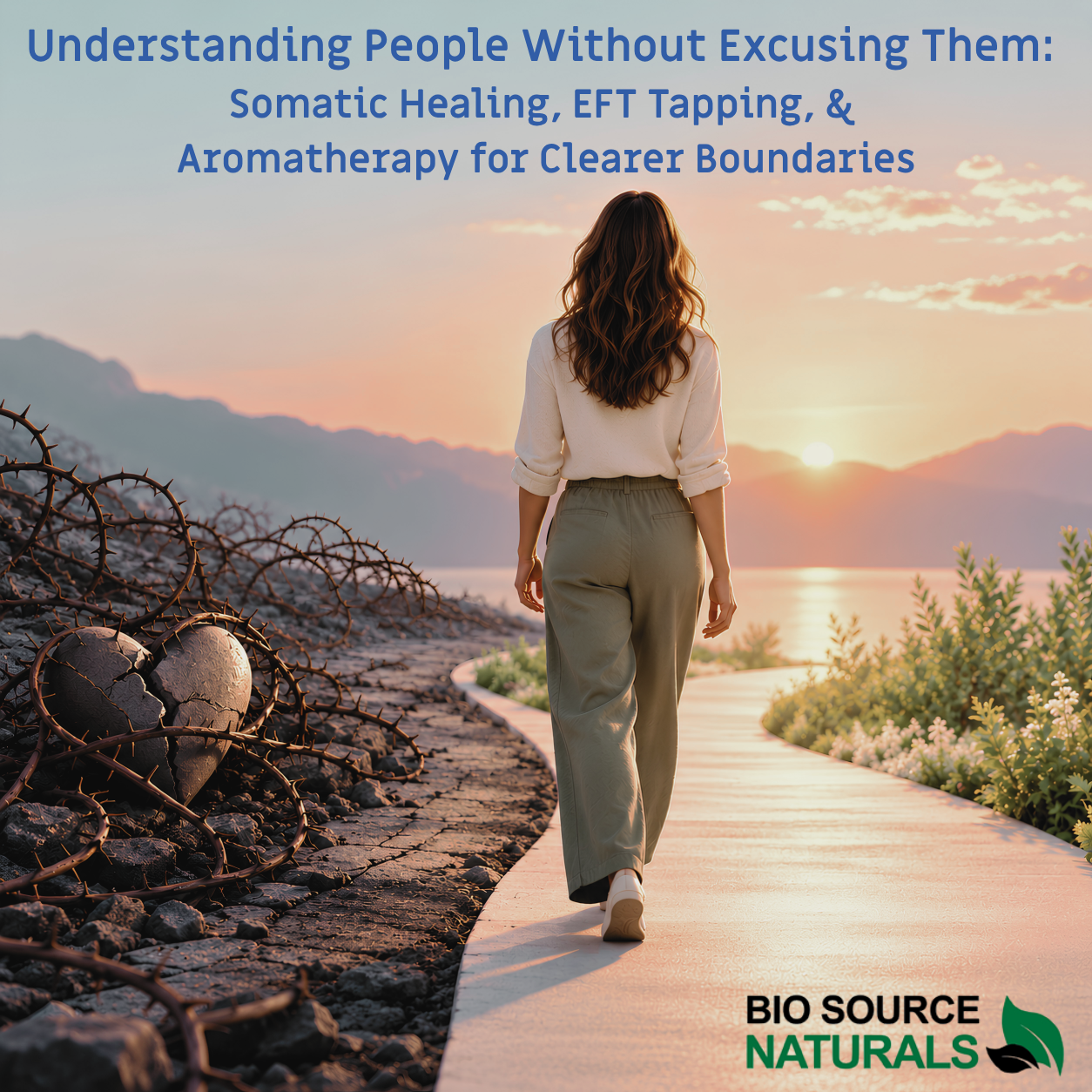
Learning to balance empathy and healthy boundaries has been an important part of my personal growth. I’ve always been an empathetic person, and for much of my life, when someone hurt, disappointed, or disrespected me, my instinct was to understand why. I believed that looking beyond the behavior to understand the person was the compassionate thing to do.
When I was younger, I would consider someone’s past, struggles, motivations, and experiences to explain behavior that didn’t feel right to me. That ability to see another person’s perspective is part of empathy, but I eventually realized that I was sometimes using understanding as a reason to give people more chances than their behavior warranted.
Over time, I learned that empathy and healthy boundaries need to exist together. Understanding someone’s pain can explain their behavior, but it does not require me to tolerate repeated disrespect, emotional inconsistency, or crossed boundaries. Without discernment, empathy can gradually become self-abandonment. I can have compassion for why someone behaves as they do while still recognizing that their behavior is not healthy for me.
When Kindness and Disrespect Exist Together
It gets especially confusing when someone does kind and thoughtful things for you while also repeatedly disrespecting you or crossing your boundaries. For a long time, I gave those kind acts too much weight. I saw them as evidence of good character and as proof that the relationship itself must be good, even when other behavior was telling me otherwise.
This kind of inconsistency can keep us emotionally invested. We may focus on the thoughtful gestures and minimize the painful patterns. We may tell ourselves that the person is trying, that they have been through a lot, or that the relationship will improve if we are patient enough.
But a kind act does not erase a harmful pattern. Generosity does not cancel out disrespect. Someone can care about us in certain ways and still be unable or unwilling to offer the consistency, accountability, and safety we need.
I eventually gained clarity about a few relationships like this and chose to end them. Looking back, I now see some of those kind acts differently. What I once interpreted as evidence of caring sometimes functioned as manipulation, keeping me invested in relationships while I continued to overlook behavior I should not have accepted.
That realization does not mean every kind gesture was fake. It means I no longer use isolated moments of kindness to dismiss repeated evidence that a relationship is unhealthy for me.
Let Patterns Speak Clearly
Now I pay much more attention to patterns. I take repeated behavior for what it is: communication. Someone can have wonderful qualities, do generous things, and still consistently behave in ways that are unhealthy for me.
Patterns can reveal more than promises. Do I feel respected? Can I express a need without being punished, mocked, ignored, or guilted? Does the person take responsibility when they hurt me? Do their actions create emotional safety, or do they keep me confused and anxious?
These questions help bring me back to reality. I do not have to build a case against someone. I only have to be honest about how their behavior affects my well-being.
Somatic Healing and the Wisdom of the Body
Boundary confusion often lives in the body before it reaches the mind. You may notice a tight chest, a clenched jaw, shallow breathing, stomach discomfort, fatigue, or a sense of dread before interacting with someone. These sensations are not always proof that another person is dangerous, but they are important information.
Somatic healing invites us to slow down and listen. Instead of immediately explaining away discomfort, we can gently ask:
- What am I feeling in my body right now?
- Do I feel safe, pressured, or emotionally contracted?
- Am I responding from genuine choice or from fear of disappointing someone?
- What boundary would help me feel more grounded?
A simple practice is to place one hand over your heart and the other over your abdomen. Take a slow breath in, then exhale a little longer than you inhale. Feel your feet on the floor and notice the support beneath you. You do not need to solve the entire relationship in that moment. You only need to reconnect with yourself.
Tapping for Courage and Clarity – Empathy and Healthy Boundaries Can Coexist
Tapping, also known as Emotional Freedom Techniques, can be used as a grounding practice while you process difficult emotions. Gently tap through points such as the side of the hand, eyebrow, side of the eye, under the eye, under the nose, chin, collarbone, and under the arm. Enhance your Tapping Session by first applying Courage and Clarity Body-Mind Lotion.
As you tap, speak honestly and compassionately:
“Even though I feel confused about this relationship, I am willing to listen to myself.”
“Even though I have been afraid to set boundaries, I can move forward with courage and clarity.”
“Even though I understand this person’s struggles, I do not have to abandon my own needs.”
“I can care about someone and still choose distance.”
“I trust myself to notice patterns and respond with self-respect.”
Tapping is not a substitute for professional mental health care, but it can be a supportive self-regulation tool. The goal is not to force yourself to feel calm or make an immediate decision. The goal is to create enough internal space to hear your own truth.
Aromatherapy for Clearing and Grounding, Empathy & Healthy Boundaries
Aromatherapy can complement somatic practices by creating a sensory cue for release, grounding, and renewal. Choose oils that feel supportive to you, and use them safely. Essential oils should generally be diluted before applying to the skin, and some oils may not be appropriate for children, pregnancy, pets, certain health conditions, or use around the face. Diffuse in a well-ventilated space and follow product guidance.
For a clearing ritual, consider:
- Frankincense: often associated with reflection, grounding, and spiritual calm.
- Cedarwood: supportive for steadiness and a sense of rootedness.
- Clary sage: commonly used for emotional release and relaxation.
- Lavender: calming and gentle during periods of stress.
- Rosemary: often associated with mental clarity and focus.
- Lemon: bright, refreshing, and uplifting when you feel emotionally heavy.
- Peppermint: invigorating and clarifying, though it should be used carefully and kept away from the eyes and sensitive skin.
- Sweet Orange: comforting and encouraging when you need warmth and optimism.
You might diffuse lavender and cedarwood while journaling or use Frankincense and Rosemary in a personal grounding ritual. You can also place a properly diluted blend on your wrists, inhale from a personal inhaler, or simply pause with the scent nearby while taking slow breaths.
As you breathe in, imagine making space for clarity. As you exhale, imagine releasing the need to explain, rescue, or convince someone to treat you well.
Courage, Clarity, and Self-Esteem
Healthy boundaries are not a punishment. They are an expression of self-esteem. They communicate that your time, energy, body, emotions, and peace matter.
Courage does not always feel powerful. Sometimes courage is sending a brief message instead of overexplaining. Sometimes it is declining an invitation, ending a conversation, taking space, or accepting that someone may not understand your decision.
Clarity may also arrive gradually. You do not need perfect certainty before honoring what you already know. If a relationship repeatedly leaves you anxious, diminished, confused, or unsafe, that information deserves your attention.
You can practice boundary statements such as:
- “I’m not available for that conversation.”
- “That does not work for me.”
- “I need time to think before I respond.”
- “I’m willing to discuss this when we can speak respectfully.”
- “I’m choosing to step back from this relationship.”
- “I understand your perspective, and my decision remains the same.”
The more consistently you honor your boundaries, the more your self-trust grows. Self-esteem is not built by convincing everyone to approve of your limits. It is built by proving to yourself that you will listen, respond, and protect your well-being.
You Do Not Have to Make Someone a Villain
I no longer need to fully understand why someone behaves a certain way in order to decide whether I want that behavior in my life. And I don’t have to decide that someone is a bad person to recognize that they are not a good person for me to be around.
This is one of the most freeing parts of healing. We can acknowledge someone’s history without taking responsibility for repairing it. We can appreciate their good qualities without remaining available for harmful behavior. We can wish them well while choosing distance.
Empathy and boundaries can exist together. Compassion and discernment can exist together. Understanding someone does not require abandoning yourself.
When you return to your body, use supportive practices such as tapping and aromatherapy, and let courage and clarity guide your choices, you create a stronger relationship with yourself. And from that relationship, healthier boundaries become less about rejection and more about self-respect.
Related Articles for Emotional Healing & Self-Care
Continue exploring ways to support emotional well-being, self-awareness, and a greater sense of inner calm:
- Forgiveness and Letting Go: A Layered Holistic Self-Care Guide – Explore forgiveness without minimizing what happened, with aromatherapy, EFT tapping, journaling, meditation, and other supportive practices.
- Nervous System Regulation with Essential Oils – Learn how aromatherapy and mind-body practices can support relaxation, grounding, and nervous system regulation.
- Essential Oils for Emotional Healing – Explore essential oils and complementary practices for working through difficult emotions and supporting emotional well-being.
- Essential Oils for Anxiety – Discover aromatherapy and holistic self-care practices that can complement your approach to stress and anxious feelings.
About the Author

🔍 Click Image to Enlarge and Read