
Pure Aromatherapy for Body, Mind & Spirit
Forgiveness and Letting Go: A Layered Holistic Self-Care Guide
Forgiveness and Letting Go: A Layered Holistic Self-Care Guide
 Forgiveness and letting go can be difficult because they are often misunderstood. Forgiveness does not have to mean forgetting what happened, deciding that someone’s behavior was acceptable, abandoning healthy boundaries or allowing someone back into your life.
Sometimes forgiveness is much simpler and much more personal:
I don’t want to keep carrying this with me every day.
You can acknowledge that something hurt you. You can recognize that a relationship, job, friendship, family dynamic or environment is no longer healthy for you. You can maintain boundaries or decide that a relationship needs to end.
And you can still begin releasing some of the anger, resentment, sadness and emotional weight connected with the experience.
Sometimes letting go happens after we’ve left a situation. Other times, we’re trying to find peace while we’re still living right in the middle of it.
And sometimes letting go eventually becomes moving forward.
There isn’t one correct way to navigate this process. Aromatherapy, journaling, EFT tapping, meditation, breathing, intention and other self-care practices can become different layers of support as you work through your own experience.
This is the idea behind Layered Holistic Self-Care: rather than expecting one practice to do everything, we can combine supportive practices in ways that feel meaningful to us.
Note: Essential oils, blends, sprays, and other BioSource Naturals products discussed in this article are available to shop below or alongside the article, depending on the device you’re using.
What Does Forgiveness and Letting Go Really Mean?
People sometimes resist the idea of forgiveness and letting go because it sounds as though they are being asked to minimize what happened. That is not the definition of forgiveness we’re using here.
Forgiveness doesn’t require reconciliation.
It doesn’t mean forgetting.
It doesn’t require trusting someone again.
It doesn’t eliminate the need for boundaries.
And it certainly doesn’t require remaining in a harmful situation.
You may even decide that you aren’t ready to use the word forgiveness at all.
That’s okay.
Release may feel more appropriate.
Perhaps your goal isn’t to forgive someone today. Perhaps you’d simply like to think about what happened a little less often. Maybe you’d like to stop replaying the conversation. Maybe you’re tired of imagining what you should have said. Maybe you’re ready to stop waiting for an apology that may never come. Or perhaps you want to keep what you learned from an experience without continuing to carry all of its emotional weight.
Those are meaningful forms of movement, too.
Why Scent Can Become Part of a Forgiveness and Letting-Go Ritual
Our sense of smell is closely connected with brain systems involved in emotion and memory. This is one reason a familiar aroma can suddenly bring back a person, place or experience. That same relationship can make aroma useful as a sensory anchor within a personal ritual.
The essential oil itself isn’t doing the emotional work for you.
Instead, you can intentionally associate a particular aroma with a practice such as slowing down, breathing, journaling, tapping, meditation or reflection.
Over time, simply encountering that familiar scent can become a reminder:
This is my moment to pause.
This is how I like to think about aromatherapy within Layered Holistic Self-Care. Aroma can be the beginning of the ritual rather than the entire ritual.
Why I Chose These Essential Oils for Forgiveness and Letting Go
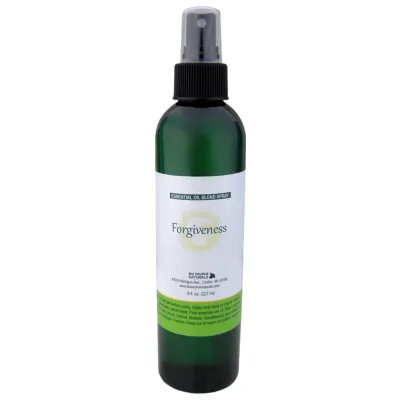
When I formulated Forgiveness Essential Oil Spray, I didn’t simply choose oils that smelled beautiful together. I wanted an aroma with different characteristics that could accompany a ritual centered on forgiveness, reflection and release.
The formula includes Melissa, Vetiver, Rosewood, Sage, Frankincense, Sandalwood, Rose, Lemon and Lavender essential oils.
Melissa and Lemon
Melissa and Lemon contribute bright, fresh aromatic notes.
Within a forgiveness ritual, I like these brighter aromas because the process isn’t only about looking backward. Eventually there may also be space for possibility, change and whatever comes next.
Lavender and Sandalwood
Lavender contributes its familiar soft floral-herbal aroma, while Sandalwood adds a warm, woody depth.
Together, these quieter aromatic notes fit naturally into moments when you want to slow down and turn inward.
Frankincense and Sage
Frankincense and Sage have long histories of use in spiritual, contemplative and ceremonial settings.
For me, they fit naturally into a blend intended to accompany intention, reflection and personal ritual.
Rose
Rose brings a rich floral and heart-centered character to the formula.
Forgiveness isn’t always about another person. Sometimes the person who needs our compassion is ourselves.
We may be trying to release guilt about something we did, regret over a decision, embarrassment about something that happened years ago or anger at ourselves for staying in a situation longer than we wish we had.
Vetiver
Vetiver has a deep, earthy aroma that gives the formula a grounding character.
That depth helps balance the brighter notes in the blend and makes it especially appropriate for quiet reflective practices.
Rosewood
Rosewood contributes a soft woody-floral note that helps bring the different aromatic elements together.
The result is not intended to make someone forgive.
Rather, the aroma can become a sensory anchor for the personal work surrounding forgiveness and release.
More Than Essential Oils in a Bottle
The essential oils are only one layer of Forgiveness Spray.
The formula also incorporates selected flower essences and gem elixirs, along with energetic preparation. Within holistic and vibrational wellness traditions, flower essences and gem elixirs are used with the intention of bringing greater awareness to emotional patterns, experiences, and issues that may be ready to be acknowledged and released. In my Layered Holistic Self-Care approach, they complement the aromatic ritual and practices such as EFT, journaling, meditation, and reflection.
I also wanted the experience to extend beyond the bottle itself. That’s why every purchase of Forgiveness Spray, Forgiveness Blend Concentrate, or Forgiveness Roll-On includes 13 digital self-care resources at no additional charge, featuring EFT tapping scripts, affirmations, meditative essays, and journal prompts created to help you explore forgiveness, release, and moving forward in your own way.
Think of the layers this way:
- Aroma creates the sensory anchor.
- Intention gives the ritual direction.
- Breathing creates a pause.
- EFT provides a structured way to explore what comes up.
- Affirmations help reinforce the intention you want to carry forward.
- Journal prompts give your thoughts somewhere to go.
- Meditative essays, meditation, prayer, or quiet reflection create space to look inward.
You don’t have to use every layer every time. Choose what you need in that moment.
A 5-Minute Forgiveness and Letting-Go Ritual
 You don’t need an elaborate ceremony to create a meaningful ritual.
Start with five minutes.
Find a quiet place where you are unlikely to be interrupted.
Mist Forgiveness Essential Oil Spray around your personal space according to the product directions and take a moment to notice the aroma.
Rather than immediately trying to change how you feel, simply notice.
Take several comfortable breaths.
Then ask yourself:
What am I still carrying that I would like to begin releasing?
Don’t force an answer. And don’t force forgiveness.
Perhaps a particular person comes to mind.
Maybe it’s a conversation.
Maybe you’re angry about something that happened yesterday.
Or maybe the answer is something you did years ago that you still haven’t forgiven yourself for.
Once you’ve identified what is present, choose another layer.
- Write about it.
- Use an EFT tapping script.
- Meditate.
- Pray.
- Sit quietly.
Or simply acknowledge:
This hurt me, and I am allowed to decide how much of it I continue carrying.
You might finish your ritual with an intention such as:
“I can honor what I experienced without carrying all of its weight forward with me.”
Then go on with your day.
You don’t have to resolve the entire experience during one ritual.
Come back when you’re ready for the next layer.
What If You Can’t Leave the Situation Yet?
Sometimes the hardest emotional work happens while the situation is still going on.
You may recognize that you’ve outgrown a job, relationship, friendship, living situation or family dynamic long before you’re able or ready to change it.
There may be financial considerations. Children or other family responsibilities may be involved. You may be caring for someone.
You may still love the person even though the relationship needs different boundaries.
Perhaps you’re waiting for the right time.
Or maybe you simply don’t know what you want to do yet.
This can create a strange emotional in-between. Physically, you’re still there. Internally, something has already changed.
You don’t necessarily have to wait for your external circumstances to change before beginning to care for yourself differently.
Create Small Areas of Agency
When you can’t change the entire situation, look for the pieces you can influence.
- Can you create a little more privacy?
- Can you take a walk?
- Can you spend time outdoors?
- Can you journal somewhere private?
- Can you reduce unnecessary conflict?
- Can you establish a small boundary?
- Can you talk with someone you trust?
- Can you create a morning or evening ritual that belongs entirely to you?
Small choices don’t solve large problems, but they can remind you that your circumstances don’t have to control every moment of your inner life.
For a deeper exploration of this experience, read:
→ Outgrowing an Environment When You Can’t Leave Yet
Try an End-of-Day Release Ritual
An evening ritual can be particularly useful when you’re still living inside a stressful situation.
Mist Forgiveness Spray into your personal space and allow the aroma to become a sensory marker between the events of the day and the evening ahead.
The blend intentionally contains both brighter aromatic notes such as Melissa and Lemon and deeper notes such as Vetiver, Sandalwood and Frankincense.
Sometimes a release ritual needs space for both.
Pause and ask:
What happened today that I’m still carrying?
- Was there a difficult interaction?
- A conversation you’re replaying?
- Something you wish you had said differently?
- Something another person said that you’re still thinking about?
Don’t tell yourself that you shouldn’t feel whatever you’re feeling.
Acknowledge it.
Journal about it, tap, meditate, pray or simply sit quietly for a few minutes.
Then consider ending with:
“I can keep what I learned without carrying this moment through the rest of my day.”
Tomorrow’s circumstances may not be different.
But you don’t necessarily have to mentally live inside them every minute between now and then.
When Letting Go Becomes Moving Forward
There may eventually come a different moment.
You realize you’re ready. Ready for a boundary. Ready for change. Ready to stop repeating a pattern. Ready to close a chapter.
Or simply ready to explore what life might look like if this situation no longer occupied so much emotional space.
We often imagine moving forward as one dramatic decision.
In reality, it can be a process.
There may be grief and relief. Fear and hope. Anger and compassion. Loneliness and excitement. Several apparently contradictory emotions can exist at the same time.
Moving forward doesn’t necessarily mean that you’ve stopped caring.
And it doesn’t mean you have completely healed from everything that happened.
It means you’re beginning to determine what comes next.
Free Resources for Making a Clean Break
If you’re at this stage, I’ve created additional resources to help you explore the process at your own pace.
Clean Break Series
The Clean Break Series explores why leaving can be difficult, recognizing patterns, preparing for change, navigating the break itself and beginning to establish new patterns afterward.
It isn’t designed to tell you whether you should stay or leave.
It’s designed to give you information and questions that can help you consider your own situation and your own next steps.
→ Explore the Clean Break Series
Clean Break Workbook
Sometimes reading about an experience isn’t enough.
Writing can help you slow your thoughts down and see patterns that are difficult to recognize when everything remains inside your head.
Use the Clean Break Workbook privately and at your own pace.
You don’t need to know what you’re going to do before you begin.
Emotional Healing with Essential Oils
For a broader exploration of emotional self-care, visit my cornerstone resource:
→ Emotional Healing with Essential Oils | Complete Guide
This guide looks at essential oils as one element within a larger emotional self-care practice and explores additional supportive approaches.
You Don’t Have to Do Every Layer
Layered Holistic Self-Care doesn’t mean creating an exhausting self-care checklist.
Quite the opposite.
Some days your ritual might be:
- Mist. Breathe. Continue with your day.
- Another day you may need twenty minutes of journaling.
- Another time you may use an EFT script.
- Sometimes you may want meditation, prayer, music or quiet reflection.
- And sometimes the healthiest choice is simply to rest.
The purpose of having multiple layers is not to do everything.
It’s to have choices.
What Are You Ready to Stop Carrying?
Perhaps forgiveness isn’t the right word for you today.
Use release.
Use acceptance.
Use peace.
Use moving forward.
Or don’t give the process a name at all.
Simply ask:
What am I ready to stop carrying?
You don’t need to deny what happened.
You don’t need to erase the past.
You don’t need to force yourself to feel differently before you’re ready.
You can begin with five quiet minutes.
- An aroma.
- A breath.
- A journal.
- A tapping script.
- A prayer.
- An intention.
- One small boundary.
- One different choice.
- And then another.
There is no prize for healing the fastest.
Sometimes growth looks dramatic.
Sometimes it means leaving.
Sometimes it means staying while something inside you changes.
And sometimes it is much quieter:
Realizing that something which once consumed your thoughts doesn’t have quite as much power over your day anymore.
That, too, is movement.
Essential oils and aromatherapy are intended for complementary wellness and personal self-care. They are not intended to diagnose, treat, cure or prevent disease or replace appropriate medical or mental health care. Energetic preparation, flower essences, gem elixirs, EFT, meditation and similar practices are offered as complementary personal-wellness practices.

🔍 Click Image to Enlarge and Read
You may contact her for private appointments through her practitioner website Holistic-Healing-Wellness.com