Pure Essential Oils - Massage Oils - BioSource Naturals

Pure Aromatherapy for Body, Mind & Spirit

Love Without Control: Learning to Stay Open Without Managing the Outcome

Love Without Control: Learning to Stay Open Without Managing the Outcome

Open birdcage, flying bird, and "Let Go" stone illustrating love without control, healthy boundaries, and emotional freedom.Learning to love without control can be one of the most difficult emotional shifts we make. This article explores how love and control become intertwined, why letting go of another person’s choices supports healthier relationships, and how boundaries, aromatherapy, EFT tapping, and somatic practices may help you remain compassionate without abandoning yourself.

Love without control means remaining open and compassionate without believing you must manage another person’s choices, emotions, or outcome.

There’s a version of love many of us were taught quietly and indirectly over time.

If you care, you help.

If you love, you fix.

If you’re committed, you stay involved.

For highly capable and emotionally aware women, that belief may gradually become:

👉 If I love you, I will try to make this better.

Better choices.

Better outcomes.

Better emotional responses.

This usually does not come from a desire to control someone. It comes from caring deeply and wanting to protect them from pain, disappointment, or consequences.

But loving someone does not give you control over their path.

Love without control means staying open and compassionate without taking responsibility for another person’s choices, emotions, or growth. It allows you to offer support without managing the outcome or abandoning yourself in the process.

đź’  Understanding Love Without Control

Love and control can become entangled when helping shifts into managing another person’s life. You may explain repeatedly, anticipate unspoken needs, prevent consequences, or work harder than the other person to create change.

Love without control does not mean becoming cold, detached, or indifferent. It means recognizing where your responsibility ends and another person’s begins.

You can remain caring and connected while allowing others to make their own choices. You can offer support without rescuing, set boundaries without withdrawing love, and step back without believing you have failed.

đź’  Where Love and Control Get Entangled

Control does not always look like dominance.

Sometimes it looks like:

  • over-explaining
  • over-helping
  • over-accommodating
  • anticipating needs before they are expressed
  • offering solutions before someone asks
  • trying to prevent every difficult consequence

These actions can feel like love.

Underneath them, however, there may be a quiet belief:

👉 If I stay involved enough, I can influence the outcome.

Sometimes your involvement may help.

But when helping becomes constant monitoring, persuading, reminding, or compensating, it can leave you carrying responsibilities that do not belong to you.

It may also prevent the other person from making choices, experiencing consequences, and developing confidence in their own abilities.

Before stepping in, pause and ask:

  • Was I asked to help?
  • Is this truly mine to manage?
  • Will my support encourage growth or replace it?
  • What will this choice cost me emotionally?

👉 Love can offer support without taking control.

đź’  The Moment You Realize You Cannot Control the Outcome

There may come a moment, often through someone you deeply love, when you recognize the limits of your influence.

You cannot:

  • make someone choose differently
  • regulate their emotions for them
  • accelerate their growth
  • protect them from every consequence
  • make them accept help they do not want
  • do their emotional work for them

This realization can feel helpless, frustrating, and even heartbreaking.

Your love is still there. Your desire for a better outcome may still be there too.

But effort, explanation, and involvement cannot create change for someone who is not ready or willing to choose it.

Accepting this does not mean you stop caring. It means you stop measuring your love by your ability to change another person.

You can offer information.

You can express concern.

You can make support available.

Then you can allow the other person to decide what they will do with it.

👉 Love can remain even when control is no longer possible.

đź’  What Love Without Control Actually Means

Love without control does not mean:

  • detaching emotionally
  • withdrawing care to punish someone
  • becoming indifferent
  • ignoring harmful behavior
  • remaining silent about your needs
  • accepting responsibilities that belong to someone else

It means staying connected without managing.

You allow:

  • people to have their own process
  • choices to carry their natural consequences
  • growth to happen at another person’s pace
  • space between your love and their decisions
  • yourself to have needs, limits, and boundaries

You may still offer help, but your help becomes a choice instead of an obligation.

You may still share your perspective, but you do not have to repeat, persuade, or pressure until the other person agrees.

You may still hope for a particular outcome, but your wellbeing no longer depends on making it happen.

Love without control asks:

Can I remain caring while allowing this person to be responsible for their own life?

Sometimes the answer includes staying close.

Sometimes it includes stepping back.

Both can be loving when they come from clarity rather than punishment.

👉 You can love someone without taking ownership of their path.

đź’  The Nervous System Shift

Love without control creates a different experience within the body.

Trying to control an outcome can keep you in a state of constant activation.

You may notice:

  • tension in your body
  • vigilance
  • repeated checking or monitoring
  • mentally rehearsing conversations
  • difficulty focusing on your own life
  • an urge to act before you have been asked

Your nervous system may have come to associate action with safety.

Doing something can feel more comfortable than waiting, allowing, or not knowing what will happen.

Love without control creates a different experience.

It invites:

  • space before responding
  • steadiness during uncertainty
  • awareness of your own needs
  • trust in another person’s ability to choose
  • acceptance of what you cannot change

At first, this may feel uncomfortable.

You are accustomed to helping, explaining, anticipating, or intervening. Now you are being asked to feel the uncertainty without immediately acting on it.

This does not mean suppressing your concern. It means noticing the urge to take over and giving yourself time to decide whether action is truly needed.

Pause.

Breathe.

Allow the first wave of urgency to pass.

Then ask:

Is this action coming from clarity, or from my need to control the outcome?

👉 You can feel concern without turning it into responsibility.

đź’  The Boundary That Changes Everything

Practicing love without control begins with one clear internal boundary:

👉 Their path is not mine to manage.

You can:

  • support
  • witness
  • listen
  • express concern
  • offer help when it is wanted

But you cannot carry another person’s emotional work, decisions, or responsibilities for them.

This boundary does not have to be announced as a threat or used to punish someone. It can begin quietly within you.

You may decide:

  • I will not repeatedly solve the same problem.
  • I will not take responsibility for emotions that are not mine.
  • I will not work harder for someone’s growth than they do.
  • I will not neglect my wellbeing to prevent their discomfort.
  • I will allow their choices to belong to them.

When you stop carrying what belongs to another person, you do not love less.

You create space for a more honest relationship.

The other person has room to choose, respond, and grow. You have room to remain connected to your own needs, values, and limits.

👉 A boundary does not remove love. It gives love a healthier place to stand.

đź’  The Grief Inside This Shift

There can be grief in releasing control.

You may be letting go of:

  • the outcome you imagined
  • the person you hoped they would become
  • the belief that your effort could change everything
  • your role as the one who makes things better
  • a relationship that depended on your over-functioning

Even when stepping back is healthy, it can still feel like loss.

You may wonder whether you are giving up too soon, being selfish, or failing someone you love.

These feelings do not necessarily mean your boundary is wrong. They may reflect how deeply your identity became connected to helping, protecting, or being needed.

You are also facing the reality that love cannot guarantee change.

That truth may be painful, but it can also be freeing.

You can grieve what you hoped for without returning to patterns that depleted you.

You can feel sadness without taking responsibility for fixing the situation.

You can love the person who is here while releasing the future you tried to create for them.

👉 Letting go of an imagined outcome is not the same as letting go of love.

đź’  This Is What Emotional Maturity Can Feel Like

Emotional maturity does not always feel confident or comfortable.

Sometimes it feels like pausing when you want to intervene.

It feels like listening without immediately offering a solution.

It feels like allowing someone to be disappointed, frustrated, or uncomfortable without rushing to remove the feeling.

It means being present without interfering.

You can speak honestly without trying to force agreement.

You can offer support without becoming responsible for whether it is accepted.

You can allow another person to make a choice you would not make while deciding how that choice affects your own boundaries.

This is not detachment.

It is not indifference.

It is the ability to remain grounded in yourself while allowing someone else to have their own experience.

You are no longer proving your love by how much you fix, prevent, or carry.

Your love becomes more honest because it no longer requires either person to abandon themselves.

👉 Love without control is presence, clarity, and respect for both people.

Explore More on Emotional Healing: This article is part of our comprehensive guide, Emotional Healing With Essential Oils: A Complete Guide to Nervous System Regulation, Emotional Release and Growth. Explore aromatherapy, EFT tapping, emotional processing, healthy boundaries, nervous system support and practical pathways toward healing and personal growth.

🌿 Aromatherapy Support for Releasing Control

Aromatherapy can create a calming pause when you notice the urge to fix, intervene, or manage an outcome that does not belong to you.

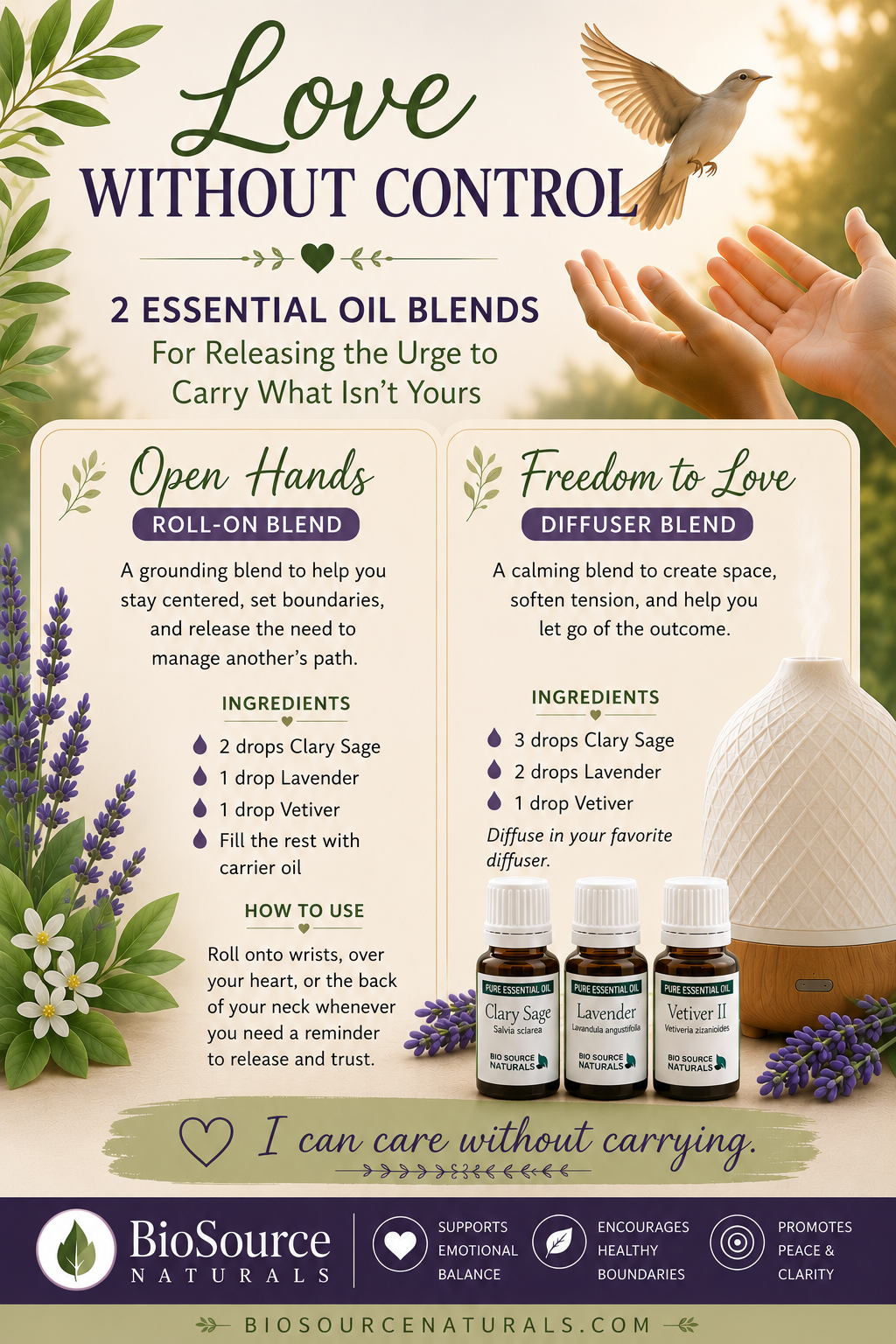
Love Without Control Pinterest recipe image featuring Open Hands Roll-On Blend and Freedom to Love Diffuser Blend with Clary Sage, Lavender, and Vetiver essential oils for healthy boundaries and emotional balance.

Click to Enlarge and Read

🥇 Open Hands Roll-On Blend

  • 2 drops Clary Sage Essential Oil
  • 1 drop Lavender Essential Oil
  • 1 drop Vetiver Essential Oil
  • Carrier oil

Add the essential oils to a 9 mL roll-on bottle. Fill the remainder with carrier oil, secure the roller top, and gently roll the bottle between your hands.

Apply to the wrists or other small areas of skin when you need a reminder to pause. Breathe naturally and repeat:

“I can care without carrying.”

🥇 Freedom to Love Diffuser Blend

  • 3 drops Clary Sage
  • 2 drops Lavender
  • 1 drop Vetiver

Add the oils to your diffuser according to its instructions. Begin with fewer drops in a small room or if you are sensitive to aromas.

For external use only. Dilute essential oils before applying them to the skin and perform a patch test before broader use. Consult a qualified healthcare professional before use if you are pregnant, nursing, taking medication, or managing a medical condition. Keep away from children and pets.

🌿 EFT Tapping Script: Letting Go of Control While Staying in Love

Setup: Karate Chop Point

Even though part of me feels responsible for how this turns out, and I have been trying to help, fix, or guide, I am open to a new way of loving.

Even though letting go of control feels difficult because I care so deeply, I honor my heart and allow myself to soften.

Even though I cannot manage another person’s choices, I can stay connected to myself and choose support with healthy boundaries.

Tapping Points

Eyebrow:
I care so much about this.

Side of Eye:
I want everything to be okay.

Under Eye:
I want them to make better choices.

Under Nose:
I want this to turn out well.

Chin:
And I have been trying to help.

Collarbone:
Trying to guide.

Under Arm:
Trying to influence the outcome.

Top of Head:
Because I love them.

Eyebrow:
But I cannot control their path.

Side of Eye:
I cannot make their choices for them.

Under Eye:
I cannot carry this for both of us.

Under Nose:
And that can be difficult to accept.

Chin:
There may be grief in letting go.

Collarbone:
There may be fear in stepping back.

Under Arm:
But there may also be relief.

Top of Head:
As I release what is not mine to carry.

Eyebrow:
I can still love.

Side of Eye:
Without controlling.

Under Eye:
I can still care.

Under Nose:
Without managing the outcome.

Chin:
I allow their path to belong to them.

Collarbone:
I choose to stay grounded in myself.

Under Arm:
I choose love without control.

Top of Head:
And that is enough.

🌿 Somatic Healing Practice: Releasing the Urge to Intervene

When you notice the impulse to fix, correct, or step in, pause before taking action.

1. Notice the Urge

Acknowledge what is happening without judging yourself.

You might say:

“I feel the urge to make this better.”

2. Locate It in Your Body

Notice where the urge appears physically. You may feel:

  • Tightness in your chest
  • Tension in your hands or jaw
  • A forward-leaning posture
  • Restlessness or an impulse to act immediately

3. Ground Yourself

Lean back slightly in your chair.

Place both feet firmly on the floor.

Notice the support beneath your body.

4. Slow Your Breathing

Inhale gently through your nose for a count of four.

Exhale slowly for a count of six to eight.

Repeat several times without forcing your breath.

5. Return to Your Boundary

Say internally:

“I can care without carrying.”

“Their path is not mine to manage.”

6. Allow the Urge to Pass

Stay with the sensations without immediately acting on them. Give yourself time to decide whether help was requested and whether responding would be supportive for both of you.

This practice may help create space between feeling responsible and taking responsibility for something that does not belong to you.

🌿 Affirmations for Loving Without Control

  • I release the need to manage what is not mine.
  • I can love deeply without controlling the outcome.
  • I can offer support without taking over.
  • I trust others to make their own choices.
  • I am responsible for my energy, actions, and boundaries.
  • I can remain compassionate without abandoning myself.
  • Stepping back does not mean I have stopped caring.
  • Love can flow more freely when I release control.
  • I can care without carrying.
  • I allow each person’s path to belong to them.

🌿 Journal Prompts for Releasing Control

  • Where do I feel responsible for outcomes that are not actually mine?
  • What am I afraid might happen if I stop intervening?
  • When did I begin believing that love means helping, fixing, or preventing discomfort?
  • Has the person asked for my help, or am I responding to my own discomfort?
  • Am I offering support, or am I taking over responsibility?
  • What would it feel like to remain present without immediately taking action?
  • Where might stepping back create room for someone else’s growth?
  • What boundary would allow me to care without abandoning myself?
  • What belongs to me in this situation, and what belongs to the other person?
  • How might love feel if I released the need to manage the outcome?

đź’  Love Without Control or Carrying

Love without control does not mean becoming distant or indifferent.

It means allowing another person to have their own choices, feelings, consequences, and path.

You can remain compassionate without becoming responsible for making everything better. You can offer support without taking over. You can stay open while remaining grounded in yourself.

Sometimes the most loving response is not another explanation, solution, or rescue.

Sometimes it is simply:

👉 “I care about you, and I trust you to carry what belongs to you.”

That is not abandonment.

It is love with clarity.

Love without control allows compassion and personal responsibility to exist together.

Healthy boundaries help create relationships that balance compassion with personal responsibility. Psychology Today offers additional insights into why boundaries are an important part of emotional well-being.

Explore the Complete Guide

Learning to let go of control is often part of a larger shift from carrying responsibility for others toward healthier, more balanced relationships. Explore our complete guide to how to stop overgiving and set healthy boundaries to understand how control, emotional responsibility, guilt, self-abandonment, and nervous system patterns can become connected.

From Overgiving to Emotional Freedom Workbook

Click to Enlarge

Get Your Free Companion Workbook

Enter your name and email below, and we'll send the From Overgiving to Emotional Freedom Companion Workbook (20 pgs.) directly to your inbox.


By submitting this form, you are consenting to receive marketing emails from BioSource Naturals. You can unsubscribe at any time using the SafeUnsubscribe® link found at the bottom of every email. Emails are serviced by Constant Contact.

From Overgiving to Alignment

This is part of a five-part series on moving from over-functioning to aligned support. Explore the full pathway below:

  1. When Love Breaks Perfectionism
  2. Love Without Control
  3. The Difference Between Support and Enabling
  4. When Helping Becomes Self-Abandonment
  5. The Guilt That Shows Up When You Choose Yourself

Disclaimer: The information provided in this article is for educational purposes only and is not intended to diagnose, treat, cure, or prevent any disease. Essential oils and wellness practices are not substitutes for medical or mental health care. Always dilute essential oils appropriately and consult a qualified healthcare professional before use if you are pregnant, nursing, taking medication, managing a medical condition, or using essential oils with children or pets. Individual responses may vary.

About the Author

Lezlie Cebulski, founder of BioSource Naturals, shares reflections on emotional healing, personal growth, boundaries, forgiveness, and emotional wellness.

🔍 Click Image to Enlarge and Read

Leave a Reply

Your email address will not be published. Required fields are marked *