
Pure Aromatherapy for Body, Mind & Spirit
When Helping Becomes Self-Abandonment
When Helping Becomes Self-Abandonment
 Helping others is often seen as a strength, but constantly putting everyone else’s needs ahead of your own can lead to emotional exhaustion and self-abandonment.
This article explores why over-helping becomes an automatic pattern for many people, how the nervous system can associate helping with safety and connection, and how aromatherapy, EFT tapping, somatic awareness, and healthy boundaries may help you reconnect with yourself while continuing to care for others. Recognizing self-abandonment is often the first step toward creating healthier relationships with yourself and the people you love.
The Hidden Cost of Always Being the One Who Shows Up
Sometimes the hardest person to stop leaving behind is yourself.
You’re reliable.
You’re generous.
You’re the one people can count on.
You anticipate needs.
You step in quickly.
You carry more than your share… without being asked.
And for a long time, this feels like who you are.
👉 The strong one
👉 The capable one
👉 The one who holds things together
💠 Where It Starts to Shift
At some point, something begins to feel different.
Not dramatically.
But quietly.
The helping that once felt meaningful begins to feel heavy.
You may notice:
- exhaustion that rest doesn’t fix
- resentment you don’t want to feel
- a sense that you’re giving more than you’re receiving
- less time and energy for yourself
And underneath it all…
👉 a subtle disconnection from yourself
You may realize you’ve become so focused on caring for everyone else that you’ve stopped asking what you need.
💠 What Self-Abandonment Actually Is
Self-abandonment rarely looks like neglect.
More often, it happens quietly through the small choices you make every day.
It can look like:
- overriding your own needs
- ignoring your internal signals
- saying yes when your body says no
- prioritizing others to maintain peace, connection, or your sense of identity
It is not that you don’t care about yourself.
It’s that you’ve learned to place your needs behind everyone else’s.
👉 You’ve learned to leave yourself to stay connected to others.
Over time, this pattern can become so familiar that you no longer notice you’re doing it. You may believe you’re simply being kind, dependable, or generous, while your own needs continue to move further down the list.
Self-abandonment doesn’t happen because you’re weak.
It often develops because caring for others once felt like the safest way to maintain love, belonging, or connection.
💠 Why Helping Becomes the Gateway
Helping others can feel deeply rewarding.
It creates:
- purpose
- connection
- validation
- a sense of identity
Helping itself isn’t the problem.
The shift happens when helping becomes something you do automatically instead of something you choose intentionally.
Over time, you may begin to:
- help before checking in with yourself
- offer before being asked
- give without noticing your limits
- feel responsible for solving problems that aren’t yours to carry
And eventually…
👉 helping becomes a reflex instead of a choice
When that happens, your own needs quietly move to the background, while everyone else’s become your priority.
💠 The Nervous System Pattern
For many people, this pattern begins long before adulthood.
You may have learned early in life that being helpful meant you were:
- safe
- valued
- accepted
- needed
Over time, your nervous system may begin to associate helping with connection and belonging.
It quietly learns:
👉 Connection comes through giving.
That’s why it can feel surprisingly difficult to:
- say no
- step back
- not respond immediately
- allow someone else to solve their own problems
Even when you know those choices are healthy, your body may interpret them as risky.
It can feel like you’re losing connection…
or even losing a part of who you’ve always believed yourself to be.
The good news is that patterns learned over time can also be gently reshaped. As you begin checking in with yourself before automatically helping, your nervous system can learn that caring for yourself and caring for others don’t have to be opposites.
You can read more in this related guide, How to Regulate Your Nervous System Naturally, where you can explore aromatherapy, EFT tapping, somatic practices, emotional wellness, and other supportive mind-body approaches.
💠 The Moment of Awareness
For many people, there comes a quiet moment of realization.
Not because someone points it out.
But because you finally stop long enough to notice.
👉 “I am showing up for everyone… but not for myself.”
That awareness can bring a mix of emotions.
For many people, this is the first time they recognize the pattern of self-abandonment that has quietly shaped their daily choices.
You may feel:
- grief for how often you’ve ignored your own needs
- anger over how much you’ve carried alone
- relief that you finally understand the pattern
- clarity about what needs to change
You begin to see how often you’ve:
- overridden your own needs
- stayed beyond your limits
- given from depletion instead of fullness
- confused self-sacrifice with love
Awareness isn’t the end of the journey.
It’s the beginning of making different choices.
💠 What Healthy Helping Actually Looks Like
Healthy helping doesn’t mean saying yes to everything.
It doesn’t mean carrying every burden or solving every problem.
Instead, healthy helping is:
- intentional
- resourced
- compassionate
- chosen
👉 Not automatic.
It begins by checking in with yourself before responding to someone else’s needs.
It includes:
- pausing before saying yes
- honoring your emotional and physical capacity
- allowing yourself time to respond instead of reacting immediately
- recognizing that someone else’s emergency doesn’t always have to become yours
And sometimes…
👉 the most loving choice is allowing someone else the opportunity to grow, even if that means choosing not to help.
Helping from a place of fullness allows you to give with greater presence, honesty, and compassion, without sacrificing your own well-being in the process.
Healthy helping allows you to support others without falling back into patterns of self-abandonment.
💠 The Boundary That Changes Everything
Real change begins with one simple, powerful shift:
👉 I do not leave myself to stay connected to others.
This doesn’t mean becoming less caring.
It doesn’t mean closing your heart.
It means staying connected to yourself while choosing how, when, and if you offer your support.
You can still:
- love
- encourage
- support
- care deeply
But not at the cost of:
- your energy
- your peace
- your boundaries
- your alignment
Healthy boundaries don’t separate you from the people you love.
They help you stay connected to yourself while building relationships based on honesty, mutual respect, and choice instead of obligation.
Healthy boundaries can strengthen relationships while protecting your emotional well-being. For additional insights into why boundaries are an important part of healthy relationships, explore Psychology Today’s guide to boundaries:
💠 What You Gain
As you begin staying connected to yourself, something starts to shift.
Not all at once.
But one choice at a time.
You may notice:
- your energy becomes more stable
- your relationships feel more honest and balanced
- your support comes from intention rather than obligation
- your nervous system begins to feel calmer and more settled
You no longer feel responsible for carrying what belongs to everyone else.
Instead, you learn to give from a place of choice, compassion, and genuine capacity.
And perhaps the greatest gift of all…
👉 you become someone you no longer have to leave.
Helping doesn’t disappear.
As you heal from self-abandonment, helping becomes a conscious choice instead of an automatic response.
It simply becomes healthier.
Because when you remain connected to yourself, the care you offer others becomes more sustainable, authentic, and freely given.
🌿 Aromatherapy Support for Returning to Yourself
Aromatherapy can create a calming pause when you notice the urge to overextend yourself, ignore your own needs, or say yes before checking in with yourself. While essential oils cannot change long-standing patterns on their own, they may support moments of reflection, grounding, and intentional self-care as you practice healthier boundaries.
- Helichrysum Essential Oil may encourage emotional renewal and support moments of self-reflection as you release old patterns.
- Patchouli Essential Oil has a rich, grounding aroma that may help you feel more present and connected to yourself.
- Petitgrain Essential Oil offers a fresh, calming scent that may promote emotional balance during times of stress or over-responsibility.
Remember: Aromatherapy is most effective when combined with mindful practices such as healthy boundaries, somatic awareness, and emotional self-care.
Click to Enlarge and Read
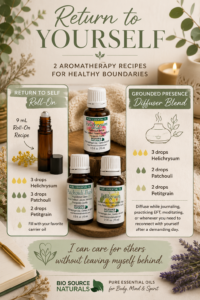
🌿 Return to Self Roll-On
9 mL Roll-On Recipe
- 3 drops Helichrysum Essential Oil
- 3 drops Patchouli Essential Oil
- 2 drops Petitgrain Essential Oil
- Fill with your favorite carrier oil
How to Use: Apply to your pulse points before responding to requests, setting boundaries, or anytime you need a reminder to pause, breathe, and check in with yourself before saying yes.
🌿 Grounded Presence Diffuser Blend
Recipe:
- 3 drops Helichrysum Essential Oil
- 2 drops Patchouli Essential Oil
- 2 drops Petitgrain Essential Oil
Diffuse while journaling, practicing EFT, meditating, or whenever you need to reconnect with yourself after a demanding day.
🌿 EFT Tapping Script
Returning to Myself
I think this script is already very strong. I would only make a few refinements so it flows more naturally and reinforces the blog’s central message of choosing yourself without giving up your compassion.
Setup (Karate Chop)
Even though I’ve been showing up for everyone else,
sometimes at the expense of myself,
I honor how this pattern has served me,
and I’m open to creating a healthier way.
Even though helping has become automatic,
I appreciate the part of me that wanted to care for others,
and I choose to reconnect with myself.
Even though I’ve believed I had to earn love through giving,
I now allow myself to receive the same care I so freely offer others.
Eyebrow
I’m always the one who helps.
Side of Eye
I show up no matter what.
Under Eye
Even when I’m tired.
Under Nose
Even when I don’t have the capacity.
Chin
I keep pushing through.
Collarbone
I leave myself behind.
Under Arm
Because I don’t want to disappoint anyone.
Top of Head
Helping has become automatic.
Eyebrow
But something inside me is asking for change.
Side of Eye
I’m learning to pause before saying yes.
Under Eye
I’m listening to my own needs.
Under Nose
I don’t have to carry everything alone.
Chin
I can care without abandoning myself.
Collarbone
I can honor my limits with compassion.
Under Arm
My needs matter, too.
Top of Head
I can stay connected to myself while caring for others.
Eyebrow
Every healthy boundary strengthens my relationship with myself.
Side of Eye
I can choose how I give.
Under Eye
I can help from a place of fullness.
Under Nose
I trust myself to know my limits.
Chin
I release the need to earn my worth through over-giving.
Collarbone
I welcome balance, peace, and self-respect.
Under Arm
I return to myself with kindness.
Top of Head
I am worthy of the same care I freely give to others.
🌿Somatic Healing Practice
Click to Enlarge and Read
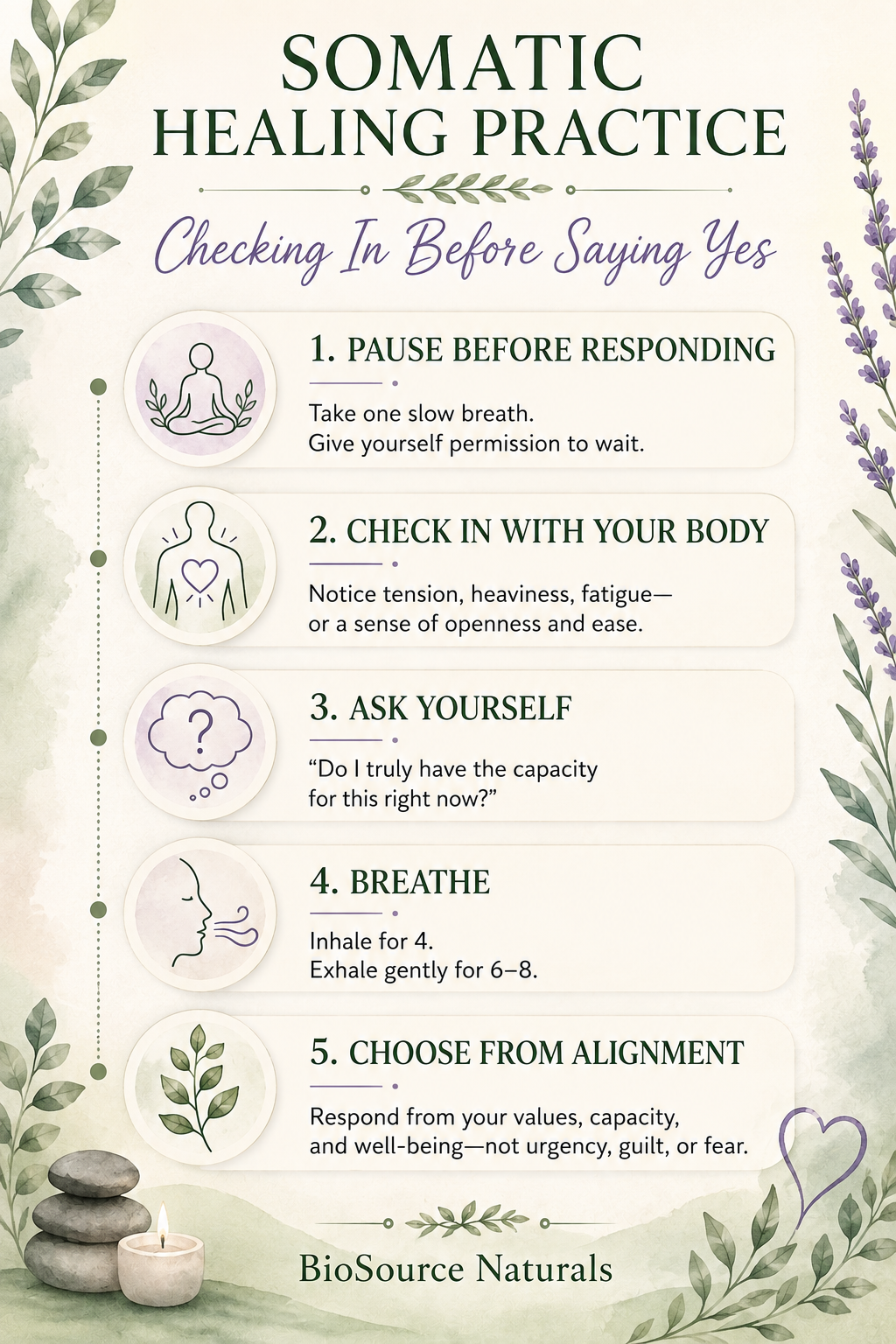
Checking In Before Saying Yes
When someone asks for your time, energy, or support, practice creating a small pause before responding. This brief moment helps you shift from reacting automatically to responding with intention.
1. Pause Before Responding
Instead of answering immediately, take one slow breath.
Give yourself permission to wait before saying yes.
2. Check In With Your Body
Notice what you’re feeling without trying to change it.
Do you sense:
- tightness in your chest or shoulders?
- heaviness or fatigue?
- tension in your stomach?
- a feeling of openness or ease?
Your body often recognizes your limits before your mind does.
3. Ask Yourself
Quietly ask:
“Do I truly have the capacity for this right now?”
You might also ask:
“Am I saying yes from love… or from obligation?”
4. Breathe
Inhale slowly for a count of 4.
Exhale gently for a count of 6 to 8.
Allow your shoulders to soften and your body to settle before making a decision.
5. Choose From Alignment
Respond from your values, your capacity, and your well-being, rather than from urgency, guilt, or fear of disappointing someone else.
Remember:
👉 A thoughtful pause is not selfish. It’s an act of self-respect.
🌿 Affirmations
- I stay connected to myself in every situation.
- I help from fullness, not from depletion.
- I honor my limits with kindness and without guilt.
- My needs are just as important as the needs of others.
- I can care deeply without abandoning myself.
- I choose my responses with intention instead of obligation.
- Healthy boundaries allow my relationships to grow stronger.
- I am worthy of the same compassion I freely offer others.
- Every time I honor myself, I strengthen my inner peace.
- I return to myself with every mindful choice.
🌿 Journal Prompts
- When do I most often override my own needs to take care of someone else?
- What emotions arise when I consider saying no or asking for more time before responding?
- When did I first begin believing that being helpful made me more worthy, loved, or accepted?
- How does my body let me know when I’ve reached my limit, and do I listen to those signals?
- What would change if I checked in with myself before every yes?
- What does helping from a place of fullness look and feel like for me?
- Where in my life could one healthy boundary create more peace?
- How can I care for others without leaving myself behind?
Continue Exploring Emotional Healing: This article is part of our comprehensive guide, Emotional Healing With Essential Oils: A Complete Guide to Nervous System Regulation, Emotional Release and Growth. Explore aromatherapy, EFT tapping, emotional processing, healthy boundaries, nervous system support and practical pathways toward healing and personal growth.
Explore the Complete Guide
When caring for others repeatedly comes at the expense of your own needs, helping can gradually become self-abandonment. Explore our complete guide to how to stop overgiving and set healthy boundaries to understand how self-sacrifice, guilt, emotional responsibility, nervous system patterns, and boundaries are connected.

Click to Enlarge
Get Your Free Companion Workbook
Enter your name and email below, and we'll send the From Overgiving to Emotional Freedom Companion Workbook (20 pgs.) directly to your inbox.
By submitting this form, you are consenting to receive marketing emails from BioSource Naturals. You can unsubscribe at any time using the SafeUnsubscribe® link found at the bottom of every email. Emails are serviced by Constant Contact.
From Overgiving to Alignment
This is part of a five-part series on moving from over-functioning to aligned support. Explore the full pathway below:
- When Love Breaks Perfectionism
- Love Without Control
- The Difference Between Support and Enabling
- When Helping Becomes Self-Abandonment
- The Guilt That Shows Up When You Choose Yourself
FDA Disclaimer: The information in this article is for educational purposes only and is not intended to diagnose, treat, cure, or prevent any disease. Essential oils support overall wellness but are not a substitute for medical care. If you have a medical condition, are pregnant or nursing, or take medications, consult your healthcare provider before using essential oils.