
Pure Aromatherapy for Body, Mind & Spirit
The Difference Between Support and Enabling
The Difference Between Support and Enabling
 Many caring people struggle to understand the difference between support and enabling. While healthy support encourages growth, responsibility, and resilience, enabling often removes natural consequences and keeps unhealthy cycles in place. This article explores the difference between support and enabling, why caring people can fall into over-helping, and practical ways to create healthier boundaries through aromatherapy, EFT tapping, somatic awareness, and self-reflection.
The Difference Between Support and Enabling
Why Helping Isn’t Always Helpful, and How to Know the Difference
There’s a quiet confusion that happens in caring, capable people.
You want to help.
You want to support.
You want to be there.
Most of your life, that’s worked.
But then you encounter situations where, no matter how much you give, explain, or show up…
👉 Nothing actually improves.
That’s when the question begins:
Am I supporting… or am I enabling?
💠 Why Support and Enabling Is So Hard to See
Enabling rarely feels harmful.
Instead, it often feels like:
- kindness
- patience
- loyalty
- love
This is especially true for people who are:
- intuitive
- responsible
- emotionally aware
You can sense what someone needs.
So you naturally step in to help.
The challenge is that repeated helping can quietly shift into taking responsibility for something that doesn’t belong to you.
Sometimes what feels like compassion may actually prevent another person from experiencing the growth that comes from facing their own challenges.
💠 The Difference Between Support and Enabling
Here’s the simplest way to understand it:
👉Support helps someone move forward.
👉 Enabling removes the need for them to move forward.
Support says:
“I’m here while you do this.”
Enabling says:
“I’ll do this so you don’t have to.”
At first, the difference can seem subtle.
Both come from a desire to help.
The difference is that healthy support encourages responsibility and growth, while enabling unintentionally keeps someone dependent on your help.
💠 What Support Looks Like
Healthy support may include:
- Encouraging responsibility
- Allowing natural consequences
- Offering guidance without taking over
- Holding healthy boundaries while staying connected
Support respects:
👉 The other person’s ability to learn, grow, and solve problems in their own way.
💠 What Enabling Looks Like
Enabling often looks like:
- Repeating the same help without seeing meaningful change
- Over-functioning for someone else
- Preventing discomfort or natural consequences
- Carrying emotional or practical responsibilities that aren’t yours
Over time, enabling can unintentionally communicate:
👉 “You don’t have to change. I’ll adjust instead.”
💠 The Nervous System Pattern Behind Enabling
Enabling is rarely just about the other person.
It’s often connected to your own nervous system.
Watching someone struggle can feel:
- uncomfortable
- activating
- even distressing
Stepping in may become a way to regulate your own discomfort, not just solve their problem.
Without realizing it, helping can become an automatic response to relieve the tension you feel inside.
Recognizing this pattern isn’t about judging yourself.
It’s about understanding that caring for someone doesn’t always mean carrying what belongs to them.
Developing resilience can make it easier to navigate the discomfort that often comes with creating healthier boundaries. The American Psychological Association provides additional information about building resilience and adapting to life’s challenges.
Explore More on Emotional Healing: This article is part of our comprehensive guide, Emotional Healing With Essential Oils: A Complete Guide to Nervous System Regulation, Emotional Release and Growth. Explore aromatherapy, EFT tapping, emotional processing, healthy boundaries, nervous system support and practical pathways toward healing and personal growth.
💠 The Honest Question
This is the question that changes everything:
👉 If I step back… what happens?
If the answer is:
“They might struggle, learn, and grow.”
That’s support.
If the answer is:
“Everything falls apart unless I hold it together.”
That may be a sign you’re over-functioning instead of supporting.
Sometimes the most compassionate choice is allowing another person the opportunity to face challenges, discover their own strengths, and take responsibility for what belongs to them.
💠 The Boundary That Defines Support
Support has a boundary.
Enabling does not.
👉Support says: “I care about you, and this part is yours.”
👉 Enabling says: “I care about you, so I’ll take this on.”
Healthy boundaries aren’t about caring less.
They’re about recognizing where your responsibility ends and another person’s begins.
When you allow others to carry what belongs to them, you give them the opportunity to develop confidence, resilience, and personal responsibility.
💠 The Discomfort of Shifting
When you move from enabling to healthy support, you may feel:
- guilt
- anxiety
- the urge to step back in
- fear of being seen as uncaring
These feelings don’t mean you’re doing something wrong.
They often mean your nervous system is adjusting to a healthier role and learning a new way to respond.
Change can feel uncomfortable at first, but discomfort doesn’t always mean you’re making the wrong choice.
💠 What Changes When You Stop Enabling
As you begin supporting instead of rescuing, meaningful changes often follow.
- You regain energy.
- Relationships become more honest.
- Others are given the opportunity to grow.
- You stop carrying what was never yours.
Most importantly:
👉 Your care becomes intentional, healthy, and rooted in compassion rather than over-functioning.
🌿 Aromatherapy Support for Healthy Boundaries and Discernment
When you’re trying to shift from enabling to healthy support, you may notice feelings of guilt, anxiety, or the urge to step back in and fix things. Aromatherapy can create a calming pause, helping you respond thoughtfully instead of reacting automatically.
The following essential oils are traditionally used in aromatherapy to encourage emotional clarity, healthy boundaries, and a greater sense of balance during challenging relationships.
- 🌿 Sweet Basil Essential Oil – Sweet Basil is commonly used in aromatherapy to promote mental clarity and focused decision-making. Its fresh, herbaceous aroma may help you step back from emotional confusion and respond with greater confidence and discernment.
- 🌿 Cypress Essential Oil – Cypress is traditionally associated with healthy transitions, emotional steadiness, and letting go. Its clean, woody aroma may support a greater sense of inner stability when you’re learning to release responsibilities that don’t belong to you.
- 🌿 Geranium Essential Oil – Geranium is commonly used to promote emotional balance and self-nurturing. Its floral aroma may help ease feelings of guilt or over-giving while encouraging compassion that includes caring for yourself as well as others.
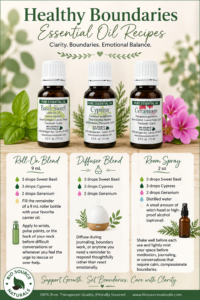
Click to Enlarge and Read
🌿 Healthy Boundaries Roll-On Blend (9 mL)
Ingredients
- 3 drops Sweet Basil Essential Oil
- 3 drops Cypress Essential Oil
- 2 drops Geranium Essential Oil
- Fill the remainder of a 9 mL roller bottle with your favorite carrier oil.
How to Use: Apply to your wrists, pulse points, or the back of your neck before difficult conversations or whenever you feel the urge to rescue, over-help, or take on responsibilities that aren’t yours.
🌿 Healthy Boundaries Diffuser Blend
- 3 drops Sweet Basil Essential Oil
- 3 drops Cypress Essential Oil
- 2 drops Geranium Essential Oil
How to Use: Diffuse during journaling, boundary work, or anytime you need a reminder to respond thoughtfully rather than react emotionally.
🌿 Healthy Boundaries Room Spray (2 oz)
Ingredients
- 3 drops Sweet Basil Essential Oil
- 3 drops Cypress Essential Oil
- 2 drops Geranium Essential Oil
- Distilled water
- A small amount of witch hazel or high-proof alcohol to help disperse the oils (optional)
How to Use: Shake well before each use and lightly mist your personal space before meditation, journaling, or conversations that require calm, compassionate boundaries.
🌿 EFT Tapping Script
Releasing the Pattern of Enabling
Setup (Karate Chop)
Even though I care deeply and want to help, and it’s hard for me to watch someone struggle, I’m open to supporting in a healthier way.
Even though part of me feels responsible for holding things together, I honor my caring heart and allow myself to release what isn’t mine to carry.
Tapping Points
Eyebrow
I care so much about this person.
Side of Eye
I don’t want them to struggle.
Under Eye
I don’t want things to fall apart.
Under Nose
So I step in.
Chin
I help.
Collarbone
I carry.
Under Arm
I take on more than my share.
Top of Head
Because it feels easier than watching.
Eyebrow
But this pattern is exhausting.
Side of Eye
And it’s not creating lasting change.
Under Eye
I’m doing too much.
Under Nose
And they’re doing too little.
Chin
I can feel the truth of that.
Collarbone
Even if it’s uncomfortable.
Under Arm
I don’t have to fix this.
Top of Head
I don’t have to carry this.
Eyebrow
I can support…
Side of Eye
Without enabling.
Under Eye
I can care…
Under Nose
Without over-functioning.
Chin
I release what isn’t mine to carry.
Collarbone
I allow others to take responsibility for their own growth.
Under Arm
I trust the process of growth.
Top of Head
For them… and for me.
🌿 Somatic Healing Practice
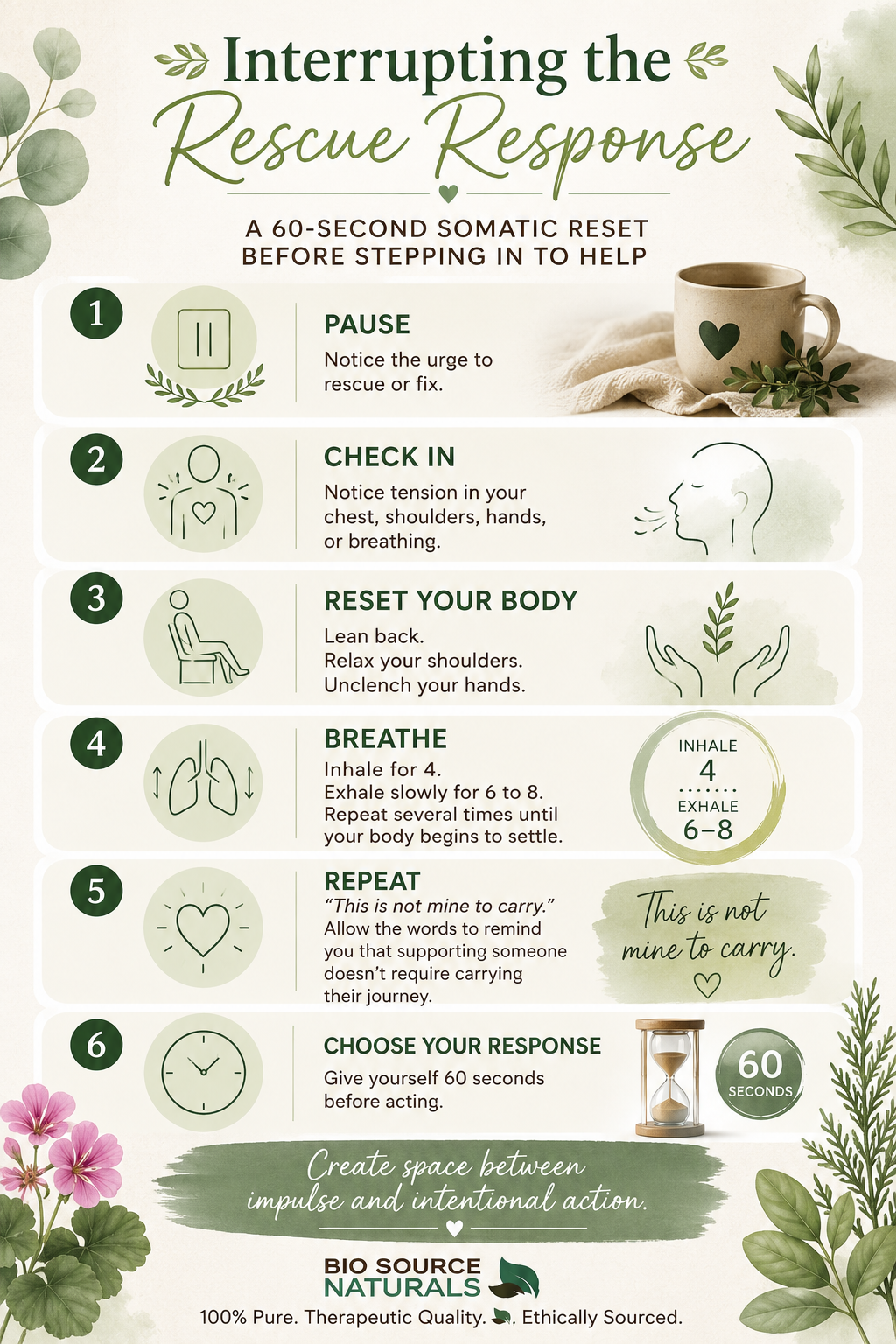
Click to Enlarge and Read
Interrupting the Rescue Response
When you notice the urge to step in, fix, or rescue someone, try this simple practice to create space between your automatic reaction and a more intentional response.
1. Notice the Activation
When you feel the urge to step in…
Pause.
Simply notice what’s happening without judging yourself.
2. Bring Awareness to Your Body
Notice any physical signs of tension, such as:
- leaning forward
- a tight chest
- urgency in your hands or voice
3. Reset Your Body
- Lean back.
- Drop your shoulders.
- Unclench your hands.
Allow your body to soften before deciding what to do next.
4. Slow Your Breath
Inhale for a count of 4.
Exhale slowly for a count of 6 to 8.
Repeat several times until your body begins to settle.
5. Repeat This Phrase
“This is not mine to carry.”
Allow the words to remind you that supporting someone doesn’t require taking responsibility for their journey.
6. Wait Before Acting
Give yourself 60 seconds before responding.
That brief pause creates space between:
👉 impulse and intentional action
🌿 Affirmations
Repeat these affirmations during meditation, journaling, or whenever you need a reminder that healthy support includes healthy boundaries.
- I support growth without taking over.
- I release the need to fix what is not mine.
- I allow others to experience their own process.
- My care does not require over-functioning.
- Healthy support includes clear boundaries.
🌿 Journal Prompts
Take a few quiet moments to reflect on these questions. Notice what thoughts or emotions arise without judging yourself.
- Where in my life am I doing more than my share?
- What am I afraid will happen if I stop helping?
- How do I feel when I don’t step in immediately?
- What would healthy support look like instead of rescue?
- Where did I learn that love means taking responsibility for others?
🌿 Final Reflection
Learning the difference between support and enabling is a journey, not a single decision.
Choosing healthy support doesn’t mean you care less. It means you’re learning to care in a way that encourages growth, respects healthy boundaries, and honors both your well-being and the well-being of the people you love.
As you practice stepping back instead of taking over, you may discover that real support isn’t about carrying someone else’s burdens. It’s about believing in their ability to grow while trusting yourself to let go of what was never yours to carry.
Explore the Complete Guide
Knowing when to help and when to step back can be especially difficult for people who are used to carrying more than their share. Explore our complete guide to how to stop overgiving and set healthy boundaries to see how rescuing, emotional responsibility, guilt, self-abandonment, and nervous system patterns can keep overgiving in place.

Click to Enlarge
Get Your Free Companion Workbook
Enter your name and email below, and we'll send the From Overgiving to Emotional Freedom Companion Workbook (20 pgs.) directly to your inbox.
By submitting this form, you are consenting to receive marketing emails from BioSource Naturals. You can unsubscribe at any time using the SafeUnsubscribe® link found at the bottom of every email. Emails are serviced by Constant Contact.
From Overgiving to Alignment
This is part of a five-part series on moving from over-functioning to aligned support. Explore the full pathway below:
- When Love Breaks Perfectionism
- Love Without Control
- The Difference Between Support and Enabling
- When Helping Becomes Self-Abandonment
- The Guilt That Shows Up When You Choose Yourself
FDA Disclaimer: These statements have not been evaluated by the Food and Drug Administration. The products and information discussed are not intended to diagnose, treat, cure, or prevent any disease. Essential oils, EFT tapping, somatic practices, affirmations, and journaling are intended to support emotional well-being and complement a healthy lifestyle. If you have a medical condition, are pregnant or nursing, or are taking medication, consult your healthcare provider before using essential oils.
About the Author

🔍 Click Image to Enlarge and Read