
Pure Aromatherapy for Body, Mind & Spirit
Essential Oils for Anti-Aging Skin Care – A Guide for Mature-Looking Skin
Essential Oils for Anti-Aging Skin Care – A Guide for Mature-Looking Skin
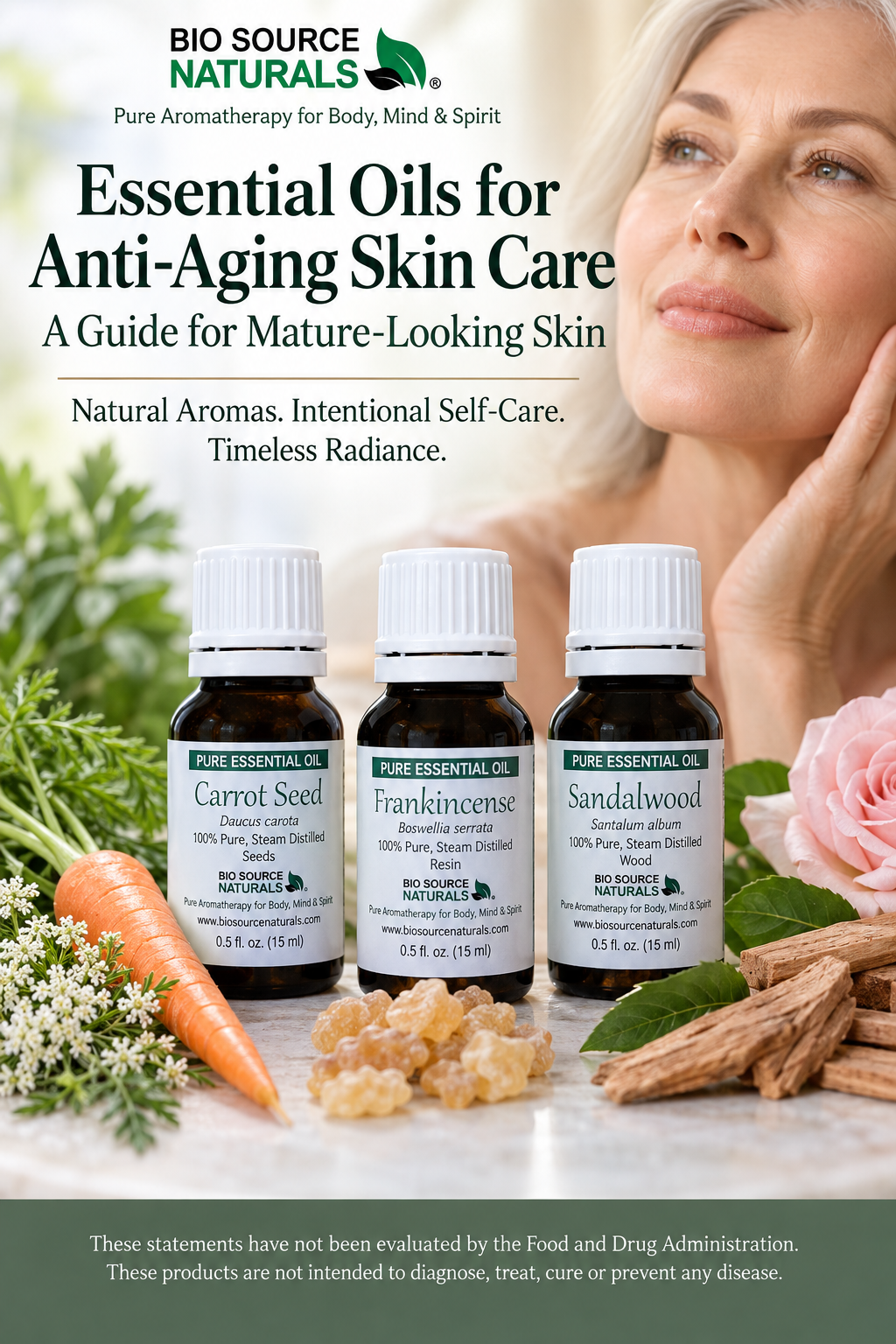 Essential oils for anti-aging skin care can add beautiful natural aromas to facial oils and transform an ordinary moisturizing routine into an intentional self-care ritual. When properly diluted, essential oils such as Rose, Frankincense, Carrot Seed, Patchouli and Sandalwood can complement carrier oils chosen to condition dry, mature-looking skin.
However, essential oils cannot stop the natural aging process, eliminate wrinkles, stimulate new skin cells or rebuild collagen. Their primary role in a facial oil is to provide aroma and enhance the sensory experience of the finished formulation. The carrier oils and the complete skin-care routine are responsible for most of the moisturizing and skin-conditioning effects.
Shop the essential oils and aromatherapy products mentioned in this article at the bottom of the page.
What Happens to Skin as It Ages?
As skin matures, it commonly becomes thinner and drier. Fine lines, changes in texture and a gradual loss of facial fullness may become more noticeable.
Genetics influence how skin ages, but environmental and lifestyle factors also matter. Sun exposure plays a significant role in premature skin aging.
According to the American Academy of Dermatology, sunscreen and moisturizer are two of the most effective over-the-counter products for supporting mature-looking skin. A facial oil can help condition the skin and reduce a dry, rough feeling, but it should complement not replace daily broad-spectrum sun protection.
Carrier Oils Versus Essential Oils
Rosehip seed oil and Argan oil are frequently discussed alongside essential oils, but they are actually carrier oils.
Carrier oils form the base of a facial formulation and dilute the much more concentrated essential oils.
Carrier oils:
- Are pressed or extracted from seeds, nuts or kernels
- Form most of a facial-oil formulation
- Provide emollience and skin-conditioning benefits
- Help dilute essential oils to a skin-appropriate concentration
- May have their own natural color and aroma
Essential oils:
- Are highly concentrated aromatic botanical materials
- Are generally used in very small amounts
- Contribute aroma to the finished formulation
- Require individual safety and dermal-limit evaluation
- Should not ordinarily be applied undiluted to the face
Understanding this distinction makes it much easier to create a safer facial oil.
Carrier Oils for Mature-Looking Skin
Rosehip Seed Oil
Rosehip seed oil is a lightweight botanical carrier oil containing naturally occurring fatty acids. It is popular in facial products formulated for dry, mature-looking or sun-exposed skin.
Rosehip seed oil can contribute a rich color to a formulation and is more vulnerable to oxidation than some other carrier oils. Purchase it in a size you can use while fresh and store it according to the supplier’s instructions.
Rosehip seed carrier oil is different from Rose essential oil.
Argan Oil
Argan oil is a conditioning carrier oil commonly used in facial, hair and body products.
Its smooth texture works well alone or blended with Rosehip seed oil, Jojoba or another carrier. Argan oil helps soften and condition the skin but should not be presented as healing scars or permanently removing wrinkles.
Other Carrier Oils to Consider
Additional carrier oils for facial formulations include:
A richer carrier is not automatically better. Choose according to your skin, the texture you prefer and how the oil feels beneath your other skin-care products.
Learn more in our complete guide to carrier oils.
Essential Oils for Anti-Aging Skin Care Formulations
The following essential oils are popular in aromatic products created for mature-looking skin. Their inclusion should be based on aroma, individual safety and compatibility with the complete formulation—not promises of structural skin changes.
Rose Essential Oil
Rose has a rich, complex floral aroma associated with luxurious facial oils, body oils and natural perfumes.
Rose contributes aroma and an elegant sensory quality to a facial formulation. It should not be described as increasing skin elasticity or physically tightening the skin.
Rose essential oil and Rose absolute are different aromatic materials, so check the product description to understand which one you are using.
Myrrh Essential Oil
Myrrh has a warm, earthy and resinous aroma. It is traditionally incorporated into mature-skin cosmetic formulations and blends beautifully with Frankincense, Rose, Sandalwood and Patchouli.
Myrrh may add depth to an aromatic facial oil, but it should not be presented as detoxifying the skin, repairing tissue or treating a skin condition.
Carrot Seed Essential Oil
Carrot Seed essential oil has a distinctive earthy, dry and slightly woody aroma.
Because its scent can easily dominate a blend, begin with a very small amount. It is frequently incorporated into facial and body formulations intended for mature-looking skin, but it should not be described as regenerating skin, stimulating circulation or increasing elasticity.
Carrot Seed essential oil is not the same ingredient as carrot-infused carrier oil.
Frankincense Essential Oil
Frankincense contributes a warm, resinous aroma to facial oils, natural perfumes and grounding aromatic blends.
Its soft, complex scent pairs especially well with Rose, Myrrh, Sandalwood and citrus oils. Frankincense can enhance the aromatic experience of a facial formulation, but it should not be described as causing new skin-cell growth.
Patchouli Essential Oil
Patchouli has a deep, earthy aroma that becomes smoother as the oil ages.
Only a very small amount may be needed in a facial blend. Patchouli combines well with Rose, Sandalwood, Frankincense and Geranium.
It adds aromatic depth but should not be promoted as creating new skin cells or treating redness and inflammation.
Sandalwood Essential Oil
Sandalwood has a warm, soft woody aroma that works beautifully in facial oils, natural perfumes and meditative self-care products.
Sandalwood provides a lingering base note and helps round out stronger floral or resinous aromas. Because genuine Sandalwood is a precious botanical material, only a small amount is necessary.
Create Your Own Signature Facial Oil
Making a facial oil allows you to customize the carrier oils, texture and aroma according to your preferences.
For everyday facial products, a conservative essential-oil concentration is appropriate. Approximately 0.5% to 1% is a useful general range for many adult facial formulations, provided each selected essential oil is suitable at that concentration.
Six drops of essential oil in one fluid ounce of carrier oil is approximately a 1% dilution. Because drop size varies, weighing ingredients is more accurate when preparing products for sale.
Mature-Looking Skin Facial Oil Recipe
Ingredients
- 1 tablespoon Rosehip seed oil
- 1 tablespoon Argan oil
- 2 drops Frankincense essential oil
- 1 drop Rose essential oil
- 1 drop Carrot Seed essential oil
- 1 drop Sandalwood essential oil
- 1 fl. oz. (30 ml) dark glass bottle
This recipe contains approximately five drops of essential oil per fluid ounce, creating a dilution slightly below 1%.
Directions
- Add the Rosehip seed and Argan carrier oils to a clean, completely dry glass bottle.
- Add the Frankincense, Rose, Carrot Seed and Sandalwood essential oils.
- Close the bottle and roll it gently between your hands to combine the ingredients.
- Label the bottle with the ingredients and date.
- Store it tightly closed away from direct sunlight, excessive heat and moisture.
How to Use
After cleansing, place one or two drops in your palm and gently press the oil onto slightly damp skin. Avoid the eyelids and immediate eye area.
Begin by using the facial oil once daily or several evenings per week. Using more product or applying it more frequently does not guarantee better results.
Allow the oil time to absorb before applying other products.
Customize the Facial-Oil Recipe
You do not need to use every essential oil listed in this article. A simple formula is often easier to evaluate and may be preferable for sensitive skin.
Possible adjustments include:
- Replace part of the Rosehip seed oil with Jojoba for a more oxidation-resistant blend.
- Use only Frankincense and Rose for a simpler aromatic profile.
- Omit essential oils completely if your skin is highly sensitive to fragrance.
- Reduce the essential-oil concentration to approximately 0.5%.
- Prepare a smaller batch if you do not use facial oil frequently.
Always research a replacement essential oil before adding it to a facial formulation.
Natural Does Not Mean Preservative-Free or Risk-Free
It is inaccurate to suggest that all synthetic cosmetic ingredients or preservatives are harmful.
Preservatives play an important safety role in products containing water. A facial cream, lotion or serum containing water can support microbial growth if it is not properly preserved.
The recipe above is water-free, so it does not generally require the same broad-spectrum preservation system as a water-containing cream. However, it can still oxidize, become contaminated or deteriorate over time.
Do not add water, hydrosols, aloe juice or other aqueous ingredients to this facial oil unless you understand emulsification and preservation.
Essential-Oil Safety for Facial Products
Essential oils are highly concentrated and facial skin can be especially sensitive.
Before using essential oils for anti-aging skin care:
- Dilute essential oils appropriately.
- Research each oil’s dermal limits.
- Avoid the eyes and mucous membranes.
- Patch test the properly diluted finished product when appropriate.
- Introduce one new product at a time.
- Stop using a product that causes persistent stinging, burning, redness or itching.
- Use additional caution during pregnancy or when managing a medical condition.
- Keep essential oils away from children and pets.
- Do not assume that adding more essential oil improves a formula.
- Check citrus oils for phototoxicity before facial application.
Older adults do not automatically need exactly half the standard concentration, but mature skin may be drier, thinner or more sensitive. Begin conservatively and evaluate how your skin responds.
A Complete Mature-Skin Routine
A facial oil is only one part of a thoughtful skin-care routine.
Consider including:
- A gentle cleanser appropriate for your skin
- A moisturizer or facial oil
- Daily broad-spectrum sunscreen with an SPF of at least 30
- Products selected according to your specific skin concerns
- Professional dermatological care for persistent or changing skin conditions
Do not rely on essential oils as a substitute for sunscreen. Protecting skin from ultraviolet exposure is one of the most important steps for reducing premature visible skin aging.
Frequently Asked Questions
What are the best essential oils for anti-aging skin care?
Rose, Frankincense, Myrrh, Carrot Seed, Patchouli and Sandalwood are popular aromatic ingredients in facial products for mature-looking skin.
There is no single “best” essential oil for everyone. Choose according to the desired aroma, individual safety considerations and compatibility with the complete formulation.
Can essential oils remove wrinkles?
Essential oils cannot remove wrinkles, rebuild collagen or stop the natural aging process.
A properly formulated facial oil can moisturize and condition the skin, which may temporarily make fine lines caused or emphasized by dryness appear less noticeable.
Is Rosehip oil an essential oil?
No. Rosehip seed oil is a carrier oil pressed from the seeds or fruit of the rose plant. It forms part of the moisturizing base of a facial formulation.
Rose essential oil is a concentrated aromatic material distilled from rose petals. These ingredients are not interchangeable.
Is Argan oil an essential oil?
No. Argan oil is a carrier oil obtained from the kernels of the Argan tree.
It can be used alone or combined with other carrier oils to dilute essential oils and create a facial or body-oil base.
Can I apply essential oils directly to my face?
Essential oils are highly concentrated and generally should not be applied undiluted to facial skin.
Dilute them appropriately in a carrier oil or use a professionally formulated cosmetic product.
How many drops of essential oil should I use in one ounce of facial oil?
Approximately three drops per fluid ounce creates a dilution near 0.5%, while six drops per fluid ounce creates a dilution near 1%.
Drops are not perfectly uniform, so these figures are approximations. Each essential oil must also be evaluated according to its individual dermal maximum and safety considerations.
Can I use this facial oil twice a day?
Some people may enjoy using a facial oil once or twice daily, while others may prefer evening use or only a few applications per week.
Begin conservatively. The amount and frequency should depend on your skin’s response, the other products in your routine and your personal preferences.
Does a homemade facial oil need a preservative?
A completely water-free facial oil does not generally require the same broad-spectrum preservative needed for a product containing water.
However, carrier oils can oxidize. Use fresh ingredients, keep water out of the bottle, store the blend properly and discard it if its aroma, color or appearance changes unexpectedly.
Are homemade products safer than commercial products?
Not automatically. Both homemade and commercially manufactured products require appropriate ingredients, concentrations, sanitation, stability and packaging.
Commercial preservatives and other cosmetic ingredients are not inherently harmful. A properly preserved product is safer than a contaminated “natural” product.
Explore More DIY Natural Body Care Recipes and Anti-Aging Information
This article is part of our complete DIY Natural Body Care Recipes with Essential Oils guide, featuring natural skin-care, hair-care, bath, beauty and personal-care recipes.
References and Further Reading
- American Academy of Dermatology: How to Select Anti-Aging Skin-Care Products
- American Academy of Dermatology: Ways to Reduce Premature Skin Aging
- U.S. Food and Drug Administration: Wrinkle Treatments and Other Anti-Aging Products
- Tisserand Institute: Dilution for Essential Oils
- Tisserand, R., and Young, R. Essential Oil Safety: A Guide for Health Care Professionals. Second edition. Churchill Livingstone Elsevier, 2014.
- Baser, K.H.C., and Buchbauer, G., editors. Handbook of Essential Oils: Science, Technology, and Applications. CRC Press.
Originally written by Veronica Roman. Updated for cosmetic claims, formulation clarity and essential-oil safety.
FDA Disclaimer
The information provided is for educational purposes only. Statements regarding essential oils and natural products have not been evaluated by the Food and Drug Administration. This article and recipe are not intended to diagnose, treat, cure or prevent disease, remove wrinkles, rebuild collagen or alter the structure of the skin. If you are pregnant, nursing, taking medication, managing a medical condition or have questions about using essential oils, consult an appropriately qualified healthcare professional.
About the Author

🔍 Click Image to Enlarge and Read
There’s definately a great deal to learn about this topic.
I love all of the points you made.
Thanks! Let us know if you have any questions.